/-/https/www.sciencebuddies.org/Files/21464/5/sb-logo.png)
/-/https/www.sciencebuddies.org/Files/21464/5/sb-logo.png)
The Golden State Star Party - III
The Golden State Star Party - III
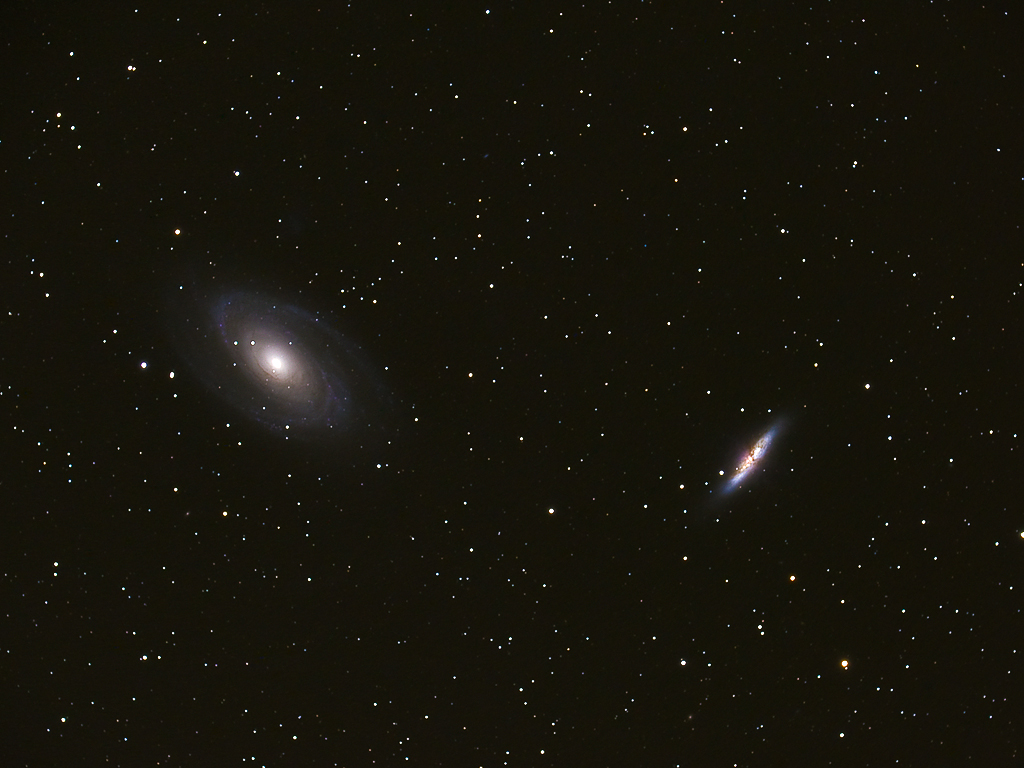
Photo: Kenneth Hess, 2009. Specs: Stack of 17 images, 85 minutes total exposure time on a Nikon D3. The telescope was an Astro-Physics 155mm f7 StarFire EDF Triplet Apochromatic Refractor. [View full-size image.]
I wrote earlier about my trek to the northeastern corner of California to attend the Golden State Star Party, as well as the process of taking deep-space images.
In this final installment in the Golden State Star Party series, I want to discuss the nature of the galaxies that I photographed.
One of the reasons that I like astronomy is that it continually stimulates me to contemplate the vast scale of the objects I observe. M81 is the dominant galaxy in a nearby group of galaxies, about 12 million light years from our own. (A light year is the distance that light travels in one year.) Knowing M81's distance and apparent size in the sky, we can readily calculate that it is about 90,000 light years in diameter.
This has the mind-bending consequence that not only did the photons of light illuminating my camera's image sensor leave M81 over 12 million years ago, but since the photons on the far side of M81 had a greater distance to travel, they had to start about 75,000 years before the photons from the near side. (M81 is tipped from our viewpoint. Otherwise they would have had to start a full 90,000 years earlier.) So, while we think of a picture as representing a moment in time, my picture of M81 is actually smeared out over 75,000 years!
M81 probably contains on the order of 100 billion stars revolving around the center in one of the most beautiful spirals of any galaxy we can see. With my telescope, they all blend together, and even the brightest star is far too small to see. However, a supernova would be visible, and indeed an amateur astronomer discovered one in M81 during 1993. The individual stars surrounding the galaxies in the photo are actually stars in our own galaxy, the Milky Way.
The other galaxy in my photo, M82, was once thought to be an irregular galaxy; however, modern astronomy has confirmed that M82 is also a spiral. Some tens of millions of years ago it had a close encounter with M81, and it was dramatically disrupted. The red at the center is from a giant cloud of dust that is undergoing a massive burst of new star formation.
Other nearby galaxies?
Look at these maps to see the location of other nearby galaxies:
Projects Ideas
The speed of light is one of the most important constants in physics and astronomy, and it took millennia for mankind to discover a means to measure it. Now you can measure the speed of light in your kitchen using either of these two Science Buddies Project Ideas:
- Using a Laser to Measure the Speed of Light in Jello (Science Buddies' Difficulty Level: 7-8)
- Measuring the Speed of 'Light' with a Microwave Oven (Science Buddies' Difficulty Level: 8)
Ken Hess is the Founder and President of Science Buddies.
Categories:
You Might Also Enjoy These Related Posts:
- Model and Track Virus Outbreaks - Student STEM
- Sun and Solar Science Projects - Solar Energy STEM
- 10 STEM Projects to Get Started Building Circuits on a Breadboard!
- Ocean Science Projects, Lessons, and Experiments
- Women in STEM! More than 60 Scientists and Engineers for Women's History Month
- Black History Month STEM - Learn More About These 40 Scientists for Black History Month!
- 10 Reasons to Do the Ball Run Engineering Challenge
- 40 New and Cutting-Edge Science and Engineering Projects in 2025




/-/https/img.youtube.com/vi/bMs5J4bJOD0/0.jpg)
/-/https/img.youtube.com/vi/iqtQ8Ikq-Ew/0.jpg)
/-/https/img.youtube.com/vi/PU-_mbX31oo/0.jpg)