/-/https/www.sciencebuddies.org/cdn/Files/21464/5/sb-logo.png)
/-/https/www.sciencebuddies.org/cdn/Files/21464/5/sb-logo.png)
How to Analyze a Physical Product
When you start to identify your design requirements, you already know what problem you are trying to solve. But what does "solving" your problem really mean? Your design requirements are the specific needs that must be met in order to call your design a solution.
For a physical product, your problem is likely making a task possible or easier for a user to complete. An
example is a pair of crutches. The problem statement is:
- From the problem statement, you can start asking the right questions to create a list of design requirements.
Pull the major need or needs of your solution from your problem statement.
Example: The major needs of a pair of crutches are that they help the user to:- Walk while using only one foot
- Get around and mobilize
- For each need, ask yourself: "What is absolutely essential to satisfy this need?" Right now, do not brainstorm.
Instead, figure out what MUST happen to meet the need in your future solution. Your answers to these questions are
your first design requirements. (Note: if you can remove your answer to the question and still meet the need, then your
answer is not a design requirement.) The "Needs" table illustrates how to find the first design requirements for the crutches example.
Swipe left to see moreMajor Needs from Step 1 What is Essential to Meet the Need
(Possible Design Requirements)Allow the user to walk while using only one foot - A way for the user to balance
Help the user to get around - Light enough to carry
- Small enough to transport
These answers are all design requirements, because they MUST be a part of your solution in order to meet the need. When you take away "a way for the user to balance," then it is impossible to meet the need for allowing the user to walk while using only one foot.
An answer to this same question that is NOT a design requirement is "a roller blade for the hurt foot or leg." Even though putting the injured foot or leg into a roller blade might allow the user to walk using only one foot, it is not absolutely essential to make the crutches work.
- What are the physical requirements/limits of the product you are designing? The answers to this question are
your next design requirements.
Example: What are the physical requirements/limits of a pair of crutches?- Less than 2 pounds
- Adjustable between 4 feet and 6 feet tall
- Able to hold up to 200 pounds of weight
- What are the conceptual requirements/limits of the product you are designing? These are requirements that are
not related to the physical nature of the product, but still must be met in order to make your solution successful.
Examples often include cost and the timeline of the project.
Example: What are the conceptual requirements/limits of a pair of crutches?- The crutches must cost less than $30.00.
- The new design must be available in the next six months.
- What other products exist that serve a similar function to solving your problem?
Example: Products similar to crutches:- Other crutches on the market
- Wheel chairs
- Leg braces
Examine these products. If possible, obtain the products themselves and take them apart. Otherwise, research everything you can about the products. Identify every individual piece of the product in addition to any features of the product. In your design notebook, draw a vertical line down the middle of the page. On the left, write down all of the component parts and features that you see. On the right, write down the purpose for each component or feature. Why is it present? See Figure 1 for an example related to crutches.
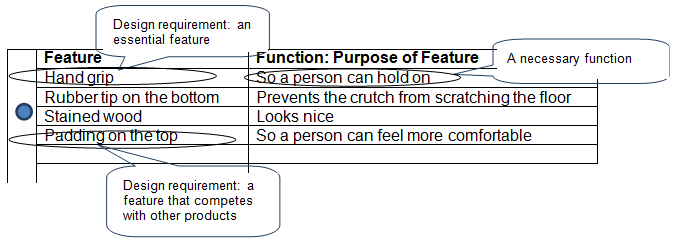
A pair of crutches are analyzed based on features and functions. Features for crutches include a hand grip (required), rubber tip, stained wood, and padding on the top (required). The respective functions of each feature are something to hold on to (required), prevents scratches on the floor, looks nice, and comfort.
Figure 1: This table shows an example of how to analyze a pair of crutches.
- Look at the right side of your table from Step 6. Which functions listed here will your product need to fulfill? Circle these functions, and look at the feature on the left for each. Is the feature absolutely essential in meeting the need on the right? If it is, then this is a design requirement, and you should circle it. If it is not, it is a possibility that could contribute to your design, but not a requirement.
- Is the product that you are designing going to have to compete with the other products you listed in Step 5? If the answer is "yes," look more closely at the features on the left side of your table. If you feel that your design needs to include the feature in order to keep up with current products, then that feature becomes another design requirement.
- Will you include any features that are not present in the competing product? What are they? If they are features that you consider to be "must haves" in order to make your design successful, then they can be considered your final, additional design requirements.
/-/https/www.sciencebuddies.org/cdn/Files/794/7/engineering_product_figure1.gif)
/-/https/img.youtube.com/vi/z9cDaV9edeo/0.jpg)
/-/https/img.youtube.com/vi/wG3OVpaHGkc/0.jpg)
/-/https/img.youtube.com/vi/RF-aET54CGk/0.jpg)