/-/https/www.sciencebuddies.org/cdn/Files/21464/5/sb-logo.png)
/-/https/www.sciencebuddies.org/cdn/Files/21464/5/sb-logo.png)
Abstract
All animals have a genome, but do they all have genome projects? Find out which animals are currently having their genomes sequenced and how much we know already. Whose genomes are already finished? Whose genomes are just getting started? Find out by doing some simple bioinformatics data digging!Summary
/-/https/www.sciencebuddies.org/cdn/Files/2971/5/Genom_img010.gif)
Objective
In this experiment you will use an online bioinformatics database to find out which animals currently have genome projects, which projects are complete, and which projects are still in progress.Introduction
All living things come with a set of instructions stored in their DNA, short for deoxyribonucleic acid. Whether you are a human, rat, tomato, or bacteria, each cell will have DNA inside of it. DNA is the blueprint for everything that happens inside the cell of an organism, and each cell has an entire copy of the same set of instructions. The entire set of instructions is called the genome and the information is stored in a code of nucleotides (A, T, C, and G) called bases. Here is an example of a DNA sequence that is 12 base pairs long:
/-/https/www.sciencebuddies.org/cdn/Files/2968/5/BioChem_img017.gif)
The information stored in the DNA is coded into sets of nucleotide sequences called genes. Each gene is a set of instructions for making a specific protein. The protein has a certain job to do, called a function. Since different cells in your body have different jobs to do, many of the genes will be turned on in some cells, but not others. For example, some genes code for proteins specific to your blood cells, like hemoglobin. Other genes code for proteins specific to your pancreas, like insulin. Even though different genes are turned on in different cells, your cells and organs all work together in a coordinated way so that your body can function properly.
Every individual has its own DNA code, but how can a code with only four letters be unique? It is hard to imagine how a code with so few parts can hold so much information. The key is that the longer the code is, the more unique sequences there can be. For example, the human genome is approximately 3 billion base pairs long and has approximately 20,000-25,000 genes!
Bigger genomes take more time to sequence and are more expensive, so scientists often choose organisms with smaller genomes to sequence. In this experiment you will access an online bioinformatics database to find out which animals currently have genome projects, which projects are complete, and which projects are still in progress. You will also be able to find out the scientific name and common name of different kinds of animals. Which animals are on the genome list? Will they be the animals that you expect?
Terms and Concepts
To do this type of experiment you should know what the following terms mean. Have an adult help you search the Internet, or take you to your local library to find out more!- Genome
- DNA sequence
- Bioinformatics
- Organism
- What kinds of animals have their genomes sequenced already?
- What kinds of animals are having their genomes sequenced right now?
- Are there some kinds of animals whose genomes are not being sequenced?
- Are there other organisms, like plants, fungi or bacteria whose genomes have been sequenced too?
Bibliography
- You will use this website at the National Center for Biotechnology Information (NCBI) to find out which genome projects are being worked on for which organisms:
NCBI, 2007. Entrez Genome Project, National Center for Biotechnology Information (NCBI), Washington, DC. Retrieved June 6, 2007. - Visit the Understanding Genetics: Human Health and the Genome online exhibit at the Tech Museum of Innovation to get an introduction to some model organisms who have had their genomes sequenced, and see how similar they are to humans:
The Tech, 2004. "Genes in Common," The Tech Museum of Innovation, San Jose, CA. Retrieved June 6, 2007. - How are genomes sequenced? Watch this flash tutorial from the NOVA Online series Cracking the Code of Life:
Groleau, Rick, 2001. Sequence For Yourself, NOVA Online. Retrieved June 6, 2007. - At the GEEE! in Genome site you can learn about what genomics means to you:
CMN, 2006. The GEEE! in Genomics, Canadian Museum of Nature. Retrieved June 6, 2007.
Materials and Equipment
- Computer with Internet connection
Experimental Procedure
/-/https/www.sciencebuddies.org/cdn/Files/20483/6/icon-flask.png)
- Go to the "NCBI Entrez Genome Project" home page at http://www.ncbi.nlm.nih.gov/sites/entrez?db=genomeprj to access the database.
- Choose an animal group from the list provided by clicking on the name of the group:
- Mammals
- Birds
- Fishes
- Insects
- Flatworms
- Roundworms
- Amphibians
- Reptiles
- Other
- When you click on the link to an animal group, you will be directed to a page containing an alphabetized list of genome projects. The list will be alphabetized according to the scientific name of the animal, which you will probably not recognize:
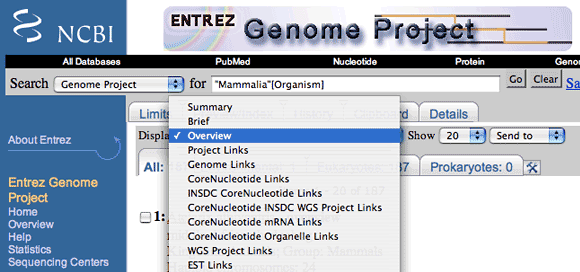
- To have the list look more familiar, click on the "Display" drop down menu at the top of the list and choose "Overview" from the menu:
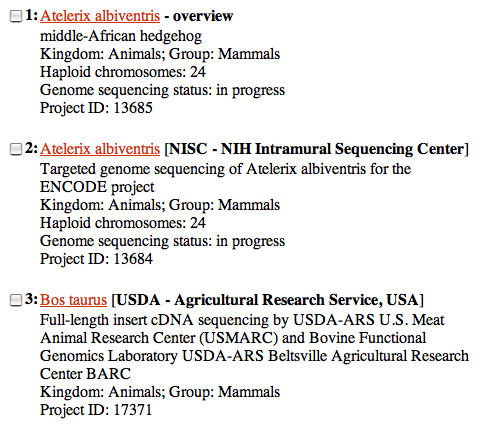
- After the page re-loads, it will have a new list with a picture of each animal and a short description of the project:
- Browse through the list, and write the animals and genome projects into your data table. Collect information such as: the common name of each animal, the scientific name of each animal, the status of the project, etc. Here is one example of a data table you could use to collect this information as you browse through the list:
Swipe left to see moreCommon Name Scientific Name Project Status Other Notes: Hedgehog Atelerix albiventris In Progress Cow Bos taurus Complete Marmoset Callithrix jacchus In Progress TOTAL NUMBER OF PROJECTS: - When you are finished, go back to the "NCBI Entrez Genome Project" home page at http://www.ncbi.nlm.nih.gov/sites/entrez?db=genomeprj and select another group of animals.
- Make a new data table for each group of animals and collect the data, following steps 1–6.
- Make a bar graph of the total number of genome projects for each group of animals. Which group is being studied the most? Which group needs more attention?
/-/https/www.sciencebuddies.org/cdn/Files/2969/3/Genom_img008.gif)
/-/https/www.sciencebuddies.org/cdn/Files/2970/3/Genom_img009.gif)
/-/https/www.sciencebuddies.org/cdn/Files/2971/5/Genom_img010.gif)

Ask an Expert
Variations
- In this experiment we focused on the genomes of different kinds of animals. Try expanding your project by focusing on another group of organisms, like:
- Plants (agricultural crops, trees, grasses)
- Fungi (mushrooms, yeasts, and molds)
- Germs (bacteria and viruses)
- There are many, many more!
- You may have noticed that different genome projects are hosted by different organizations, like the US Department of Agriculture (USDA), the Department of Energy (DOE), or maybe a private organization. Think about the purpose of each animal genome project. Are some groups more popular for different reasons? Think about how different industries affect the number of genome projects for certain types of animals. Some industries to think about are: scientific research, health and medicine, agriculture, ecology, and biodiversity. Do you see a correlation of the number of projects suited to these different industries?
- How big is a genome? Are different genomes different sizes? Try the Science Buddies experiment Who Has the Biggest Genome to find out.
Careers
If you like this project, you might enjoy exploring these related careers:
/-/https/careerdiscovery.sciencebuddies.org/cdn/Files/1900/17/iStock-1191167137.jpg)

/-/https/careerdiscovery.sciencebuddies.org/cdn/Files/967/17/unsplash-d4KQc-ZqBrc.jpg)
/-/https/careerdiscovery.sciencebuddies.org/cdn/Files/956/18/unsplash-mVV0s8ZvEm4.jpg)

/-/https/img.youtube.com/vi/TnHPLc87XiM/0.jpg)
/-/https/img.youtube.com/vi/rbhzoCb0xWM/0.jpg)
/-/https/img.youtube.com/vi/lYITnkFxa5A/0.jpg)