/-/https/www.sciencebuddies.org/Files/21464/5/sb-logo.png)
/-/https/www.sciencebuddies.org/Files/21464/5/sb-logo.png)
Abstract
Have you ever had to dig a hole in really hard soil? It is a lot of work! In this science project you can make an instrument to test the soil and find out how compacted it is, before you dig!Summary
Sara Agee, Ph.D., Science Buddies
Brynie, F.H., 2005. Parent's Crash Course: Elementary School Science Fair Projects, Hoboken, NJ: Wiley Publishing Inc. pp 165-168.
/-/https/www.sciencebuddies.org/Files/12122/4/soil-compaction-thumbnail.jpg)
Objective
Test the level of compaction of soil at different locations.
Introduction
/-/https/www.sciencebuddies.org/Files/12122/4/soil-compaction-thumbnail.jpg)
Have you ever wondered why it is so much work to dig a hole in really hard soil but it is much easier to dig a hole in soft, loose soil? Soil that is hard and dry is often compacted, which means that it has been packed down solid, making it denser and more difficult to penetrate.
Just as it is difficult for you to dig in compacted soil, it is also difficult for soil dwelling organisms, like bugs and worms, to tunnel in compacted soil. You will not usually find many organisms living in compacted soils because they cannot get the air, water, space, and nutrients that they need to survive. Also, compacted soil makes it difficult for plants with delicate root systems to thrive. Very compacted soil tends to support the growth of weeds, which have thick tap roots which penetrate deeply into compacted soil and out-compete other plants.
Which areas are most susceptible to soil compaction? In this geology science project you will make an instrument to test different areas to see where the soil is the most compacted. You should test places like gardens, walkways, turf, sunny areas, shady areas, and moist and dry areas. Where do you think the most compacted soil will be? Can you think of creative ways to avoid soil compaction in these areas?
Terms and Concepts
- Soil
- Compaction
- Density
- Soil dwelling organisms
- How does soil become compacted?
- How can soil compaction be measured?
- How does soil compaction affect the organisms that live in the soil?
Bibliography
- U.S. Geological Survey. (2004). Recovery and Vulnerability of Desert Ecosystems: Soil Compaction. Retrieved April 23, 2012.
- Whiting, D., Card, A., Wilson, C., and Reeder, J. (2011, December). Soil Compaction. Retrieved December 17, 2012.
- Brynie, F.H., 2005. Parent's Crash Course: Elementary School Science Fair Projects, Hoboken, NJ: Wiley Publishing Inc. pp 165-168.
Materials and Equipment
- Metal knitting needle; size 7 or small enough to fit inside the spool.
- Small spool of thread
- Permanent marker
- Rubber band
- Metric ruler or measuring tape
- Lab notebook
Experimental Procedure
/-/https/www.sciencebuddies.org/Files/20483/6/icon-flask.png)
- Place the needle into the spool to see that it fits.
- Place the apparatus, pointy side down, onto a table. Mark where the knitting needle sticks out of the top of the spool with your permanent marker, as shown in Figure 1 below. This line will be zero.
- Tightly wrap a rubber band around the knitting needle and push it towards the non-pointy, capped end of the needle. You will use this to mark the depth of your soil measurements.
/-/https/www.sciencebuddies.org/Files/2458/3/Geo_img004.gif)
Figure 1. Putting the knitting needle inside the spool, mark where the knitting needle sticks out of the top of the spool.
- Choose different locations to test the soil for compaction. Make a data table in your lab notebook, like Table 1 shown below, and describe each location in it. Where is each location? What type of soil is there? Is it wet or dry? Are there any plants?
| Location | Description | Measurement (cm) |
|---|---|---|
| 1 | ||
| 2 | ||
| 3 | ||
| 4 |
-
At each location place the spool on the ground pointy side down. Push down hard on the knitting needle until it stops moving into the ground, as shown in Figure 2 below. Slide the rubber band down against the top of the spool.
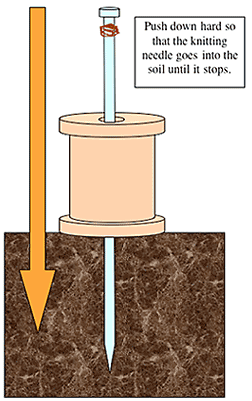
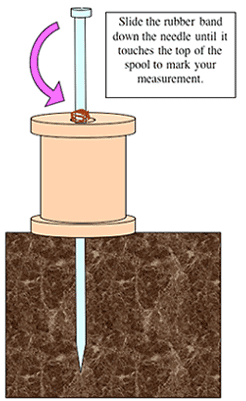
Figure 2. Placing the knitting needle and spool on the ground, push down on the needle until it stops moving. Slide the rubber band down until it touches the top of the spool.
- Carefully remove the knitting needle from the ground, making sure not to move the rubber band, and measure the distance between the line and the rubber band with your ruler or measuring tape, in centimeters (cm), as shown in Figure 3 below.
/-/https/www.sciencebuddies.org/Files/2459/3/Geo_img005.gif)
/-/https/www.sciencebuddies.org/Files/2460/3/Geo_img006.gif)
/-/https/www.sciencebuddies.org/Files/2461/3/Geo_img007.gif)
Figure 3. After removing the needle from the ground, measure the distance between the line on the needle and the rubber band.
- Record the measurement in the data table in your lab notebook.
- Where is the soil most compacted? The least compacted? What characteristics did you notice about the most compact soils? What characteristics did you notice about the least compact soils? Think about things like foot traffic, soil type, moisture, and plant covering. Why do you think it is important not to walk in an area where plants are trying to go, such as in a garden bed?
- Based on your results, what do you think could be done to reduce soil compaction?

Ask an Expert
Global Goals
The United Nations Sustainable Development Goals (UNSDGs) are a blueprint to achieve a better and more sustainable future for all.
/-/https/www.sciencebuddies.org/Files/19745/5/E-WEB-Goal-02.png)
/-/https/www.sciencebuddies.org/Files/19752/5/E-WEB-Goal-09.png)
Variations
- You could do a science project similar to this one to investigate the effect of walking on soil compaction. Dig up some soil so that it is loose. Measure the compaction of the soil with your spool. Now walk over the site and measure again. How did it change? Will it continue to change if you keep repeating the experiment, walking over the soil repeatedly?
- Do wet or dry soils become more compacted? Collect some dry soil samples and add different amounts of water to some of the dry soil samples (but leave some samples dry). Use a tamper or water roller to compact the soil in each sample. Measure each sample with your spool. Which soils are the most compacted? What happens if you let them dry out and measure them again afterwards?
Careers
If you like this project, you might enjoy exploring these related careers:
/-/https/careerdiscovery.sciencebuddies.org/Files/1783/17/nrcseprd423668.jpg)

/-/https/careerdiscovery.sciencebuddies.org/Files/1359/18/VNIIOarctic.jpg)
/-/https/careerdiscovery.sciencebuddies.org/Files/20196/5/Environ_KeyPhoto.jpg)

/-/https/img.youtube.com/vi/aJhYQsL0-kI/0.jpg)
/-/https/img.youtube.com/vi/SyQQt0jzLu4/0.jpg)
/-/https/img.youtube.com/vi/mn_-XdmyMuA/0.jpg)