/-/https/www.sciencebuddies.org/Files/21464/5/sb-logo.png)
/-/https/www.sciencebuddies.org/Files/21464/5/sb-logo.png)
Abstract
You have probably heard about left-brain and right-brain differences in people. The left brain is supposed to be better at language, and organizing sequential actions, the right brain is supposed to be better at visualizing orientations in space, making and listening to music, and deciphering the emotions of others. Is there evidence for left/right brain specialization in other animals? This project examines tail-wagging in dogs. Does tail-wagging show any evidence of left/right brain differences in man's best friend?Summary
Sources
This project is based on:- Quaranta, A., M. Siniscalchi, and G. Vallortigara, 2007. "Asymmetric Tail-Wagging Responses by Dogs to Different Emotive Stimuli," Current Biology, 17 (6): R199-201.
/-/https/www.sciencebuddies.org/cdn/Files/2965/5/MamBio_img029.jpg)
Objective
The goal of this project is to determine whether dogs' tail-wagging behavior shows left/right biases depending on the stimuli presented to the dog.Introduction
There is a large body of evidence indicating that, in most people, the two halves of the human brain are specialized for different functions. In other words, there is evidence for lateralization (sidedness) of brain function. The goal of this project is to look for evidence of lateralization in another animal, man's best friend. By studying the behavior of animals besides humans, we can hope to gain an understanding of when and how lateralization of brain function evolved. This broad approach is called comparative neuroscience, because comparisons are made between the brains and behavior of different species. The remainder of the Introduction is a brief synopsis of the evidence for brain lateralization in people, and a general description of the tail-wagging experiment for dogs.
The earliest evidence for lateralization of brain function in humans came from studies of people who had brain damage on one side of the brain due to injury or stroke. The most obvious finding was that each side of the brain controlled the opposite side of the body. Damage to the left side of the brain can cause loss of sensation, weakness, or paralysis in body parts on the right side of the body. Conversely, damage to the right side of the brain can cause loss of sensation, weakness, or paralysis in body parts on the left side of the body.
Another finding was that damage to the left hemisphere of the brain frequently caused the injured person to experience difficulty in producing or understanding language. Some patients might be able to understand language (as evidenced by their ability to act in response to a question or request), but be unable to give a spoken response. Other patients might be able to speak, but when they did, the grammar was so garbled that they could not be understood. Collectively, these different types of problems with language production, comprehension, or both are called aphasia. In the majority of people, the brain areas specialized for language are in the left side of the brain. Some people (anywhere from 5 to 40% of the population) have a right-hemisphere specialization for language, or both hemispheres involved in language production and comprehension (Chudler et al., date unknown, Brain Australia, 2003).
Damage to the right side of the brain tended to cause problems with spatial perception. For example, patients with damage to the right hemisphere might ignore sensory stimulation that occurred on their left side. When asked to draw a clock face, they might draw a complete circle, but then put all of the clock numbers on the right-hand half of the clock face. The symptoms could even extend to the patient's perception of their own body. For example, they might neglect to shave the left side of the face, or to dress the left side of the body. They might not even recognize the limbs on the left side of the body as their own. Patients with right hemisphere strokes may also lack awareness of or insight into their condition (Brain Australia, 2003).
The finding of brain lateralization in humans leads curious scientists to wonder how and why such specialization of the two brain hemispheres evolved. Comparative neuroscience can be used to try to answer these types of questions. One place to look is in other mammals, which are fairly closely related to humans. In this project you'll measure one behavior of dogs—tail-wagging— to see if there are left-right biases that might indicate some degree of brain lateralization in dogs.
If you've been a good observer of your pet dog, you've no doubt noticed that it behaves differently in different situations. For example, when you come in the door, your dog recognizes you and welcomes you. When a stranger rings the doorbell, on the other hand, the reaction may be quite different. Many dogs will bark warningly in this situation. Recently, researchers in Italy found that dogs wagged their tails further to the right when they could see their master, and less far when presented with a stranger. Do you think their findings are a fluke, or do you think it is possible to measure lateralization in tail-wagging behavior in different situations? You can try it for yourself and find out!
Terms and Concepts
To do this project, you should do research that enables you to understand the following terms and concepts:- Brain lateralization (i.e., left-brain, right-brain specialization)
- Comparative neuroscience
- Canine behavior
- Behavioral testing in dogs
Questions
- Which side of the brain controls the left side of a dog's body?
- Which side of the brain controls the right side of a dog's body?
Bibliography
- For news articles describing the original findings, see:
- Whitfield, J. (2007). 'Here boy' Makes Dogs Wag to the Right. [email protected], available at BioEd Online, Baylor College of Medicine .
- Blakeslee, S. (2007). "If You Want to Know if Spot Love You So, It's in His Tail," New York Times, April 24, 2007, p. D3.
- For information on brain lateralization in humans, see:
- Chudler, E., et al. (n.d.). 'Oh Say Can You Say:' The Brain and Language, Neuroscience for Kids, University of Washington, Seattle. Retrieved April 24, 2007.
- Brain Australia (2003). What Are the Effects of Stroke? The Brain Foundation, Australia. Retrieved April 24, 2007.
- For information on brain lateralization in animals, see:
Rogers, L.R. (n.d.). Survival with an Asymmetrical Brain, School of Biological Sciences, University of New England, New South Wales, Australia. Retrieved April 24, 2007. - This project is based on:
Quaranta, A., M. Siniscalchi, and G. Vallortigara. (2007). "Asymmetric Tail-Wagging Responses by Dogs to Different Emotive Stimuli," Current Biology, 17 (6): R199-201. - Here are some good books on dog behavior:
- Coren, S. (1995). The Intelligence of Dogs: A Guide to the Thoughts, Emotions, and Inner Lives of Our Canine Companions New York, NY: Bantam Books.
- Coren, S. (2000). How To Speak Dog: Mastering the Art of Dog-Human Communication New York, NY: Free Press.
- McConnell, P.B. (2002). The Other End of the Leash: Why We Do What We Do Around Dogs New York, NY: Ballantine Books.
Materials and Equipment
To do this experiment you will need the following materials and equipment:- At least 10 different dogs to test; possible sources:
- An obedience class which you are attending with your dog (with the prior consent of the class teacher)
- A local dog park
- Animals and humans to use as visual stimuli for testing dog's tail-wagging response, for example:
- The dog's owner
- A stranger (another human, not known to the dog)
- A dominant dog (get a dog trainer's assistance for identifying such a dog)
- A cat (with the consent of the owner; should be a cat that is familiar with dogs and not stressed by them)
- Two wire-frame dog crates
- One wire-frame cat crate
- Large piece(s) of dark cloth
- For covering sides of crate so the dog cannot see out
- Need a removable "window" in the cloth to expose the dog to visual stimuli
- A fairly large, quiet room for performing the tests, with a separate room or outdoor space nearby for keeping the people and animals used as visual stimuli
- Watch or timer
- Video camera
- Tripod
- Four different signs, one for each visual stimulus
- Monitor for video playback
- Plastic wrap
- Ruler
- Marker
- Protractor
Experimental Procedure
/-/https/www.sciencebuddies.org/Files/20483/6/icon-flask.png)
- Do your background research so that you are knowledgeable about the terms, concepts, and questions.
- Prepare the dog crate for testing by covering all of the sides with opaque cloth.
- The top should be left open, for air circulation and video recording.
- Make a removable "window" in the covering for the front side of the crate so that the dog can see out when the window is open.
- The test should be done indoors, in a fairly quiet space.
- You don't want a lot of audible distractions while the dog is in the test crate.
- All of the visual stimuli should be presented at the same distance away from the crate. A good distance would be somewhere in the range of 120-200 cm.
- The animals presented as visual stimuli (dominant dog and cat) should be in crates when shown to the dog being tested. Tip: since the dominant dog is likely to be large (and heavy), place its empty crate at the proper distance from the test crate, then have the dominant dog enter the crate.
- The background behind the visual stimuli should be uniform, with good contrast between background and stimulus.
- Use the same lighting for each test.
- Keep each test session short. The original study tested only two visual stimuli per session, so individual sessions were only about 5 minutes long.
- Set up the video camera on a tripod so that you can record the dog's tail-wagging behavior inside the crate.
- Place the dog to be tested in the test crate.
- Start the video recording.
- After 90 seconds, place one of the four visual stimuli at the proper distance from the crate and open the removable window.
- To identify the trial on the video recording, hold the sign identifying the visual stimulus that you are about to present in front of the camera for a second or two. (This way there is no audible signal to cue the dog being tested.)
- Allow the dog to view the stimulus for one minute.
- Close the removable window, and let the dog rest for 90 seconds.
- Repeat steps 5-9 with the second visual stimulus.
- Let the dog out of the crate to rest for at least twenty minutes.
- Ideally, each dog would be tested with multiple short test sessions, on multiple days. Here is how the original study was set up:
- The dogs were tested over 25 days, with 10 short sessions per day.
- Only two stimuli were tested per session.
- The dog saw the stimulus for one minute, then rested for 90 seconds (removable window closed) before seeing the second stimulus.
- You probably won't have time for this many test sessions, but see if you can manage at least ten trials per animal for each of the four visual stimuli. The more trials you have, the more reliable your results will be.
Analyzing Your Results
- Play back the video tape on a monitor to measure the tail-wagging angle for each of the five test conditions (four different visual stimuli, rest period with no stimulus).
- Cover the monitor with a sheet of plastic wrap.
- Mark the centerline of the dog's body with a marker and ruler (see Figure 1). This line should pass through the base of the dog's tail, and should be mid-way between the dog's back legs. It should pass along the length of the dog's body.
- Advance the tape frame by frame.
- For each tail wag, measure the angle of the tail's maximal excursion to each side. In other words, for each tail wag, find the frame where the tail reaches its maximum travel to the left, and the frame where the tail reaches its maximum travel to the right.
- Draw a line from the tip of the tail at its maximum side travel to the base of the tail (see Figure 1).
- Measure the angle between this line and the dog's centerline (see Figure 1).
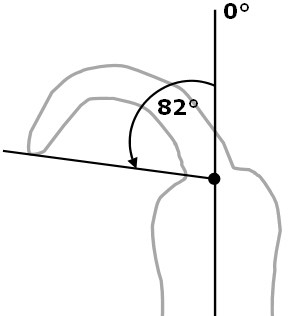
Figure 1. The line drawing illustrates how to measure the maximum tail-wagging angle to the dog's right side. This is a view from above the dog being tested, as would be recorded by the video camera above the test crate. The centerline (0°) passes through the base of the dog's tail, and is midway between the hind legs. Draw a second line from the tip of the dog's tail (at its maximum extent) to the base of the tail. Measure the angle between the centerline and the maximum tail-wagging line, as shown. For tail-wags to the left, the diagram would be a mirror image of this one.
- For each stimulus, calculate the average extent of tail-wagging to the left and to the right.
- Repeat the measurements for each trial.
- For each stimulus, calculate the average extent of tail-wagging to the left and to the right over all of the trials.
- Do you find a consistent asymmetry for any of the visual stimuli?
- Is it consistent across all of the individual dogs?
/-/https/www.sciencebuddies.org/Files/2965/5/MamBio_img029.jpg)

Ask an Expert
Variations
- For a more basic experiment in brain lateralization in pets, see the Science Buddies project, Paw Preference in Pets.
- For an experiment on brain lateralization in lizards, see the Science Buddies project Where Do Lizards Go for Lunch?
Careers
If you like this project, you might enjoy exploring these related careers:
/-/https/careerdiscovery.sciencebuddies.org/cdn/Files/1856/17/pexels-photo-5487067.jpg)

/-/https/careerdiscovery.sciencebuddies.org/cdn/Files/1864/17/pexels-photo-6234618.jpg)
/-/https/careerdiscovery.sciencebuddies.org/cdn/Files/872/17/iStock-883216142.jpg)

/-/https/img.youtube.com/vi/WsDQWPpTzZM/0.jpg)
/-/https/img.youtube.com/vi/YxOSHj_kVlA/0.jpg)
/-/https/img.youtube.com/vi/r0UDLuV6058/0.jpg)