/-/https/www.sciencebuddies.org/cdn/Files/21464/5/sb-logo.png)
/-/https/www.sciencebuddies.org/cdn/Files/21464/5/sb-logo.png)
Abstract
Does your hair go crazy when the weather turns damp? Did you know that strands of hair can relax and lengthen when the humidity increases and then contract again when the humidity decreases? In fact, hair strands can be used as the basis for a hygrometer, a device which measures the humidity level in the air. Can a human hair hygrometer also detect changes in hair structure caused by chemical lightening? This project shows you how to find out.Summary
Sources
- The information on how to build a hygrometer is from:
Franklin Institute, 1994–2006. Make Your Own Hygrometer, Franklin Institute. Retrieved January 23, 2007. - Thanks to Cecilia Cuba for the information on hair coloring.
/-/https/www.sciencebuddies.org/cdn/Files/2823/3/Chem_img018.gif)
Objective
The goal of this project is to determine whether chemical lightening treatments affect the natural elasticity of human hair.Introduction
In order to understand how the process of chemically lightening hair works, it is important to understand the structure of a shaft of human hair. Figure 1 (Tobin, 2006), illustrates the microscopic structure of a human hair. The left-hand panel of the illustration (Figure 1a), is a cartoon of a human hair shaft with a cut-away view to show the inner structure. Each strand of hair has an outer layer of flattened cuticle cells (Cu), which surround the fibrous cortical cells (Co). The medulla (Md) is a central core of cells in the hair shaft. Also shown is a microfibril (MF) within a cortical cell. The middle panel (Figure 1b), shows an actual hair shaft under the microscope. You can see how the flattened cuticle cells (Cu) have a scale-like appearance when magnified. The dark central medulla (Md) is also visible. The right-hand panel (Figure 1c), shows a cross-section of a fine human hair. Here you can see that the cuticle cells (Cu) are highly flattened, and wrap around the cortical cells (Co) in many layers. The cortical cells contain the dark pigment granules that give each hair strand its natural color./-/https/www.sciencebuddies.org/cdn/Files/2823/3/Chem_img018.gif)
Figure 1. Microscopic structure of a human hair shaft. Part (a) shows a cutaway cartoon of a single hair shaft. The labels show cuticle cells (Cu), cortical cells (Co), the medulla (Md), and a microfibril (MF) within a cortical cell. Part (b) shows a transmitted light micrograph of a single hair strand. The scale-like layer of cuticle cells (Cu) is clearly visible, as is the central medulla (Md). Part (c) shows a cross-section of a fine hair strand. The flattened cuticle cells (Cu) wrap tightly around the cortical cells (Co), which contain many dark pigment granules (Tobin, 2006).
The predominant proteins in hair are from the family of keratins, the same family of proteins that make your fingernails. Protein molecules are built from amino acids. In a hair strand, the keratin molecules contain a large number of a particular amino acid called cysteine. Each cysteine in the keratin molecule is a potential attachment point, where the keratin molecule can be tightly connected to another cysteine, forming a chemical bond called a cross-link. The keratins in hair have many such cross-links, making a hair strand strong and flexible. If you are interested in finding out about how hair grows, you should do research on hair follicles, the specialized structure in the skin that produces each individual hair strand.
The cuticle cells also have a coating of specialized molecules that repel water. These molecules are called lipids. By repelling water, the lipid molecules help to protect the hair strand. In order for bleaching chemicals to reach the pigment molecules in the cortical cells, the cuticle layer (including its protective lipid coating) must first be opened up. In chemical lightening solutions, this opening is accomplished by making the solution basic. You should do background research on the pH scale, to learn about basic, neutral, and acidic solutions. See the Bibliography for resources to get started.
The hair pigment goes through different stages of changing color as it lightens. The amount of change depends on how much pigment the hair has and the length of time the hair is exposed to the lightening chemicals. Lightening can be divided into roughly seven stages from the darkest to the lightest. A natural head of black hair will go from black to brown, to red, to red-gold, to gold, to yellow, and finally to pale yellow (almost white).
Hydrogen peroxide (H2O2) is an oxidizing chemical that bleaches the natural pigments in human hair. For hair treatment, the concentration of hydrogen peroxide is often expressed in volumes, referring to the total volume of oxygen (at standard temperature and pressure) that can be produced from the hydrogen peroxide. A "10 volume" solution is equivalent to 3% hydrogen peroxide in water (weight/volume, i.e., 3 grams of H2O2 plus enough water to make a total volume of 100 ml). A "20 volume" solution is equivalent to 6% hydrogen peroxide, etc. (Wikipedia contributors, 2006). The higher the concentration of peroxide used the greater the breakdown of melanin (tiny grains of pigment which create natural hair color) resulting in a lighter color.
Does the chemical process of hair lightening permanently alter the structure of the hair strands? One feature of the hair structure that you can readily investigate is how the hair strand changes with varying humidity. A strand of hair under slight, steady tension will change in length when the humidity changes. The hair will contract when the air is drier, and stretch out when the air is wetter.
"A single lock will stretch about two and a half percent as the humidity goes from 0 to 100 percent. While that's only a smidgen of length, the rate of this change is very dependable, so it's possible to obtain highly accurate humidity readings by measuring these tiny shifts. Hair hygrometers are best suited for keeping track of humidity in closed settings such as office buildings, where the variations are small and the goal is to keep humidity constant." (Weather Notebook, 2005)
In this project, you'll learn how to make a hair hygrometer to test the structure of both untreated and chemically lightened hair.
Terms and Concepts
To do this project, you should do research that enables you to understand the following terms and concepts:- Human hair strand, structure, composition, how it grows
- Cuticle
- Cortex
- Pigments: eumelanin, phaeomelanin
- Keratin
- Hair follicle
- Understanding the pH scale is helpful for this project
- Hydrogen peroxide (H2O2)
- Helative humidity
Questions
- How does the structure of the hair strand change as the relative humidity of the surrounding air varies?
- More advanced students should study how hydrogen bonds between keratin proteins involved in the expansion and contraction of hair as humidity changes.
Bibliography
- For information on the process of chemically lightening hair, try these references. Most libraries should have copies of these books. (Note that each has multiple editions with different publication dates; the particular edition is not critical.)
- Milady Publishing Company, 2000. Milady's Standard Textbook of Cosmetology Albany, NY: Milady Publishing Company, a division of Delmar Publishers, Inc.
- Heavilin, S., ed., 2002. Milady's Illustrated Cosmetology Dictionary Albany, NY: Milady/Thomson Learning.
- This site explains the pH scale:
- Science Buddies. (n.d.). Acids, Bases, & the pH Scale. Retrieved May 1, 2018.
- For a start on background information on hair lightening chemicals, try these references:
- Helmenstine, A.M., Ph.D., 2007. Hair Color Chemistry, About: Chemistry, About, Inc., a part of The New York Times Company. Retrieved on January 10, 2007.
- Wikipedia contributors, 2007. Peroxide, Wikipedia, The Free Encyclopedia. Retrieved on January 10, 2007.
- Field, Simon Quellen, 2003. Ingredients: What's in the Stuff We Buy Kinetic MicroScience Press. Retrieved on January 10, 2007.
- The figures in the Introduction on human hair structure are from this (advanced!) article, which contains excellent illustrations of hair follicles and hair shafts: Tobin, D.J., 2006. "Biochemistry of Human Skin—Our Brain on the Outside," Chem. Soc. Rev. 35: 52–67. Retrieved on January 10, 2007.
- For information on hygrometers and relative humidity, see these references:
- USA Today, 2007. Understanding Humidity, USA Today. Retrieved on January 23, 2007.
- Williams, J., 2005. Getting a Handle on Humidity, USAToday.com. Retrieved on January 23, 2007.
Materials and Equipment
For chemically lightening swatches of hair, you will need the following materials and equipment:- swatches of chemically untreated human hair:
- approximately 1.5 cm wide × 20 cm long;
- light brown or darker color;
- 'chemically untreated' means no permanent waves, no hair color (or even beat up from styling with blow dryers and curling irons);
- you should be able to obtain these from a beauty salon.
- at least 6 ounces hydrogen peroxide-based developer, in both "10 volume" (contains 3% hydrogen peroxide) and "20 volume" (contains 6% hydrogen peroxide) concentrations; notes:
- These are the most commonly available volumes at beauty supply stores open to the public.
- You will need a parent or guardian to purchase.
- You could also ask at a beauty salon if the salon would be willing to help you with obtaining some.
- If you can get "40 volume" developer (contains 12% hydrogen peroxide) this would expand the experiment.
- Most hydrogen peroxide in hair lightening kits sold at superstores or drug stores would be "20 volume."
- hair lightener, powder or cream type; notes:
- Available at beauty supply stores open to the public.
- You will need a parent or guardian to purchase.
- You could also purchase a hair lightener (highlighting) kit from a superstore or drugstore.
- You could also ask a beauty salon if they would help you in obtaining these.
- You will need at least enough for one application on a typical head (i.e., the amount from one kit).
- tint brush; notes:
- Available at a beauty supply store open to the public, or
- use a stiff brush approximately 4 cm wide.
- plastic or glass bowl (no metal),
- Protective, disposable gloves. Can be purchased at a local drug store or pharmacy, or through an online supplier like Carolina Biological Supply Company. If you are allergic to latex, use vinyl or polyethylene gloves.
- Protective eye wear (e.g., goggles); available from online suppliers such as Carolina Biological Supply Company
- aluminum foil.
- a scrap piece of wood or flat styrofoam (about 25 cm long and 10 cm wide),
- a flat piece of plastic (about 8 cm long and 8 cm wide) thin enough that you can cut,
- 2 small nails,
- 3 long strands of human hair (about 20 cm long),
- a dime,
- glue,
- tape,
- hammer,
- scissors (strong enough to cut plastic),
- rubbing alcohol,
- cotton swab.
Disclaimer: Science Buddies participates in affiliate programs with Home Science Tools®, Amazon.com, Carolina Biological, and Jameco Electronics. Proceeds from the affiliate programs help support Science Buddies, a 501(c)(3) public charity, and keep our resources free for everyone. Our top priority is student learning. If you have any comments (positive or negative) related to purchases you've made for science projects from recommendations on our site, please let us know. Write to us at [email protected].
Experimental Procedure
/-/https/www.sciencebuddies.org/cdn/Files/20483/6/icon-flask.png)
Safety Note: Use caution with the hydrogen peroxide solutions in this project.
- Wear protective gloves and eye wear.
- The solutions can bleach your clothing if they splatter, so it's a good idea to wear a lab coat or old clothes.
- Avoid contact with skin and eyes. If contact occurs, immediately flush with lukewarm water.
- Obtain medical assistance for eye contact.
Procedure for Chemical Lightening of Hair Swatches
- Do your background research so that you are knowledgeable about the terms, concepts and questions. It is especially important that you research and understand the terms and structure of the human hair strand.
- For chemically lightening a swatch of hair, use the following procedure:
- Secure one end of each hair swatch with an elastic band or sturdy tape.
- Wear protective gloves when mixing and using the hair lightener solution.
- Mix the hair lightener in a bowl.
- If you are using powder lightener, use approximately 2 tablespoons of powder. Add enough hydrogen peroxide to make a creamy paste about the consistency of honey.
- If you are using a cream lightener, mix enough hydrogen peroxide to make a honey consistency.
- For a fair comparison (for example, if you use different concentrations of hydrogen peroxide) use the same amount of hydrogen peroxide for each solution you make.
- Lay a hair swatch on a piece of aluminum foil.
- Apply the lightening mixture to the hair swatch with the stiff brush. Saturate the swatch with the mixture.
- Time how long you leave each swatch in the lightening solution. If you are varying the treatment time, try doubling it for each successive swatch (e.g., 10 minutes, 20 minutes, 40 minutes).
- Rinse the hair swatch with tap water.
- Dry the hair swatch.
- Remember to label each swatch and keep track of the treatment for each swatch (e.g., hydrogen peroxide concentration, lightener used, length of treatment time) in your lab notebook.
- Keep one hair swatch completely untreated for comparison.
- Tip: You will only use a few strands of each swatch for making hygrometers. Save the remainder of the swatch and use it on your display board to illustrate the condition of the hair used for each hygrometer.
Procedure for Making and Testing Hygrometers
- Make at least one hygrometer from each of the swatches. You should have a minimum of three hygrometers.
- For example, if you are investigating how treatment time affects hair structure, the minimum would be untreated hair, hair lightened 10 minutes, and hair lightened 20 minutes (additional time points would be even better).
- If you are investigating the effect of hydrogen peroxide concentration on hair structure, the minimum would be untreated hair, hair lightened with "10 volume" H2O2, and hair lightened with "20 volume" H2O2 (additional concentrations would be even better).
- For each hygrometer you will need three strands of hair.
- Wipe down the strands with alcohol.
- Make a solution of 20% rubbing alcohol (chemical name: isopropyl alcohol) and 80% water.
- Use a dab of this 20% alcohol on a cotton swab to wipe down the hair strands.
- This will remove any residual oils and allow water to permeate the hair strands more easily.
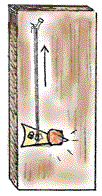
Figure 2. A simple hygrometer made with strands of human hair. The hair cells expand when the humidity is higher, and the weight of the dime moves the pointer lower. The hair cells contract when the humidity is lower, and the contracting hair pulls the pointer higher. (Image courtesy of The Franklin Institute Resources for Science Learning, www.fi.edu/learn).
- Figure 2 shows what the completed hygrometer looks like. Here's how to make it:
- Use the template to cut the piece of plastic into a triangular shape to make the pointer. Make sure each of your pointers is the exact same size.
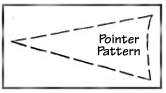
Template for making the pointer. (Image courtesy of The Franklin Institute Resources for Science Learning, www.fi.edu/learn).
- Tape a dime onto the pointer, as shown in the illustration. Again, make sure that you tape the dime in the exact same place on each pointer.
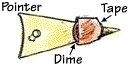
A close-up of the pointer, with dime attached. (Image courtesy of The Franklin Institute Resources for Science Learning, www.fi.edu/learn).
- Poke one of the nails through the plastic pointer, near the base of the triangle. Again, it is important to use the exact same position on each pointer. Wiggle the nail until the pointer moves freely and loosely around the nail.
- Glue the hair strands to the pointer, between the dime and the nail hole (refer to the illustrations). As usual, use the same position for each of the pointers.
- Position the pointer on the wood or styrofoam base about three quarters of the way down the side. Attach the nail to the base. The pointer must be able to turn easily around the nail. As usual, use the same position for each of the hygrometers.
- Attach the other nail to the base about one inch from the top of the base, in line with the pointer. As usual, use the same position for each of the hygrometers.
- Gently pull the hair strands taut, so that the pointer points parallel to the ground. That is, make sure the point of the pointer is perpendicular to the hair. The hair should hang perfectly vertical and the pointer should point perfectly horizontal.
- Glue the free ends of the hair strands to the top nail. If the hair is too long, trim the ends.
- Use the template to cut the piece of plastic into a triangular shape to make the pointer. Make sure each of your pointers is the exact same size.
- Test how the hygrometers made with the different hair strands respond to changes in humidity. For example, you set them side-by-side in the bathroom, close the door and turn on the shower for a minute or two.
- Do the hygrometers all have the same reading after 5 minutes (i.e., do their pointers all point in the same direction)?
- Do the hygrometers all change at the same rate, or do some of the hygrometers respond more quickly than others?
- Can you draw any conclusions about how the chemical lightening treatment affected the structure of the hair?
/-/https/www.sciencebuddies.org/cdn/Files/2824/3/MatlSci_img048.gif)
/-/https/www.sciencebuddies.org/cdn/Files/2826/3/MatlSci_img050.gif)
/-/https/www.sciencebuddies.org/cdn/Files/2825/3/MatlSci_img049.gif)

Ask an Expert
Variations
- Another idea for testing the hygrometers is to use them to monitor changes in humidity as a storm system moves through your area. Place the hygrometers together outdoors, but in a sheltered location where they are out of the rain. Compare their responses. Do all of the hygrometers change length at the same rate? Do they all reach the same reading? How do their readings compare to an electronic hygrometer (e.g., Radio Shack part #63-1032 or 63-1089).
- Does blow-drying hair affect its structure? Try blow-drying sample hair strands for varying periods of time. Use the same heat setting, and hold the dryer the same distance away. Label the hair strands with the amount of time they were exposed to heat. Make a hygrometer with each hair strand. Are there any differences? Do hairs exposed to heat for longer times expand more when exposed to higher humidity? You can also measure the strength of the hair strands (see below).
- Measure the strength of the hair strands before and after chemical lightening treatment. How much weight can a hair strand support before breaking? Hang a small cup from a single strand of hair and add pennies to the cup until the hair strand breaks. Count the number of pennies the hair strand could support before breaking. Test at least 10 separate untreated strands and at least 10 separate treated strands.
- [Advanced.] Hair strands can stretch a bit before breaking. The stretching is called elasticity, and is measured as the change in length divided by the initial length. Can you think of a way to measure elasticity of hair strands? Can you think of other ways to examine the structure of treated and untreated hair?
- For a related experiment on the chemistry of hair coloring, see the Science Buddies project The Chemistry of Hair Highlights.
Careers
If you like this project, you might enjoy exploring these related careers:
/-/https/careerdiscovery.sciencebuddies.org/cdn/Files/1429/17/unsplash-4pM4nhHyo9M.jpg)

/-/https/careerdiscovery.sciencebuddies.org/cdn/Files/1107/19/pexels-photo-3938023.jpg)
/-/https/careerdiscovery.sciencebuddies.org/cdn/Files/1100/18/unsplash-NP6JLl_2C-c.jpg)

/-/https/img.youtube.com/vi/dk4Bg0dV5-w/0.jpg)
/-/https/img.youtube.com/vi/NF_nanpcQ9c/0.jpg)
/-/https/img.youtube.com/vi/E2OZssB_W7M/0.jpg)