/-/https/www.sciencebuddies.org/cdn/Files/21464/5/sb-logo.png)
/-/https/www.sciencebuddies.org/cdn/Files/21464/5/sb-logo.png)
Abstract
Here is a project that is almost like a magic trick: with a strong magnet and a simple apparatus you can build yourself, you can make a coin "walk" up and down a wire coat hanger! This project is an interesting way to learn about the distance over which magnetic forces act on magnetic materials.Summary
Seagate Technology
- Maria Noer
- Elzbieta J Haftek
- Vivien W Talghader
- Katie L Staub
- LiJun Fu
Edited by Andrew Olson, Ph.D., Science Buddies
Sources
This experiment was initially popularized by Fred Jeffers, 1999–2000 IEEE Distinguished Lecturer and Neil Smith IEEE Member.
/-/https/www.sciencebuddies.org/cdn/Files/2457/3/Phys_img027.jpg)
Objective
This project has two goals:
- to classify coins by their magnetic properties, and
- to measure the magnetic interaction between magnetic and ferromagnetic materials.
Introduction
Every country has some form of coin currency. Money may appear silver, gold, or copper but the bulk of the coin is usually made of multiple materials (alloys). Materials may be differentiated by their response to externally applied magnetic fields as diamagnetic, paramagnetic, or ferromagnetic. These magnetic responses differ significantly in strength. Ferromagnetic effects are very large, producing magnetizations sometimes orders of magnitude greater than the applied field. One way to show if coin material is ferromagnetic is experimenting with magnets.
Ferromagnetic materials have microscopic regions that each act as small magnets. These are called domains. Magnetic domains exist because atoms behave like tiny compass needles. Within each magnetic domain, forces in a ferromagnetic material align the atoms ("compass needles") in one direction. In the absence of an external magnetic field, the magnetic moments of each separate domain are pointing in random directions, and therefore the material does not show net magnetization. When an external magnetic field is applied, the magnetic moments of each microscopic domain align themselves with the applied field. Now the material shows a net magnetization. As an analogy, think of students in a classroom during a break. The students are all turned in various directions. Then the teacher walks into the classroom, and they all get back into their seats and face forward. The students are like the microscopic domains, and the teacher is like the external magnetic field.
In this project, you will investigate the magnetic properties of various coins from different countries. Which coins are ferromagnetic and which are not? Can you use a magnetic field to make a coin "walk" along a coat hanger wire? How close does the magnet need to be in order to make this work? How strong does the magnet need to be? This project shows you how you can build a simple experimental apparatus and find out for yourself.
Terms and Concepts
To do this project, you should do research that enables you to understand the following terms and concepts:
- ferromagnetism,
- ferromagnetic material,
- metals that can be magnetized,
- alloys.
More advanced students would want to study:
- the concept of magnetic fields and magnetic flux lines,
- magnetic forces,
- electromagnetism,
- atoms.
Bibliography
Here are some resources to get you started:
- Wikipedia contributors, 2006. Group 11 Elements, Wikipedia, The Free Encyclopedia. Retrieved April 19, 2006.
- Wikipedia contributors, 2006. Euro Coins, Wikipedia, The Free Encyclopedia. Retrieved April 19, 2006.
- Berger, D., 2000. Why Are Coins Made of Metal? MadSci Network: Chemistry. Retrieved April 19, 2006.
- TJNAF-OSE, date unknown. Magnets and Electromagnets, Thomas Jefferson National Accelerator Facility - Office of Science Education. Retrieved April 19, 2006.
- K&J Magnetics, 2006. Neodymium Magnet Safety,. Retrieved April 19, 2006.
Materials and Equipment
To do this experiment you will need the following materials and equipment:
- safety glasses,
- ordinary metal wire coat hanger,
- a variety of coins from various countries (if you don't have some already, you can ask friends, neighbors, or relatives, or you can get some from a bank),
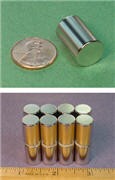
- a strong magnet, e.g., a neodymium cylinder magnet, 1/2 in diameter, 3/4 in tall, 17.5 pounds pulling force (available from K&J Magnetics, http://www.kjmagnetics.com/proddetail.asp?prod=D8C, see photos),
- materials for experimental apparatus (see photos in Experimental Procedure section, below):
- piece of wood (or other sturdy material) to make the base (minimum size: 8 in × 12 in),
- piece of Plexiglass, wood, aluminum, or other thin (3/8 or 1/4 in), stiff, non-magnetic material for wall, (approximate size: 8 in × 10 in),
- small wood blocks to secure 'wall' and hanger,
- fastening hardware,
- drill and bits,
- saw,
- screwdriver and/or wrench for fastening hardware,
- sandpaper,
- thin metric ruler, or you can use tape or paper with a metric scale marked on it.
/-/https/www.sciencebuddies.org/cdn/Files/2456/3/Phys_img026.jpg)
Experimental Procedure
/-/https/www.sciencebuddies.org/cdn/Files/20483/6/icon-flask.png)
Safety Notes on Neodymium Magnets. (K&J Magnetics, 2006)
"The neodymium magnets [used in this project] are extremely strong, and must be handled with care to avoid personal injury and damage to the magnets. Fingers and other body parts can get severely pinched between two attracting magnets. Neodymium magnets are brittle, and can peel, crack or shatter if allowed to slam together. Eye protection should be worn when handling these magnets, because shattering magnets can launch pieces at great speeds.
"The strong magnetic fields of neodymium magnets can also damage magnetic media such as floppy disks, credit cards, magnetic I.D. cards, cassette tapes, video tapes or other such devices. They can also damage televisions, VCRs, computer monitors and other CRT displays. Never place neodymium magnets near electronic appliances.
"Children should not be allowed to handle neodymium magnets as they can be dangerous. Small magnets pose a choking hazard and should never be swallowed or inserted into any part of the body.
"Never allow neodymium magnets near a person with a pacemaker or similar medical aid. The strong magnetic fields of the magnet can affect the operation of such devices.
"Neodymium magnets are brittle and prone to chipping and cracking. They do not take kindly to machining.
"Neodymium magnets will lose their magnetic properties if heated above 175℃ F (80℃ C).
"Neodymium magnets should never be burned, as burning them will create toxic fumes.
"Like any tool or toy, neodymium magnets can be fun and useful, but must always be treated with care."
Determining Magnetic Properties of Coins
- Mix all the coins together in a bowl or in a pile on a table.
- Pass your strong magnet over the top of the coins.
- Record which coins are attracted to the magnet and which ones are not.
- Did it matter what color the coin was or which country the coin was from?
Building the Walking Coin Apparatus
An example of the walking coin apparatus is shown in Figure 1, below. Construction tips follow. As noted in the materials section, you can build the apparatus with wood, which is much easier to work with (the illustrations show metal and plastic construction).
/-/https/www.sciencebuddies.org/cdn/Files/2457/3/Phys_img027.jpg)
- Create a base fixture out of wood or other material (steel is shown in Figure 1).
- Use two small pieces of material to secure the hanger in a vertical position. Attach the first piece to the base, and clamp the hanger to it with the second piece (see Figure 1, bottom picture).
- Use a small piece of material to secure the vertical 'wall.' Cut a slot in the piece to hold the wall vertically (see Figure 1, top left). The wall needs to be able to slide back and forth so that different-sized coins can fit between the wall and the hanger (see Figure 1, top right).
- Clamp the hanger in a vertical position. The hanger should be held tightly in place, without movement.
- Attach the 'wall' to the sliding block. Make sure that it stays securely held when the block is moved back and forth.
- Attach the metric ruler. Make sure that the 'wall' can be slid over it without obstruction. For your own convenience when measuring, place the ruler so zero (0) is aligned with the edge of the hanger closest to the wall. (This was not done in the example above.)
Experimenting with the Walking Coin Apparatus
- How does the diameter of a coin affect its ability to "walk" up the wire? How far can the "wall" be moved from the coin without it falling down? Formulate a hypothesis regarding each of these questions.
- To test your hypotheses, move the "wall" to the position closest to the wire hanger.
- Take one of the ferromagnetic coins and place in the center of the wire hanger as shown below. Hold the coin with one hand and take your other hand and place the magnet against the opposite site of the wall adjacent to the coin.
-
Remove your hand from the coin. Does the coin stay up? If so:
- Record the distance the wall is from the hanger.
- Record the diameter of the coin.
- Calculate (or measure) the width of the gap between the wall and the coin.
- Slowly move the magnet up and down the wall causing the coin to 'walk.'
- Try moving the wall 1–mm further from the hanger and repeat steps 3 and 4. Continue to increase the gap distance in 1 mm steps until the coin will no longer stay on the hanger.
- Repeat steps (3–5) of the experiment with other ferromagnetic coins with different diameters and record the data.
Suggestions for Demonstration at Science Fair
- Pass a magnet over a bowl of coins to show which ones adhere.
- Before you start the experiment, show the penny does not adhere to the hanger (without the magnet). Explain how the hanger is a conductor and needs to be magnetized before the coin will adhere to it.
- You can place a cover in front of the wall to make it look like the coin is 'floating' — like a magic trick.

Ask an Expert
Variations
- Use metal washers of varying size in place of the coin. The washers should not be more than 1/2 inch (about 13 mm) in diameter. Since washers are available in regular size increments, this will allow you to determine how size affects the distance over which the object can be magnetized.
- Try using other magnets to 'walk' the coins. Think of an independent method for measuring the strength of the magnets. How strong does a magnet need to be in order to 'walk' coins?
- Can you find a magnet strong enough to 'walk' two coins (one on either side of the hanger)? Re-read the safety note above, and be extra-cautious with a magnet this strong!
- With a coin in place on the coat hanger, move the wall so that it is closer to the hanger than the diameter of the coin. What happens and why?
- What happens if you use a ferromagnetic material for the 'wall' on the experimental apparatus? Why?
Careers
If you like this project, you might enjoy exploring these related careers:
/-/https/careerdiscovery.sciencebuddies.org/cdn/Files/1450/21/iStock-1227179796.jpg)

/-/https/careerdiscovery.sciencebuddies.org/cdn/Files/1429/17/unsplash-4pM4nhHyo9M.jpg)
/-/https/careerdiscovery.sciencebuddies.org/cdn/Files/1457/17/pexels-photo-3861938.jpg)

/-/https/img.youtube.com/vi/M8e6T-Hc9wE/0.jpg)
/-/https/img.youtube.com/vi/jrWPagS6I68/0.jpg)
/-/https/img.youtube.com/vi/T8tmVMyzu18/0.jpg)