/-/https/www.sciencebuddies.org/cdn/Files/21464/5/sb-logo.png)
/-/https/www.sciencebuddies.org/cdn/Files/21464/5/sb-logo.png)
Abstract
This is a really fun project even if you don't like going on roller coasters yourself. You'll build a roller coaster track for marbles using foam pipe insulation and masking tape, and see how much of an initial drop is required to get the marble to "loop the loop." It's a great way to learn about how stored energy (potential energy) is converted into the energy of motion (kinetic energy).
Summary
None
Readily available
Adult supervision recommended when using utility knife
Andrew Olson, Ph.D., Science Buddies
/-/https/i.ytimg.com/vi/ugv0iWn4G2U/maxresdefault.jpg)
Objective
The goal of this project is to build a roller coaster for marbles using foam pipe insulation and to investigate how much height is needed in order for the marble to run through a loop of fixed size.
Introduction
/-/https/www.sciencebuddies.org/cdn/Files/14030/7/marble-roller-coaster-loop-thumbnail.jpg)
Slow and clanking, the string of cars is pulled up to the crest of the tallest point on the roller coaster. One by one, the cars start downhill on the other side, until gravity takes over and the full weight of the train is careening down into curves, twists, and turns. The roller coaster is a great example of conversions between potential energy (stored energy) and kinetic energy (the energy of motion). As the cars are being pulled up to the top of the first hill, they are acquiring potential energy. The chain that pulls them up the hill works against the force of gravity. At the top of the hill, the cars' potential energy is at it's maximum. When the cars start down the other side, this potential energy is converted to kinetic energy. The cars pick up speed as they go downhill. As the cars go through the next uphill section, they slow down. Some of the kinetic energy is now being converted to potential energy, which will be be released when the cars go down the other side.
You've probably noticed that the first hill on the roller coaster is always the highest (unless the coaster is given another "boost" of energy along the way). This is because not all of the potential energy is converted to kinetic energy. Some of the potential energy is "lost" in other energy conversion processes. For example, the friction of the wheels and other moving parts converts some of the energy to heat. The cars also make noise as they move on the tracks, so some of the energy is dissipated as sound. The cars also cause the supporting structure to flex, bend, and vibrate. This is motion, so it is kinetic energy, but of the track, not the cars. Because some of the potential energy is dissipated to friction, sound, and vibration of the track, the cars cannot possibly have enough kinetic energy to climb back up a hill that is equal in height to the first one. The way that physicists describe this situation is to say that energy is conserved in a closed system like a roller coaster. That is, energy is neither created nor destroyed; there is a balance between energy inputs to the system (raising the train to the top of the initial hill) and energy outputs from the system (the motion of the train, its sound, frictional heating of moving parts, flexing and bending of the track structure, and so on).
You can investigate the conversion of potential energy to kinetic energy with this project. You'll use foam pipe insulation (available at your local hardware store) to make a roller coaster track. For the roller coaster itself, you'll use marbles. There are as many possible variations to this project as there are twists and turns on a great roller coaster ride, but a good place to start is to see how much initial height you need in order to have your marble successfully navigate a loop in the track.
You'll use the same size loop for each of your tests, but you'll add (or subtract) track before the loop so that you can change the initial height where the marble starts. For each track configuration, you should try at least 10 separate tests with the marble to see whether it can loop the loop or not. You should also measure the slope of each track configuration. An easy way to think about the slope is the expression rise/run (see the illustration below). The rise is the height of the starting point, and the run is the horizontal distance from the starting point to the beginning of the loop.
/-/https/www.sciencebuddies.org/cdn/Files/2988/8/Phys_img061.jpg)
Figure 1. The illustration above shows how to measure "rise" and "run" in order to calculate the average slope of the track leading in to the loop.
How much height (rise) will be required to successfully navigate a given loop size? A foam roller coaster for marbles is easy to build, so try it for yourself and find out!
Terms and Concepts
To do this project, you should do research that enables you to understand the following terms and concepts:
- Potential energy (stored energy)
- Kinetic energy (energy of motion)
- Conservation of energy (basic law of physics)
- Gravity
- Velocity
- Friction
- Slope (rise/run)
Questions
- How high do you have to make the starting point of your roller coaster in order for the marble to "loop-the-loop"?
Bibliography
- This short animation explains kinetic energy and potential energy:
Brain POP. (n.d.). Kinetic Energy. Brain POP Animated Educational Site for Kids. Retrieved August 23, 2007. - Here is a good reference for more advanced students:
Henderson, T. (2004). Work, Energy, and Power. The Physics Classroom and Mathsoft Engineering & Education, Inc. Retrieved August 23, 2007.
Materials and Equipment
To do this experiment you will need the following materials and equipment:
- At least two 6 foot (183 cm) sections of 1-1/2 in (about 4 cm) diameter foam pipe insulation
- Glass marbles
- Utility knife
- Masking tape
- Tape measure
- Bookshelf, table, or other support for roller coaster starting point
Experimental Procedure
/-/https/www.sciencebuddies.org/cdn/Files/20483/6/icon-flask.png)
Note: Use the utility knife with care. A fresh, sharp blade will make cutting the insulation easier.
- Do your background research so that you are knowledgeable about the terms, concepts, and questions, above.
- Cut the foam pipe insulation in half (the long way) to make two U-shaped channels.
- The illustration below shows the foam pipe insulation, end-on.
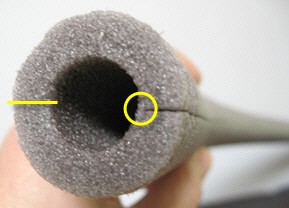
Figure 2. The illustration above shows the cross-section at one end of the foam pipe insulation. - The insulation comes with one partial cut along the entire length. Complete this cut with the utility knife (yellow circle in the illustration above).
- Make a second cut on the other side of the tube (yellow line in the illustration above), along the entire length of the tube.
- You will end up with two separate U-channel foam pieces. You can use masking tape to attach pieces end-to-end to make the roller coaster track as long as you want.
- The illustration below shows the foam pipe insulation, end-on.
- Pick a diameter for the loop. Something in the range of 30–50 cm (12–20 in) should work well.
- Tape two lengths of the foam U-channel together, end-to-end. The joint between the two pieces should be as smooth as possible.
- Curl the track into a loop of the desired diameter. Tape the loop together where the two tracks meet at the bottom (see illustration below). Don't tape the loop to the floor just yet.
- Raise the other end of the track up to make a ramp coming down into the loop (see illustration below).
- Tape the top of the ramp in place on a bookshelf or other piece of furniture.
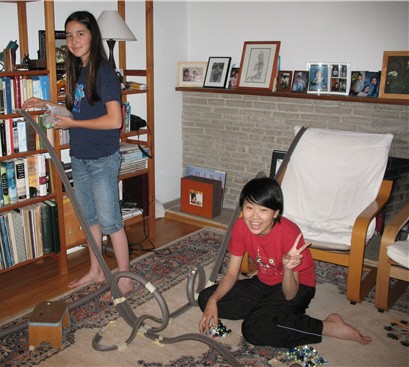
Figure 3. The illustration above shows two different roller coaster tracks for marbles. How much height is needed at the starting point in order for the marble to loop the loop? - Now you can tape the loop down to the floor.
- Measure the diameter of the loop.
- Measure the height of the starting point for the track (rise).
- Measure the horizontal distance from the track starting point to the beginning of the loop (run).
- Run a single marble down the track 10 separate times. How many times does it successfully go through the loop?
- Change the height and repeat the previous step. If the marble makes it through the loop most of the time, lower the height. If the marble fails to make it through the loop most of the time, raise the height.
- What starting height was needed for the marble to make it through the loop most of the time?
/-/https/www.sciencebuddies.org/cdn/Files/2989/8/Phys_img059.jpg)
/-/https/www.sciencebuddies.org/cdn/Files/2990/8/Phys_img060.jpg)

Ask an Expert
Global Goals
The United Nations Sustainable Development Goals (UNSDGs) are a blueprint to achieve a better and more sustainable future for all.
/-/https/www.sciencebuddies.org/cdn/Files/19752/5/E-WEB-Goal-09.png)
Variations
Here are just a few of many possible variations on this project. Perhaps these will stimulate your thoughts about other experiments you could try:
- You probably have marbles of different diameters in your collection. What happens if you test marbles of different diameter on your roller coaster? Can they all loop the loop? If some marbles can't make it, can you figure out why?
- You can expand the experiment by building a set of roller coaster tracks with various loop sizes. How does the height requirement change when the loop diameter increases? How does the height requirement change when the loop diameter decreases?
- Maybe you noticed that your loop wobbles a bit as your marble passes through it. The energy to move the track comes from the marble. The energy that the marble loses to make the track move means less energy is available to make the marble itself move. Can you think of a way to stabilize the loop so that it doesn't wobble? With a stabilized loop, can the marble start at a lower height and still make it through the loop? Design an experiment to find out!
- Try using different lengths of roller coaster track so that you can adjust the slope of the track leading to the loop. Keep the starting height the same, but change the slope by adding additional track length. (Remember, slope is rise/run, so you'll be holding the "rise" constant, and gradually increasing the "run.") Do you think that the marbles will continue to "loop the loop" as the slope is decreased? Tip: start with a track height and loop diameter such that the marbles just make it around the loop.
- For a more advanced version of this experiment, see the Science Buddies project Marble Roller Coaster: Converting Potential Energy to Kinetic Energy.
- Can you use software to make a physics simulation of your ball launcher? Check out the project The Physics of Simulation vs Reality.
Careers
If you like this project, you might enjoy exploring these related careers:
/-/https/careerdiscovery.sciencebuddies.org/cdn/Files/1450/21/iStock-1227179796.jpg)

/-/https/careerdiscovery.sciencebuddies.org/cdn/Files/1457/17/pexels-photo-3861938.jpg)
/-/https/careerdiscovery.sciencebuddies.org/cdn/Files/1640/26/Fyysikot_tyossaan.jpg)

/-/https/img.youtube.com/vi/r7oWtcE6QQc/0.jpg)
/-/https/img.youtube.com/vi/YFReFIetr14/0.jpg)
/-/https/img.youtube.com/vi/_Ofev8WsEkM/0.jpg)