/-/https/www.sciencebuddies.org/cdn/Files/21464/5/sb-logo.png)
/-/https/www.sciencebuddies.org/cdn/Files/21464/5/sb-logo.png)
Crossed Up: Does Crossed Hand/Eye Dominance Affect Basketball Shooting Percentage?
Abstract
Everyone's used to the idea that people are either right-handed or left-handed for particular tasks. That is, one hand is preferred (or dominant) over the other for a particular task. Did you know that people also have a dominant eye? This project is designed to look for consequences of having the dominant hand and eye on the same side of the body (uncrossed) vs. having the dominant hand and eye on opposite sides of the body (crossed).Summary
Working with Human Test Subjects
There are special considerations when designing an experiment involving human subjects. Fairs affiliated with Regeneron International Science and Engineering Fair (ISEF) often require an Informed Consent Form (permission sheet) for every participant who is questioned. Consult the rules and regulations of the science fair that you are entering, prior to performing experiments or surveys. Please refer to the Science Buddies documents Projects Involving Human Subjects and Scientific Review Committee for additional important requirements. If you are working with minors, you must get advance permission from the children's parents or guardians (and teachers if you are performing the test while they are in school) to make sure that it is all right for the children to participate in the science fair project. Here are suggested guidelines for obtaining permission for working with minors:
- Write a clear description of your science fair project, what you are studying, and what you hope to learn. Include how the child will be tested. Include a paragraph where you get a parent's or guardian's and/or teacher's signature.
- Print out as many copies as you need for each child you will be surveying.
- Pass out the permission sheet to the children or to the teachers of the children to give to the parents. You must have permission for all the children in order to be able to use them as test subjects.
Andrew Olson, Ph.D., Science Buddies
Sources
This project is based on an entry to the 2007 California State Science Fair:
- Hines, K.K. and R.S. Thurman, 2007. Ballin': The Effect of Hand and Eye Dominance on a Subject's Free Throw Percentage, California State Science Fair Abstract. Retrieved June 7, 2007.
/-/https/www.sciencebuddies.org/cdn/Files/3028/5/Sports_img059.gif)
Objective
The goal of this project is to determine whether crossed hand/eye dominance helps or hurts when shooting basketball free throws.
Introduction
The idea of having a dominant hand (being left-handed or right-handed) is familiar to everyone. What may not be so familiar is the concept of a dominant eye. Most people are accustomed to using both eyes together, and don't think much about situations where it might matter if one eye is dominant over the other.
This project is based on an entry to the 2007 California State Science Fair by Keith Hines and Robert Thurman, both winners of the Science Buddies Clever Scientist Award for their work. When Keith learned about eye dominance, he wondered if there might be consequences for athletes. For example, if the dominant eye and the dominant hand were on opposite sides of the body (crossed hand-eye dominance), might that be an advantage in certain situations in sports. He first thought about hitting in baseball. In the case of crossed dominance, the dominant eye would be closer to the pitcher when the batter was standing in the box. Would that be an advantage? Keith decided that there were too many variables involved in an investigation of hitting, but with his friend Robert, he decided that freethrow shooting in basketball offered a better situation for study.
When shooting free throws in basketball, players often hold the ball up at face-level when preparing for the shot. In this position, the ball can easily block (at least partially) the eye on the same side of the body as the shooting hand. For shooters with uncrossed hand and eye dominances, this would mean that the dominant eye was partially blocked. For shooters with crossed hand and eye dominances, this would mean that the non-dominant eye was partially blocked.
On the basis of the description above, you might hypothesize— as Keith and Robert did— that players with crossed hand and eye dominances would have an advantage for free throw shooting over players with uncrossed hand and eye dominances (Hines and Thurman, 2007). Here's an experiment that you can try to find out.
Terms and Concepts
- Hand dominance
- Eye dominance
- Crossed hand and eye dominances
Questions
- Will crossed hand/eye dominance have a negative effect, a positive effect, or no effect on free-throw shooters?
Bibliography
- This webpage has an explanation of eye dominance:
McWilliams, K., 1998. What Is 'Eye Dominance'? MadSci Network: Neuroscience. Retrieved June 7, 2007. - These webpages have information on how the brain is involved in hand and eye dominance:
- Chudler, E.H., et al., 2006a. Hemispheres, Neuroscience for Kids. Retrieved June 7, 2007.
- Chudler, E.H., et al., 2006b. Sidedness, Neuroscience for Kids. Retrieved June 7, 2007.
- This project is based on an entry to the 2007 California State Science Fair:
- Hines, K.K. and R.S. Thurman, 2007. Ballin': The Effect of Hand and Eye Dominance on a Subject's Free Throw Percentage, California State Science Fair Abstract. Retrieved June 7, 2007.
- This website has descriptions and calculators for several statistical tests, including the Student's t-test that you can use in this project: Kirkman, T., date unknown. Student's t-Tests, Department of Physics, College of St. Benedict & St. John's University. Retrieved June 7, 2007.
Materials and Equipment
To do this experiment you will need the following materials and equipment:
- 50-100 volunteers to take hand and eye dominance tests and then shoot free throws; notes:
- The more subjects you can test, the more reliable your results will be
- For more information, see the Science Buddies resource, How Many Participants Do I Need?
- Basketball
- Basketball court
- Hand dominance surveys
- Lab notebook
Experimental Procedure
/-/https/www.sciencebuddies.org/cdn/Files/20483/6/icon-flask.png)
- Do your background research so that you are knowledgeable about the terms, concepts, and questions, above.
- You'll need to recruit 50-100 volunteers for this project. Ideally all of your volunteers will be approximately the same age, and will have roughly the same amount of experience shooting free throws.
-
The simplest way to collect the data for this experiment is to use a separate data sheet for each participant. On each data sheet you will need to collect the following information:
- Name
- Age
- Gender
- Hand dominance
- Eye dominance
- Number of years playing basketball
- Free throw percentage
-
To determine hand dominance, ask or observe:
- Which hand does your subject use for writing? (Just ask your subject to write his or her name.)
- Which hand does your subject use to throw a ball. Give a ball to your subject and ask him or her to throw it to you.
- Which hand does your subject use to shoot baskets? (Generally when shooting, one hand cradles the ball, and the other hand launches the ball toward the basket. The hand providing the driving force to the ball is the shooting hand.)
- You could also simply ask each subject if they are right-handed, left-handed or mixed (ask for examples of what they do with each hand). You may want to analyze the data from subjects with mixed hand dominance separately (but you may need a large group of test subjects to get significant results).
-
To determine eye dominance, have the subject do the following:
-
Extend both hands to arm's length in front of you, and put your hands together to make a small triangle between your thumbs and the first knuckle on each hand (see Figure 1 below). The triangle should be roughly 2-3 cm on each side.
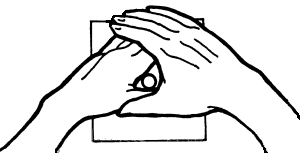
Figure 1. The illustration above shows how to make a 'sighting triangle' with your hands to determine which of your eyes is dominant.
- With both eyes open, look through the triangle and center something (e.g., a doorknob) in the triangle.
- Close your left eye. If the object remains in view, you are right eye dominant. If your hands appear to move off the object and move to the left, then you are left eye dominant.
- To validate the first test, look through the triangle and center the object again with both eyes open.
- Close your right eye. If the object remains in view, you are left eye dominant. If your hands appear to move off the object and move to the right, then you are right eye dominant.
- An alternative method is to assume the same position with your hands, and center the triangle around the object with both eyes open. Now, slowly bring your hands toward your face while continuing to look at the object with both eyes open. When your hands touch your face, the triangle opening should be in front of your dominant eye.
- Repeat the above tests a number of times to satisfy yourself that you are sure which eye is your dominant eye.
-
Extend both hands to arm's length in front of you, and put your hands together to make a small triangle between your thumbs and the first knuckle on each hand (see Figure 1 below). The triangle should be roughly 2-3 cm on each side.
-
Have the subject shoot at least 10 free throws (more is better, but all subjects should take the same number of shots). Determine the shooting percentage for each subject:
shooting % = 100 * number of shots made / number of shots taken.
-
For each subject, determine whether they have crossed or uncrossed hand and eye dominances.
- Crossed hand and eye dominances would be: left hand/right eye or right hand/left eye.
- Uncrossed hand and eye dominances would be: left hand/left eye or right hand/right eye.
- Calculate the average shooting percentage for the participants with uncrossed hand and eye dominances.
- Calculate the average shooting percentage for the participants with crossed hand and eye dominances.
- More advanced students should also calculate the standard deviation of the shooting percentage for each group.
- Make a bar graph to show the average shooting percentage for both groups. Is there any difference between the two groups?
- More advanced students should also calculate whether any difference found is statistically significant. For example, you could use a t-test to see if any difference between the mean shooting percentage of the two groups is significant (Kirkman, date unknown).
/-/https/www.sciencebuddies.org/cdn/Files/3028/5/Sports_img059.gif)

Ask an Expert
Variations
- For a more basic experiment on determining right side/left side dominance in a sample population, see the Science Buddies project Are You Left or Right Sided?
- In this experiment, your hypothesis might have been that, when shooting free throws, the ball would (at least partially) block the dominant eye for shooters with uncrossed hand and eye dominances. Therefore, shooters with crossed hand and eye dominances might be expected to have an advantage. Can you think of a way to measure how much the ball blocks the vision of the dominant eye for each shooter? Can you incorporate this additional data into your analysis?
- Another approach to this project would be to use actual freethrow shooting statistics for real basketball teams. The trick is that you will need to be able to test (or survey) each player to find out their dominant hand and dominant eye. As in the experiment described above, it would be best to have at least 50-100 participants in your study, so you'll need to test (or survey) a lot of players. Each player you include in your study will also need to have a significant number of freethrow attempts over the course of the season, so that you know the freethrow shooting percentage is reliable.
- What do you think the effect of crossed hand/eye dominance would be in other sports, e.g.: hitting a baseball, archery, target rifle shooting, soccer, or golf? Design an experiment to test your hypothesis.
Careers
If you like this project, you might enjoy exploring these related careers:
/-/https/careerdiscovery.sciencebuddies.org/cdn/Files/1522/17/unsplash-FVh_yqLR9eA.jpg)

/-/https/careerdiscovery.sciencebuddies.org/cdn/Files/1815/24/stat.jpg)
/-/https/careerdiscovery.sciencebuddies.org/cdn/Files/911/17/pexels-photo-4058382.jpg)
/-/https/careerdiscovery.sciencebuddies.org/cdn/Files/1564/17/pexels-photo-4173339.jpg)

/-/https/img.youtube.com/vi/0QQAU5gB0fI/0.jpg)
/-/https/img.youtube.com/vi/EGp2LHOEWTI/0.jpg)
/-/https/img.youtube.com/vi/wLIxwnjRnqA/0.jpg)