/-/https/www.sciencebuddies.org/cdn/Files/21464/5/sb-logo.png)
/-/https/www.sciencebuddies.org/cdn/Files/21464/5/sb-logo.png)
Abstract
You might know that your body needs oxygen to keep going, and that you breathe out carbon dioxide as waste. What happens when you exercise? You have probably noticed that you breathe faster, and your heart beats faster. What triggers your body to respond in this way? How does it "rev up" to keep your muscles going? In this project, you will get a peek into the fascinating science of exercise physiology and find out—with the help of a color changing reaction.Summary
Edited by Svenja Lohner, PhD, Science Buddies
Sources
- Investigating CO2 in Breathing. Bronx High School of Science.
- How Much Carbon Dioxide Is Produced During Exercise? Teacher's Notes. Faculty of Education, The Chinese University of Hong Kong.
/-/https/www.sciencebuddies.org/cdn/Files/9024/9/exercise-respirator-bottle-green.jpg)
Objective
To measure changes in carbon dioxide levels in exhaled air before and after physical exercise.Introduction
/-/https/www.sciencebuddies.org/cdn/Files/9024/9/exercise-respirator-bottle-green.jpg)
Every day, you need lots of energy for all the activities you do, even when you are just sleeping. To produce this energy, your body extracts energy from the food you eat. This process is called cellular respiration and takes place in the cells of your body. In a series of chemical reactions, the food you eat is broken down to glucose, which then reacts with oxygen from the air you breathe to carbon dioxide (CO2), water and energy as shown in Figure 1.
/-/https/www.sciencebuddies.org/cdn/Files/9025/5/cellular-respiration-reaction.jpg)
Figure 1. Cellular respiration—a process in which glucose reacts with oxygen to form carbon dioxide, water and energy—happens inside the cells of your body.
The chemical equation of cellular respiration is given in Equation 1.
Equation 1:
What this equation means is for each 1-unit change in pH, the hydrogen ion concentration changes tenfold. Pure water has a neutral pH of 7. pH values lower than 7 are acidic, and pH values higher than 7 are basic (alkaline). If you want to know more about acids, bases, and pH, you will find more information here.
A colorimetric pH test means that the color of the solution changes when the pH changes. Here is how it works. When you add the pH indicator solution (specifically bromothymol blue) to plain water, it turns blue, or greenish blue, indicating that the pH is near 7. Carbon dioxide is very soluble in water. When it dissolves, it forms carbonic acid, which is acidic. This makes the pH of the water shift from neutral (7) to more acidic (somewhere near 6)—the pH indicator will change color to yellow. Figure 2, below, shows an example of the pH indicator solution bromothymol blue changing color over this pH range.
/-/https/www.sciencebuddies.org/cdn/Files/9026/5/fig2-indicator-solutions-pH-scaled.png)
Figure 2. The pH indicator bromothymol blue changes color from yellow to blue over the pH range 6.0–7.6.
To compare your CO2 output under different conditions, you will exhale through a tube into a bottle partly filled with the pH indicator solution. The CO2 that you exhale will dissolve in the water, and gradually acidify it. You will be able to see the pH indicator change color as this happens. By measuring how long it takes for the pH change to occur, you will have a relative measure of the amount of CO2 in your breath. The less time it took for the color change to happen, the more CO2 there was in your breath.
The two conditions you will test are before and after a short period of exercising. You probably notice that your breathing gets faster and your heart rate increases when you exercise. You can do your own research to look into how your body controls heart rate and breathing during exercise, which is a topic called exercise physiology. What do you think will happen to the amount of CO2 that you exhale after exercising? Will it increase, decrease, or stay the same? And what does your result mean with respect to the cellular respiration reaction in your body?
Terms and Concepts
- Cellular respiration
- Glucose
- Oxygen
- Carbon dioxide (CO2)
- pH
- Acidic pH
- Basic pH
- Neutral pH
- Colorimetric pH test
- pH indicator
- Bromothymol blue
- Heart rate
- Exercise physiology
Questions
- How is oxygen used and carbon dioxide produced in cellular respiration?
- How do cells in the body obtain oxygen and get rid of carbon dioxide?
- How does the body sense and respond to increased cellular respiration rate?
- How can you measure the amount of carbon dioxide in your exhaled breath?
- What is a colorimetric test and what can you use it for?
Bibliography
For information on respiration and exercise, carbon dioxide, and how the human lungs function, check out these websites:- D.A. Burton et al., 2004. Physiological effects of exercise, Continuing Education in Anaesthesia Critical Care & Pain, Volume 4, Issue 6, Pages 185-188. Retrieved August 22, 2017.
- SMM, 2002. Habits of the Heart: The Lungs, Science Museum of Minnesota. Retrieved September 19, 2006.
- Shakashiri, B. Carbon Dioxide, Chemical of the Week, University of Wisconsin. Retrieved January 26, 2006.
- Calabrese, L., 2001. Volume of human lungs, Elert, G. "The Physics Factbook". Retrieved January 27, 2006.
- # Link Name="Zoo_p013.11" Value="HtmlAnchor" HtmlText="Cellular respiration introduction" #], Khan Academy (video). Retrieved August 22, 2017.
- Robin Wasserman, 2017. Why Does Blood Become More Acidic When Carbon Dioxide Increases?, Live Strong. Retrieved August 22, 2017.
Materials and Equipment
- Clear plastic bottle (ca. 500 mL) (2)
- Water
- Teaspoon
- Bromothymol blue solution (0.04%). You can purchase bromothymol blue through an online supplier such as Amazon.
- Aeration setup for de-acidifying the pH indicator solution. The setup should include an aquarium pump, tubing, and an airstone that can all fit together, although the airstone is optional. Such a setup may be purchased at a local aquarium store, or through an online supplier such as Amazon.
- Scissors
- Modeling clay
- Straw
- Safety valve for tube; available from Amazon
- Stopwatch or a clock or watch with a second hand
- A helper to time you
- Lab notebook
- Pencil
Disclaimer: Science Buddies participates in affiliate programs with Home Science Tools®, Amazon.com, Carolina Biological, and Jameco Electronics. Proceeds from the affiliate programs help support Science Buddies, a 501(c)(3) public charity, and keep our resources free for everyone. Our top priority is student learning. If you have any comments (positive or negative) related to purchases you've made for science projects from recommendations on our site, please let us know. Write to us at [email protected].
Experimental Procedure
/-/https/www.sciencebuddies.org/cdn/Files/20483/6/icon-flask.png)
Building Your Respirometer
- Fill one clear plastic bottle a little less than one-third full with water and add one teaspoon (about 5 mL) of the 0.04% bromothymol blue solution. You should get a nice green or blue-green color (pH >= 7) as shown in Figure 3. If not, try using distilled water. This will be your diluted pH indicator solution.
/-/https/www.sciencebuddies.org/cdn/Files/9027/5/make-indicator-solution.jpg)
Figure 3. Adding the bromothymol blue solution to the water should result in a green or blue-green solution.
- Cut about two inches from one side of the tube for the aquarium pump.
- Insert the safety valve in between both pieces of tube as shown in Figure 4. The tip of the red part inside the valve should be on the side of the longer end of the tube. Note: The safety valve will prevent you from accidentally sucking up indicator solution from the bottle.
/-/https/www.sciencebuddies.org/cdn/Files/9028/5/valve-in-tube.jpg)
Figure 4. The safety valve ensures that you do not accidentally suck up indicator solution.
- Cut a two-inch piece off your straw. You will use this as the outlet tube of your respirometer.
- Using the aquarium pump tube (with inserted valve and the airstone), the straw, and the modeling clay, set up your respirometer as shown in Figure 5. Make sure that the inlet tube reaches all the way to the bottom of the bottle. The outlet tube (the straw) should stay above the indicator solution.
/-/https/www.sciencebuddies.org/cdn/Files/9029/5/respirator-bottle-setup.jpg)
Figure 5. Set up respirometer with inlet and outlet tubes and diluted indicator solution.
Measuring Your Carbon Dioxide Output
- Fill the second bottle with the same amount of water as the first one and again add one teaspoon of bromothymol blue solution. Make sure the solution has the same color as the previous one and set the bottle aside as a control for color comparison.
- Now you are ready to begin. Your helper should tell you when to start, and start the stopwatch.
- On your helper's command, take a deep breath and start exhaling through the inlet tube into the indicator solution for as long as you can. Do your best to maintain your current, comfortable breathing rate, inhaling through your nose and exhaling from your mouth through the tube.
- When the indicator solution in your respirometer has turned yellow-green (as shown in Figure 6) and the color does not change anymore, your helper should stop the stopwatch.
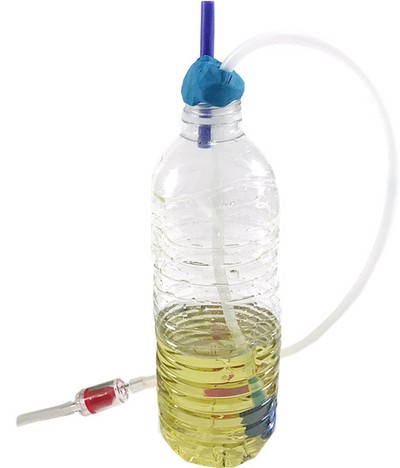
Figure 6. At the end of your reaction the indicator solution should be yellowish.
- In your lab notebook, record the number of seconds it took to change the color of the solution. You may need to practice this process with your partner several times before actual testing to determine the exact color at which to stop the time.
- Now aerate the pH indicator solution (in the respirometer) to return it to the starting pH. To do that, attach the inlet tube to the aquarium pump and switch it on (you can leave the safety valve attached) as shown in Figure 7. Aerate the solution until the solution matches the original color (compare to your control; it will take 5–10 minutes).
/-/https/www.sciencebuddies.org/cdn/Files/9032/12/respirator-bottle-yellowish.jpg)
/-/https/www.sciencebuddies.org/cdn/Files/9033/5/neutralizing-with-pump.jpg)
Figure 7. Aerating the indicator solution with an aquarium pump.
- When your respirometer solution is ready again, repeat step 3–6 until you have at least three measurements at rest (more is better).
- Next, collect at least three measurements right after exercising (doing jumping jacks) for one minute. Test how long it takes you to change the color of the pH indicator immediately after you finished exercising, then rest for 10 minutes while you re-aerate the buffer. Then repeat the measurement until you have at least three data points for each condition (more is better).
- Average the results for each test condition and compare the results using graphs and data tables.
- How do your results compare to your expectations from your background research? Did the amount of carbon dioxide in your exhaled breath decrease or increase after exercising? Can you explain your results?

Ask an Expert
Global Goals
The United Nations Sustainable Development Goals (UNSDGs) are a blueprint to achieve a better and more sustainable future for all.
/-/https/www.sciencebuddies.org/cdn/Files/19746/5/E-WEB-Goal-03.png)
Variations
- Correlating CO2 Production with Other Measures. How does CO2 output correlate with other measures of increased physical activity such as breaths per minute and pulse rate?
- Making Your Results More Quantitative. For a more advanced project, you can actually calculate the amount of CO2 produced. You can do this by adding a known amount of NaOH to the indicator solution, and calculating how much CO2 would be required to change the pH to 6. Then, measure how long it takes to acidify the indicator solution. Your measurements will allow you to calculate an estimate of the CO2 exhaled per second. Of course, to make this work you will have to work with solutions of known concentration and volume.
- Effects of Training: Athletes vs. Non-Athletes. If you wanted to get really ambitious, you could see how conditioning affects CO2 output. Do conditioned athletes take longer to start producing additional CO2 with moderate exercise? Do they recover to normal levels faster after exercise?
- Compare CO2 production after anaerobic and aerobic exercise. Compare respirometer results from subjects who run, walk, or bike for 4–7 minutes to those from subjects who do push-ups, lunges, or squats for the same duration.
- For another Science Buddies project on exercise physiology, see: Heart Health: How Does Heart Rate Change with Exercise?.
Careers
If you like this project, you might enjoy exploring these related careers:
/-/https/careerdiscovery.sciencebuddies.org/cdn/Files/1719/17/Respiratory_therapist.jpg)

/-/https/careerdiscovery.sciencebuddies.org/cdn/Files/1628/18/iStock-1203995945.jpg)
/-/https/careerdiscovery.sciencebuddies.org/cdn/Files/1634/17/unsplash-8WGHcMEAa2k.jpg)
/-/https/careerdiscovery.sciencebuddies.org/cdn/Files/1707/17/unsplash-pA0uoltkwao.jpg)

/-/https/img.youtube.com/vi/B937Ox9JNEQ/0.jpg)
/-/https/img.youtube.com/vi/Qme0DYXcF-0/0.jpg)
/-/https/img.youtube.com/vi/jhRyistosQk/0.jpg)