/-/https/www.sciencebuddies.org/Files/21464/5/sb-logo.png)
/-/https/www.sciencebuddies.org/Files/21464/5/sb-logo.png)
Abstract
Do you wish that you had duck feet? Aside from being a fun Dr. Seuss story, there is a lot you can learn about hydrodynamics by looking at the feet of birds. How are the feet of birds that swim unique? Find out in this experiment.
Summary
None
Readily available
Adult supervision required for swim tests.
/-/https/www.sciencebuddies.org/Files/2669/8/Aero_img027.jpg)
Objective
In this experiment, you will investigate different foot adaptations of water birds to see if they increase the speed of swimming.
Introduction
Water birds use their feet to swim through the water, often as a way to get food. Penguins need to dive and swim quickly through the water to chase and catch small fish as prey. Ducks swim to eat from the bottom of ponds, lakes, and streams. Each type of swimming bird has a unique adaptation for locomotion through the water.
How do ducks swim? When they push their feet back under water, the web spreads out, allowing it to push more water. When they pull their feet forward, their toes and web come together, so there is less water resistance on the foot. This resistance is in the form of friction, and is an important force in hydrodynamics and locomotion. The spread-out webs also allow the ducks to walk on mud without sinking in.
/-/https/www.sciencebuddies.org/Files/2668/10/Aero_img026.jpg)
Here is a picture of two duck feet showing the webbing between the toes.
(Copyright © 2003 Matthew Mullenweg)
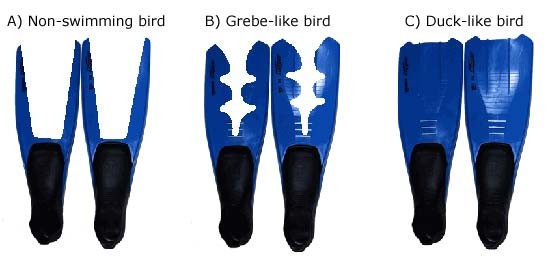
There are many different kinds of water birds, each with adaptations for swimming through the water. Ducks, geese, and pelicans have webbing between their toes. Other water birds, like grebes have flattened, lobed toes that help with diving and swimming. In this experiment you will use swim fins to make three sets of bird feet: one from a non-swimmer, one from a grebe, and one from a duck. Which adaptations will help a swimmer swim the fastest?
Terms and Concepts
To do this type of experiment you should know what the following terms mean. Have an adult help you search the internet, or take you to your local library to find out more!
- water birds
- ducks
- geese
- grebes
- penguins
- and many more...
- foot morphology
- surface area
- hydrodynamics
- locomotion
- friction
Questions
- How are the feet of water birds unique from other birds?
- How does the webbing of duck feet help ducks to swim?
- Does the webbing of water birds increase or decrease surface area of the feet?
Bibliography
- Project BEAK (n.d.). Swimming. Retrieved February 27, 2018.
- LeSieg, T., 1965. I Wish That I Had Duck Feet, New York, NY: Random House.
Materials and Equipment
- pool
- swimmer
- stop-watch
- kick board
- three pairs of large swim fins (you will cut two of them up, so preferably used and cheap!)
- strong pair of scissors
- permanent marker
Experimental Procedure
/-/https/www.sciencebuddies.org/Files/20483/6/icon-flask.png)
- First you need to find a location with a lap pool and a good swimmer to help you with your experiment.
- Next, you will need to make three sets of fins for your swimmer's feet, each modeled after a different kind of bird: a non-swimming bird (A), a grebe-like bird (B), and a duck-like bird (C). Use the images to outline the shape of the bird foot on the fin and then use the scissors to cut out portions of the fin between the "toes" of the bird. When you are finished you should have three sets of fins that look similar to these drawings:
- Now go to the pool with your swimming volunteer to conduct the experiment. Bring your volunteer, the three pairs of "feet", a kick board, a stop-watch, and a data table.
- You will have your helper use each set of "feet" to swim one lap of the pool while you time the lap with a stop watch. You should do three trials for each set of "feet" to get more reliable data. For each trial, explain to your volunteer that they should wait for you to say "GO!" and then swim to the other end of the pool while holding on to the kick board and without using their arms. When they get to the other side you will stop the stop-watch and record the time in the data table:
Swipe left to see more
Time (seconds) Trial 1 Trial 2 Trial 3 Average Non-swimming feet Grebe-like feet Duck-like feet - When you get home you will need to calculate the average time for each set of "feet" to swim across the pool. Do this by adding together the times for the three trials and dividing the answer by three.
- Make a bar graph of the swim time for each type of foot pattern. Do this by making a scale of time in seconds on the left side (y-axis) of the graph. Then draw a bar for each type of "foot" up to the matching average number of seconds it took for the volunteer to swim across the pool. How do they compare? Which type of "foot" gave the best swim times? How does this make you think about foot adaptations in swimming birds?
/-/https/www.sciencebuddies.org/Files/2669/8/Aero_img027.jpg)

Ask an Expert
Global Goals
The United Nations Sustainable Development Goals (UNSDGs) are a blueprint to achieve a better and more sustainable future for all.
/-/https/www.sciencebuddies.org/Files/19752/5/E-WEB-Goal-09.png)
Variations
- One way that webbing can cause faster swimming is by making the surface area of the foot larger. Try measuring the surface area of your fin designs to see if the faster times also have larger surface area. You can measure the surface area by placing the fins on several sheets of graph paper that have been taped together, outlining the fin and then counting the number of squares inside. Make a graph of this new data. Do you see a trend?
- In this experiment you used fins to mimic the feet of swimming birds, but there is one major difference- the fins that you used for your experiment can't open and close when swimming. When a duck swims, it spreads the feet when pushing back (the down stroke) and closes the feet when pulling the foot forward (the up stroke). Do an experiment showing how this behavior results in changes in the surface area of the foot during each stroke. Which stroke has the largest surface area, the upstroke or the down stroke? How do you think this alternation of strokes helps the bird swim through the water during locomotion?
Careers
If you like this project, you might enjoy exploring these related careers:
/-/https/careerdiscovery.sciencebuddies.org/Files/1408/24/iStock-507243709.jpg)

/-/https/careerdiscovery.sciencebuddies.org/Files/1900/17/iStock-1191167137.jpg)
/-/https/careerdiscovery.sciencebuddies.org/Files/1147/17/unsplash-fJebhGIP0P4.jpg)
/-/https/careerdiscovery.sciencebuddies.org/Files/1209/17/pexels-photo-5901269.jpg)

/-/https/img.youtube.com/vi/pFSAMkEDBQA/0.jpg)
/-/https/img.youtube.com/vi/DgCP-3rSHCY/0.jpg)
/-/https/img.youtube.com/vi/bv8Fgw30VkM/0.jpg)