/-/https/www.sciencebuddies.org/cdn/Files/21464/5/sb-logo.png)
/-/https/www.sciencebuddies.org/cdn/Files/21464/5/sb-logo.png)
Abstract
Many materials expand when heated and contract when cooled. What do you think will happen to the elasticity (stretchiness) of a rubber band when it is heated or cooled to various temperatures?Summary
Andrew Olson, PhD, Science Buddies
Justin Spahn, Science Buddies
Sandra Slutz, PhD, Science Buddies
Sources
The idea for this project is by Vince Calder, from his answer on the Newton Ask A Scientist bulletin board:
- Mellendorf, K., et al. (2002). Hooke's Law and Rubber Bands Newton Ask A Scientist, Argonne National Laboratory. Retrieved March 25, 2015.
/-/https/www.sciencebuddies.org/cdn/Files/3047/5/ApMech_img064.jpg)
Objective
The goal of this project is to investigate how the restoring force of a rubber band varies with temperature.
Introduction
All matter is made up of atoms, like carbon, or hydrogen, or oxygen. Atoms are linked together to form larger compounds called molecules. Some molecules are made by stringing together repeated subunits. Such molecules are called polymers. In some polymers, including many synthetic polymers in textiles and plastics, the subunits are identical. In other polymers, such as proteins manufactured inside cells, the subunits have a common 'backbone' structure, to which different chemical groups are attached.
Rubber is an example of a natural polymer. The chains of molecules in rubber have a natural elasticity: they can stretch when pulled. When the pulling force is removed, the elastic polymers in rubber spring back to their original length. A polymer with elastic properties like this is sometimes called an elastomer. The molecular chains of an elastomer basically act like springs.
Solid materials generally expand when heated and contract when cooled. How will temperature affect the elasticity of rubber bands? You can find out for yourself with this experiment.
Terms and Concepts
To do this project, you should do research that enables you to understand the following terms and concepts:
- Atom
- Molecule
- Polymer
- Elastomer
- Hooke's law
Questions
- How does the elasticity of rubber change with temperature?
Bibliography
- Explore this website to find out much more about polymers:
PSLC. (2007). The Kids' Macrogalleria. Polymer Science Learning Center, Department of Polymer Science, University of Southern Mississippi. Retrieved June 15, 2007. - Here you can learn about the chemical structure of rubber, a natural polymer:
Polymer Science Learning Center. (n.d.). Rubber. Department of Polymer Science, University of Southern Mississippi. Retrieved March 25, 2015. - The idea for this project is by Vince Calder, from his answer on the Newton Ask A Scientist bulletin board:
Mellendorf, K., et al. (2002). Hooke's Law and Rubber Bands. Newton Ask A Scientist, Argonne National Laboratory. Retrieved March 25, 2015.
For help creating graphs, try this website:
- National Center for Education Statistics. (n.d.). Create a Graph. Retrieved November 12, 2008.
Materials and Equipment
- Rubber bands (six or more, all of the same size and width)
- Scissors
- Thermometer; available from online suppliers such as Carolina Biological Supply Company
- 250 ml graduated cylinder; must be clear and heat resistant. This item can be purchased from online vendors, such as Carolina Biological Supply Company. You may be able to borrow a similar item from your school.
- 100 g steel weight, with a hook or knob for attaching a rubber band to. This item can be purchased from online vendors, such as Carolina Biological Supply Company. You may be able to borrow a similar item from your school.
- Water
- Ice
- Pot or kettle
- Stovetop
- Wooden spoon, or other long-handled tool for stirring
- Ruler or tape measure, metric
- Play dough or putty
- Bamboo skewer or popsicle stick
Disclaimer: Science Buddies participates in affiliate programs with Home Science Tools®, Amazon.com, Carolina Biological, and Jameco Electronics. Proceeds from the affiliate programs help support Science Buddies, a 501(c)(3) public charity, and keep our resources free for everyone. Our top priority is student learning. If you have any comments (positive or negative) related to purchases you've made for science projects from recommendations on our site, please let us know. Write to us at [email protected].
Experimental Procedure
/-/https/www.sciencebuddies.org/cdn/Files/20483/6/icon-flask.png)
- Do your background research so that you are knowledgeable about the terms, concepts, and questions, above.
- Heat a pot of water to boiling on the stovetop. With the help of an adult, carefully pour the boiling water into the graduated cylinder.
- Using the scissors, cut one rubber band so that it is a straight ribbon rather than a circle.
- Tie one end of the rubber band to the middle of the skewer, and the other end to the hook (or knob) on the steel weight.
-
Gently, being careful not to burn yourself on the hot water or steam, lower the weight and rubber band into the graduated cylinder. Rest the skewer across the opening of the graduated cylinder to prevent the whole thing from falling inside. Use putty or play dough to secure the skewer to the edges of the graduated cylinder. Figure 1 shows a diagram of the experimental setup.
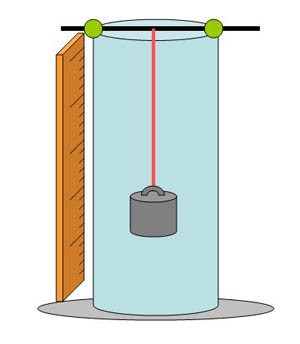
Figure 1. This diagram shows how to immerse the rubber band in water, by dangling it from a skewer. The other end of the rubber band is securely tied to a weight and a ruler is used to measure the rubber band stretch length between the skewer and the weight.
-
Measure the water temperature with a thermometer. With the ruler, measure the rubber band stretch length between the skewer and the weight. Record both of these measurements in a data table in your lab notebook.
- Tip: If you find it difficult to use the ruler to measure the rubber band stretch length, then use the ruler to measure how many millimeters apart the tick marks are on the graduated cylinder. Now count tick marks between the bamboo skewer and the weight and convert that back into millimeters.
- Continue to measure the water temperature and stretch length every three to five minutes until the water temperature stabilizes around room temperature.
- Once the temperature has stabilized, pour out approximately 25mL of water from the graduated cylinder. Add 25mL of ice water to replace it. Mix the water in the graduated cylinder thoroughly with the handle of a wooden spoon or other long implement. Measure the water temperature and rubber band stretch length. Record the measurements in your lab notebook.
- Repeat step 8 until the final water temperature is approximately the same as your ice water.
-
Repeat steps 2-9 twice more. Use a new rubber band each time. Make sure the starting length of your rubber bands (once they are tied to the bamboo and weight) is approximately the same each time.
- Repeating the experiment a total of three times will help you determine if your findings are consistent and reliable.
-
Make a line graph of the rubber band stretch length (y-axis) vs. the water temperature (x-axis).
- In the end you should have one graph with three lines, each representing a different trial with a different rubber band.
- You can make your graph by hand, or use computer software, like Create A Graph.
- What happened to the rubber band stretch length as the temperature decreased? Is this what you expected to see based on your background reading? Did all three of your experimental trials behave similarly? What do you think would happen to the rubber band stretch if you started with ice water and kept increasing the water temperature? Repeat the experiment, this time figuring out a way to start with ice water and end with near-boiling water.
/-/https/www.sciencebuddies.org/cdn/Files/3047/5/ApMech_img064.jpg)

Ask an Expert
Global Goals
The United Nations Sustainable Development Goals (UNSDGs) are a blueprint to achieve a better and more sustainable future for all.
/-/https/www.sciencebuddies.org/cdn/Files/19752/5/E-WEB-Goal-09.png)
Variations
- Do rubber bands behave like springs? Use the Procedure described in the following Science Buddies project with rubber bands in place of springs in order to find out: Applying Hooke's Law: Make Your Own Spring Scale.
- Do you think that the force required to break a rubber band will change with temperature? Use a spring scale to measure the maximum force that a rubber band can withstand before breaking. Perform multiple trials with rubber bands at different initial temperatures.
Careers
If you like this project, you might enjoy exploring these related careers:
/-/https/careerdiscovery.sciencebuddies.org/cdn/Files/1450/21/iStock-1227179796.jpg)

/-/https/careerdiscovery.sciencebuddies.org/cdn/Files/1457/17/pexels-photo-3861938.jpg)

/-/https/img.youtube.com/vi/Dg3uYPvSoIs/0.jpg)
/-/https/img.youtube.com/vi/GDROkh1zlr8/0.jpg)
/-/https/img.youtube.com/vi/WtP7sxWSF9c/0.jpg)