/-/https/www.sciencebuddies.org/cdn/Files/21464/5/sb-logo.png)
/-/https/www.sciencebuddies.org/cdn/Files/21464/5/sb-logo.png)
Using the Solar & Heliospheric Observatory Satellite (SOHO) to Determine the Rotation of the Sun
Abstract
Here's a cool project that shows you how to use images from an orbiting observatory to measure how fast the Sun rotates.Summary
Objective
The objective of this science project is to use the Solar & Heliospheric Observatory satellite (SOHO) to determine the rotation of the sun.Introduction
| Before You Start: The sun has periods of increased, solar maximum, and decreased, solar minimum, sunspot activity. This 11-year cycle has effects on many types of space weather. Before starting this experiment you should read a bit about the sunspot cycle and determine where we currently are in the cycle. During a solar minimum you may need to rely on historical data (which we tell you how to obtain in the Experimental Procedure) to complete this project. |
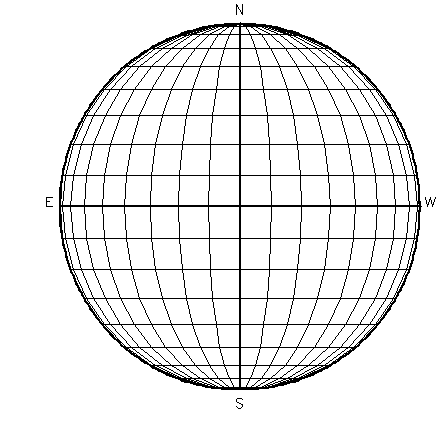
SOHO launched on December 2, 1995 as a joint effort by the European Space Agency (ESA) and the US National Aeronautics and Space Administration (NASA). In your reading you will learn about the basic physics of the sun, and how a star differs from planets like the Earth. For example, the Sun has a north and south pole, just as the Earth does, and rotates on its axis. However, unlike Earth, which rotates at all latitudes every 24 hours, the Sun rotates at a different speed at the equator than it does at the poles. This is known as differential rotation. In this project you would use the images of the sun that SOHO beams to Earth and places on the Internet every day, along with a spherical grid to track the rotation of sunspots. You will use the data you collect to determine the rotational speed of the sun at different distances from the equator.
Terms and Concepts
In your background reading, you should research the following terms, concepts, and questions in addition to any other areas that arouse your curiosity:- Longitude and latitude
- Universal time (UT)
- Basic facts about the sun (size, temperature, distance)
- Sunspots
- Magnetic fields
- Solar cycle
- Solar limb darkening
- Carrington rotations
- Why does the sun display differential rotation?
- Where in space is the SOHO satellite and how was it launched?
- What is the MDI? What is the EIT?
- If you know the circumference of the sun, how would you calculate how fast a feature on the surface at the equator is rotating (in kilometers/hour)?
Bibliography
These are some Web resources to get you started with your research about the Sun and the SOHO satellite:- High Altitude Observatory Education Pages: https://www2.hao.ucar.edu/Education
- Our Star the Sun: http://sohowww.nascom.nasa.gov/explore/sun101.html
- Terms, Concepts, and Definitions: http://sohowww.nascom.nasa.gov/explore/glossary.html
- SOHO Satellite Web Site: http://sohowww.nascom.nasa.gov/
Experimental Procedure
/-/https/www.sciencebuddies.org/cdn/Files/20483/6/icon-flask.png)
After completing your background research, begin your investigation.
You can find the latest SOHO images at: http://sohowww.nascom.nasa.gov/data/latestimages.html You can click on "Near real-time images" to see the absolute latest images. Click on 256 x 256, 512 x 512, or 1024 x 1024 under any of the different images types to see past images from that same instrument.
Some of the best images for tracking sunspots are those labeled "MDI Continuum." You can also use the "EIT" images, but those can sometimes be hard to interpret because they show much more of the activity on the sun. The different EIT images show the solar atmosphere at different wavelengths (171, 195, 284, and 304 Angstroms). By looking at both MDI Continuum and EIT images, you can learn more than by looking at just one.
There are some possible problems in obtaining current data. Sometimes one of the imagers is shut down for maintenance or other reasons, and sometimes the sun does not show any sunspots. Either of these problems can disrupt your experiment. Fortunately, the SOHO site archives past images (as indicated above).
Past MDI data also can be found at: http://sohowww.nascom.nasa.gov/sunspots/# Click on "List of all available daily images" for past images. These images have the advantage that the sunspots are numbered for identification.
Thus, if you need to, you can pick a set of past images to perform your experiment.
Regardless of whether you use current data or past data, make sure that your images fall on consecutive days. Every image has a "timestamp" to indicate the day it was taken.
When you are ready to begin measuring your images, print out the solar grid found at http://sohowww.nascom.nasa.gov/explore/lessons/sun_grid.gif. Note that the grid has 36 divisions. (Remember the sun is spherical: so there are 18 "wedges" in front and 18 in back. Some longitude lines appear closer together than others due to perspective, but all are equally spaced. Look at a globe to help you visualize how this is true.)
By holding the grid over the image up to the light, or by placing it on an overhead projector, you can mark the location of each sunspot group over a period of time. You can calculate the speed of rotation as follows:
Speed of rotation in days =

                              # of days
          -------------------------------------------------
          (# of divisions the sunspot moves) / 36 divisions
The "# of days" is the elapsed time between your first and last image for a given sunspot. Just look at a calendar and mark the date of your first and last image. DON'T count the first day, DO count the other days including the last one. (If you are missing an image because of bad weather or other problems, that's OK, but you would still count the missing day. The sun continued to rotate, you just didn't see it!) For example, if a sunspot moves 18 divisions (18/36 = 1/2 rotation) in 14 days, the projected time for a complete rotation would be 14 divided by 1/2, which equals 28 days.
Setup a spreadsheet to collect your data and perform your calculations. The same spreadsheet will make a nice table for your display board.
What is the speed of sunspots at different latitudes, measured in kilometers per hour at the surface of the sun? Utilizing your background research, can you explain what is happening?

Ask an Expert
Global Goals
The United Nations Sustainable Development Goals (UNSDGs) are a blueprint to achieve a better and more sustainable future for all.
/-/https/www.sciencebuddies.org/cdn/Files/19756/5/E-WEB-Goal-13.png)
Careers
If you like this project, you might enjoy exploring these related careers:
/-/https/careerdiscovery.sciencebuddies.org/cdn/Files/902/18/iStock-1174945987.jpg)


/-/https/img.youtube.com/vi/WRKQGwh_Mw0/0.jpg)
/-/https/img.youtube.com/vi/Ar78O1hl7TE/0.jpg)
/-/https/img.youtube.com/vi/WtP7sxWSF9c/0.jpg)