/-/https/www.sciencebuddies.org/Files/21464/5/sb-logo.png)
/-/https/www.sciencebuddies.org/Files/21464/5/sb-logo.png)
Abstract
Do you know why enzymes are oftentimes called the workhorses of biochemistry? It's because they can speed up a wide variety of chemical reactions, and chemists and biologists use enzymes to do all kinds of jobs. In this project, pectinase, an enzyme frequently used in the food industry, will be used to extract juice from apples.Summary
Andrew Olson, Ph.D., Science Buddies
/-/https/www.sciencebuddies.org/Files/6771/9/CB-pectinase.png)
Objective
The goal of this project is to monitor enzyme activity by measuring the amount of apple juice released by pectinase.
Introduction
Enzymes are the workhorses of biochemistry. Enzymes are proteins that catalyze (speed up) specific chemical reactions—increasing reaction rates by factors of at least a million.
Pectinase is an enzyme that catalyzes the breakdown of pectin, a component of the cell wall in fruits such as apples and oranges. Pectinase is used commercially to aid in extracting juice from fruit. By enzymatically breaking down the cell wall, pectinase releases the juice from within the cells. Pectinase is also used for clarifying the extracted juice.
In this project, you can apply pectinase to fruit under controlled experimental conditions in order to investigate the enzyme activity of pectinase. You can monitor the enzyme activity by measuring how much juice is produced under the various experimental conditions. Some possible conditions to investigate are duration of enzyme treatment, enzyme concentration, and temperature.
Terms and Concepts
- Pectin
- Pant cell wall
- Enzymes
- Substrate
- Pectinase
- Cellulase
- Amylase
Questions
- What is the source of pectinase enzyme?
- How does pectinase promote the release of juice from apples?
- What are the substrates for the enzymes cellulase and amylase? Do you think that these enzymes would increase juice production?
Bibliography
- NCBE, 2006. "In a Jam and Out of Juice," National Centre for Biotechnology Education, University of Reading, U.K. [accessed July 7, 2006] http://www.ncbe.reading.ac.uk/NCBE/PROTOCOLS/INAJAM/PDF/JAM03.pdf.
- Wikipedia contributors, 2006a. "Cell Wall," Wikipedia, The Free Encyclopedia. [accessed July 7, 2006] http://en.wikipedia.org/w/index.php?title=Cell_wall&oldid=61797174.
- Wikipedia contributors, 2006b. "Enzyme," Wikipedia, The Free Encyclopedia. [accessed July 7, 2006] http://en.wikipedia.org/w/index.php?title=Enzyme&oldid=62644117.
- Wikipedia contributors, 2006c. "Pectin," Wikipedia, The Free Encyclopedia. [accessed July 7, 2006] http://en.wikipedia.org/w/index.php?title=Pectin&oldid=61390030.
Materials and Equipment
These items can be purchased from Carolina Biological Supply Company, a Science Buddies Approved Supplier:
- 100 mL beakers (2). Alternatively, you could use clean glass jars.
- Pectinase. You may also be able to find it locally at a store with home winemaking supplies.
- Watering pipets (2). Alternatively, 1 mL syringes or pipets may be used.
- Thermometer
- Funnels (2)
- 100 mL graduated cylinders (2)
You will also need to gather these items:
- Apples (2)
- Ruler, metric
- Sharp knife for cutting apples
- Balance for weighing out apple pieces, such as the Fast Weigh MS-500-BLK Digital Pocket Scale, 500 by 0.1 G available at Amazon.com
- Distilled water
- Masking tape and permanent marker or sticky notes and a pen
- Disposable plastic spoons for stirring (2)
- Plastic wrap
- Water bath; can be as simple as a styrofoam box or insulated chest, big enough to hold the beakers
- Timer or clock
- Optional: wooden spoon
- Paper coffee filters (2)
- Lab notebook
Disclaimer: Science Buddies participates in affiliate programs with Home Science Tools®, Amazon.com, Carolina Biological, and Jameco Electronics. Proceeds from the affiliate programs help support Science Buddies, a 501(c)(3) public charity, and keep our resources free for everyone. Our top priority is student learning. If you have any comments (positive or negative) related to purchases you've made for science projects from recommendations on our site, please let us know. Write to us at [email protected].
Experimental Procedure
/-/https/www.sciencebuddies.org/Files/20483/6/icon-flask.png)
Safety Note. Do not drink or cook with the juice produced in this experiment. The concentration of pectinase used will be much higher than is used in commercial juice production, and the fruit and enzyme have not been handled aseptically.
- Chop the apples into cubes that are roughly 5 millimeters (mm) on a side. (Use care with the knife!) It is important to chop the apple into very small pieces—added surface area helps the enzyme break down the pectin in the plant cell walls, releasing more juice.
- Use the balance to weigh equal amounts of chopped apple (about 50 grams [g]) into each beaker.
- Prepare the pectinase enzyme according to the manufacturer's instructions.
- Using a pipet or 1 milliliter (mL) syringe, add 4 mL of diluted enzyme to one beaker. Using a different, clean pipet or syringe, add 4 mL of distilled water to the other beaker. Using masking tape and a permanent marker (or sticky notes and a pen), label the beakers ("pectinase" and "water").
- Stir the chopped apple pieces in each beaker with a separate plastic spoon. Be sure to wet all of the pieces. Cover the beakers with plastic wrap.
- Put both beakers into a 40°C water bath for 25–30 minutes. Your water bath can be as simple as a styrofoam box or insulated cooler, with water at 40°C. The water should come up to the level of the chopped apples, but you do not want so much water that the beakers float and tip over. After removing the beakers from the water bath, you may want to use a wooden spoon to gently stir/squeeze the apple pieces in each.
-
Place a paper coffee filter in a funnel and then set the funnel in a 100 mL graduated cylinder, as shown in Figure 1, below, to filter the juice from one of the apple preparations. Make a second setup using a different paper coffee filter, funnel, and 100 mL graduated cylinder. Again, label the cylinders so you can keep track of the contents. Separately pour the juice from each beaker into its own funnel. Record the amount of juice in each cylinder at 5 min intervals. You can make a data table in your lab notebook to record your results.
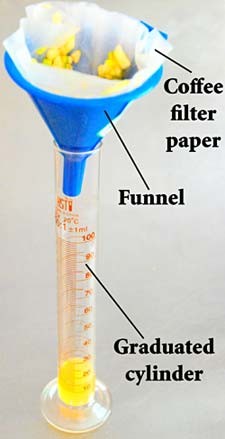
Figure 1. Use a paper coffee filter in a funnel to filter the juice from the apple pieces and collect the juice in a graduated cylinder below. You will need to use two separate setups like this, one for each beaker. Record the amount of juice collected in each cylinder at 5 min intervals.
- Make a graph showing the total volume of juice (mL) produced by each treatment vs. the time (hours).
- Analyze your results. What do you think they tell you about the activity of the enzyme pectinase?
/-/https/www.sciencebuddies.org/Files/5013/8/pectin_pectinase_filter_img.jpg)

Ask an Expert
Global Goals
The United Nations Sustainable Development Goals (UNSDGs) are a blueprint to achieve a better and more sustainable future for all.
/-/https/www.sciencebuddies.org/Files/19746/5/E-WEB-Goal-03.png)
Careers
If you like this project, you might enjoy exploring these related careers:
/-/https/careerdiscovery.sciencebuddies.org/Files/947/17/pexels-photo-3825412.jpg)

/-/https/careerdiscovery.sciencebuddies.org/Files/1316/17/unsplash-ePJQise0OkQ.jpg)
/-/https/careerdiscovery.sciencebuddies.org/Files/962/18/pexels-photo-4299436.jpg)
/-/https/careerdiscovery.sciencebuddies.org/Files/860/17/pexels-photo-5230966.jpg)

/-/https/img.youtube.com/vi/xIjMYB_qNOI/0.jpg)
/-/https/img.youtube.com/vi/kzJ480muh4U/0.jpg)
/-/https/img.youtube.com/vi/YdVwjqPa7M8/0.jpg)