/-/https/www.sciencebuddies.org/cdn/Files/21464/5/sb-logo.png)
/-/https/www.sciencebuddies.org/cdn/Files/21464/5/sb-logo.png)
Abstract
Enzymes speed up chemical reactions by factors of at least a million. Now that's acceleration! This project investigates how temperature affects how fast these enzymatic reactions occur.Summary
This project is from:
- Pritchard, J. (2002). Teaching of enzyme biology practicals. School of Biosciences, University of Birmingham, UK.
Edited by Andrew Olson, Ph.D., Science Buddies, and Teisha Rowland, Ph.D., Science Buddies
/-/https/www.sciencebuddies.org/cdn/Files/2590/5/BioChem_img046.jpg)
Objective
Investigate how temperature affects the activity of an enzyme, specifically an enzyme called catalase, which can be extracted from potatoes.
Introduction
A by-product of many chemical reactions that take place in living cells is hydrogen peroxide (H2O2). For example, when some amino acids or fatty acids are broken down into other useful molecules, hydrogen peroxide is produced as a by-product. But hydrogen peroxide is extremely toxic to cells.
Because hydrogen peroxide is so toxic - it can damage DNA, protein, and lipid membranes, and may even be a causative factor in cancer - organisms have developed ways to get rid of hydrogen peroxide. Catalase is an enzyme made by most aerobic organisms that helps break down hydrogen peroxide into water and oxygen, as shown in Figure 1 below.
/-/https/www.sciencebuddies.org/cdn/Files/2586/3/BioChem_img007.gif)
Enzymes, like catalase, are proteins that speed up chemical reactions by reducing the amount of energy the reaction needs to take place. Specifically, an enzyme reduces the activation energy needed to convert a certain substrate into a particular product. For example, in the catalase reaction in Figure 1 above, hydrogen peroxide is the substrate and there are two products, water and oxygen. The study of how enzymes change the speed at which a chemical reaction occurs is called enzyme kinetics.
Because enzymes are proteins, they are somewhat fragile, and their activity is often dependent on their temperature. For example, heating an enzyme a little might increase its activity, but heating a protein a lot can cause it to change shape and stop working (a process called denaturing). On the other hand, cooling an enzyme down might make it less active. Additionally, proteins can easily be broken down when the cells that contain them are opened (such as by crushing the cells). When cells are broken open, enzymes called proteases are the culprits responsible for breaking down proteins like catalase. Consequently, to protect proteins from the proteases released when cells are broken open, it is important to keep the cells cool, such as by putting them on ice. When proteases are cold, they become less active.
The catalase enzyme is found in animal and plant tissues; it is especially abundant in plant storage organs such as potato tubers, corn, and in the fleshy parts of fruits. In this biochemistry science project, you will isolate catalase from potato tubers and investigate how temperature affects its activity. You will measure such activity indirectly by determining how much oxygen it produces when it reacts with hydrogen peroxide (based on the reaction shown in Figure 1). After blending potato pieces to create a catalase solution, you will soak a piece of filter paper with catalase, place the filter paper in a container with hydrogen peroxide kept at a certain temperature, and time how long it takes the filter paper to sink and then rise to the surface of the hydrogen peroxide. At first, as the paper is saturated with hydrogen peroxide and becomes heavier, it will sink. Then, the oxygen produced from the reaction between the catalase and hydrogen peroxide will become trapped in the filter paper and will make it rise to the surface. The time measured from the moment the filter paper touches the hydrogen peroxide and sinks to the time it floats back up to the surface of the hydrogen peroxide is an indirect, but easily quantifiable, measure of the enzyme's activity.
Terms and Concepts
- Chemical reactions
- Hydrogen peroxide
- Catalase
- Enzymes
- Activation energy
- Substrate
- Product
- Enzyme kinetics
- Denaturing
- Proteases
Questions
- In this project, when the piece of filter paper is put in the container of hydrogen peroxide and sinks, what causes the filter paper to rise to the surface again?
- After you make it, why do you think it is important to keep the catalase solution on ice? What do you think would happen if you did not keep it on ice?
- How do you expect the activity of the enzyme at -4 degrees Celsius (C) to compare to its activity at 40 degrees C? Do you expect it to have less, more, or about the same activity at 40 degrees C? Why?
Bibliography
- Crook, J. (2003, July 5). Catalase-an extraordinary enzyme. Retrieved April 26, 2012.
- Cross, A. (1999, September 27). Re: Where does hydrogen peroxide come from in the body? MadSci Network. Retrieved April 26, 2012.
- Wikipedia contributors. (2012, April 23). Catalase. Retrieved April 26, 2012.
Materials and Equipment
- Distilled water (at least 400 mL); can be purchased in the bottled water section of most grocery stores
- Refrigerator, freezer, and stove or hot plate
- Coffee filters (at least 3)
- Scissors
- Metric ruler or tape measure
- Small ice chest
- Ice cubes (enough to fill the ice chest about 10 cm deep with ice)
- Sealable plastic bag, gallon size
- Hammer or wooden mallet
- Potato, raw
- Potato peeler
- Knife
- Piece of wax paper
- Gram balance, such as the Fast Weigh MS-500-BLK Digital Pocket Scale, 500 by 0.1 G, available at Amazon.com
- Graduated cylinder, 100 mL capacity, such as the Nalgene Polypropylene Graduated Cylinder available from Amazon.com Alternatively, measuring spoons and a measuring cup may be used.
- Blender
- Large jar or cup (should be able to stably hold at least 400 mL, or about 1¾ cups, of liquid). For example, a 16 oz. peanut butter jar would work. Two large jars or cups may be needed if the blender jar does not fit inside the small ice chest.
- Optional: Funnel
- Baby food jars, 4 oz. At least one jar is required, but you can use as many as five jars if you want to test multiple temperatures at once.
- Hydrogen peroxide, 3%, new or recently opened (at least 740 mL)
- Stopwatch or timer
- Forceps or tweezers
- Thermometer, must be able to measure temperature in air and water
- Cooking pot
- Lab notebook
Note About the Quantities Needed: If you cannot complete the testing in two to three hours, you will need larger total quantities of a few items for preparing a new catalase solution:
- Distilled water (at least 800 mL)
- Coffee filters (at least 4 to 5)
- Potato, raw (2)
- Hydrogen peroxide, 3%, new or recently opened (at least 900 mL)
Disclaimer: Science Buddies participates in affiliate programs with Home Science Tools®, Amazon.com, Carolina Biological, and Jameco Electronics. Proceeds from the affiliate programs help support Science Buddies, a 501(c)(3) public charity, and keep our resources free for everyone. Our top priority is student learning. If you have any comments (positive or negative) related to purchases you've made for science projects from recommendations on our site, please let us know. Write to us at [email protected].
Experimental Procedure
/-/https/www.sciencebuddies.org/cdn/Files/20483/6/icon-flask.png)
Making a Catalase Enzyme Solution
In this part of the project, you will make a catalase enzyme solution from a potato. You will also test the enzyme to make sure it is active at room temperature, and that its activity is not too high or too low at room temperature. The catalase solution should show a level of activity at room temperature that will give you enough range to see increases or decreases in the activity when you test it at other temperatures.
Note: It is best to make your catalase solution right before you plan to use it. The enzymes in the solution will begin to denature (or stop working) within a couple of hours, so you do not want to make this solution in advance.
- Put the distilled water in the refrigerator to cool it down while you get ready to use it.
-
Cut a coffee filter into small squares.
- Make each square 3 x 3 centimeters (cm).
- You will need at least 18 squares total.
- Fill the ice chest about 5 cm deep with ice. Close the ice chest.
-
Crush about eight ice cubes.
- Crush the ice in a 1 gallon sealable plastic bag using a hammer or wooden mallet so that the largest pieces are no longer than 2 cm.
- You will want to do this on a hard surface, such as concrete, and be careful not to damage it.
- When you have finished crushing the ice cubes, put the bag in the ice chest with the other ice.
-
Carefully peel a raw potato, cut it into small pieces, and weigh out 50 grams (g), as shown in Figure 2 below.
- Cut the potato so that no pieces are larger than 3 cm.
- To keep the potato pieces clean and uncontaminated, weigh them on a piece of wax paper. Make sure to zero out the scale with the wax paper on it before weighing out the 50 g of potato pieces on the wax paper.
/-/https/www.sciencebuddies.org/cdn/Files/2587/5/BioChem_img043.jpg)
- Place the potato pieces, 60 milliliters (mL) (¼ cup) of cold distilled water, and approximately 30 mL (2 tablespoons [tbsp.]) of crushed ice in a blender.
- Blend the potato pieces, distilled water, and crushed ice for 20 seconds at high speed.
-
If the blender jar is small enough to fit, put it inside of the small ice chest, surrounded by ice. This will keep the iced solution, which is the catalase solution, chilled.
- If the blender jar does not fit inside the ice chest, pour the blended, iced catalase solution into a large jar or cup and put it inside of the small ice chest, surrounded by ice. Alternatively, if you are ready, you can immediately proceed to step 9, but keep the catalase solution off of the ice for as little as possible.
- Rearrange the ice so that it completely surrounds the catalase solution container (but make sure no ice falls into the solution), as shown in Figure 3 below. Add more ice to the ice chest if needed.
- From this point on, leave the catalase solution in the ice in the small ice chest as much as possible.
- The activity of the catalase slowly decreases over time, and if it is not chilled the activity will decrease faster.
/-/https/www.sciencebuddies.org/cdn/Files/2588/5/BioChem_img044.jpg)
-
Over another large jar or cup (which should be able to stably hold at least 400 mL, or about 1 ¾ cups), place a coffee filter and carefully pour your catalase solution into the coffee filter, as shown in Figure 4 below. Hold the coffee filter over the new jar to make sure that it does not sink down into the jar. To give it more support, you could place the coffee filter in a funnel
and set it so that it drains into the new jar.
- Be careful not to pour too much catalase solution into the coffee filter at once or it might become too heavy or tear.
-
If you let the catalase solution filter for a few minutes and a lot of liquid is still trapped in the coffee
filter, get a new jar or cup and carefully and gently squeeze the liquid through the filter over the new jar.
- You will need to use a new jar in case the filter tears, releasing unfiltered pulp into the jar.
- When you have squeezed out most of the remaining liquid, pour the liquid from this new jar into the jar with the original filtered catalase solution. Pouring the liquid slowly can trap any unfiltered pulp (that may have accidentally spilled out) at the bottom of the jar.
- When you have filtered all of the catalase solution, discard the coffee filter.
/-/https/www.sciencebuddies.org/cdn/Files/2589/5/BioChem_img045.jpg)
- Add 175 mL (3/4 cup) cold distilled water to the filtered catalase solution. Mix well.
- Put the catalase solution back on ice. Add more ice to the ice chest so that the catalase solution in the jar is still surrounded by ice.
-
Test your catalase solution to see how well it works at room temperature.
- If the catalase enzyme works too quickly at room temperature, it will be hard to measure its activity as it increases at other temperatures. If the catalase works too slowly, then it will take a long time to measure its activity as it decreases at other temperatures.
-
In a clean baby 4 oz. food jar, add 40 mL (2 ¾ tbsp.) of hydrogen peroxide.
- Make sure the hydrogen peroxide is at room temperature for at least an hour before using it for this project.
- Have a stopwatch or timer ready.
- Using forceps or tweezers, immerse a 3 x 3 cm coffee filter square into the catalase solution and hold it immersed for five seconds.
- Remove the coffee filter square and drain off any excess catalase solution by touching an edge of the filter square to the inside of the catalase solution jar.
-
Lower the coffee filter square so that it is just above the surface of the hydrogen peroxide in the baby food jar, and then drop the coffee filter square.
- Releasing the coffee filter square from right above the surface of the hydrogen peroxide will help prevent the coffee filter square from sticking to the sides of the jar.
-
Once the coffee filter square touches the surface of the hydrogen peroxide, immediately start your stopwatch.
The filter square should sink, and then rise to the surface of the hydrogen peroxide again, as shown in Figure 5
below. Stop your stopwatch when the filter square reaches the surface again.
It is easiest to observe the filter square's movements from the side, instead of from above.
- Remove and dispose of the filter square, pour the hydrogen peroxide out of the jar, and rinse the jar with water.
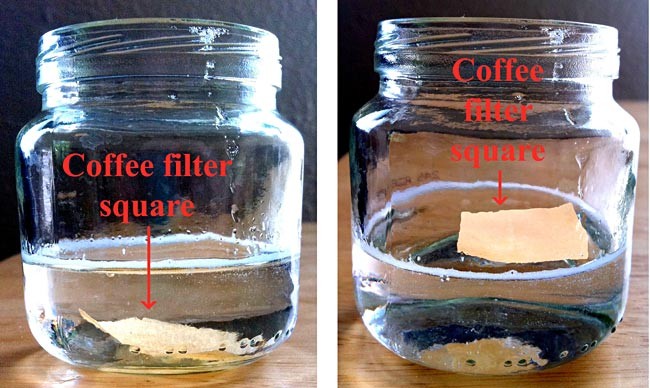 Figure 5. When the coffee filter square is soaked in the catalase solution and then dropped into the baby food jar with the hydrogen peroxide, it should initially sink (left) and then rise back to the surface of the hydrogen peroxide (right).
-
Ideally the coffee filter square should take about 20 seconds to rise at room temperature. If it takes less than 15 seconds or more than 25 seconds to rise, you will need to modify your catalase solution so that it takes between 15 to 25 seconds for the coffee filter square to rise.
- If it takes less than 15 seconds to rise, add 30 mL (2 tbsp.) of cold distilled water to your catalase solution, stir, and repeat steps 12 b to h. You may need to do this multiple times, adding cold distilled water until the filter square takes more than 15 seconds to rise.
- If it takes more than 25 seconds to rise, prepare and test the catalase solution again (repeating steps 5 to 12, as well as step 4 if more crushed ice is needed or it has melted) but skip step 10 so that the catalase solution is more concentrated.
- If you need to retest your catalase solution, make sure to use new hydrogen peroxide in step 12b each time.
- What do you think this says about how the concentration of an enzyme affects its activity?
- When you have finished testing your catalase solution, add more ice to the ice chest so that the catalase solution in the jar is still surrounded by ice.
/-/https/www.sciencebuddies.org/cdn/Files/2590/5/BioChem_img046.jpg)
Testing The Effect of Temperature on Enzyme Activity
After making the catalase enzyme solution and making sure that it works well at room temperature, you will investigate its activity at a range of different temperatures. The temperatures you will be testing are approximately 0 degrees C (in the freezer),10 degrees C (in the refrigerator), 20 degrees C (room temperature), 30 degrees C, and 40 degrees C. As before, you will soak a coffee filter square in the catalase solution and then time how long it takes to sink and rise in a jar of hydrogen peroxide. Make a table in your lab notebook to easily record your data. In addition, make sure you clean the baby food jars in between each test. You do not want the catalase left over from a previous test to influence the results of the next test. Read all of the instructions before you start, so that you can decide which will be the most efficient testing method for you.
-
First test the enzyme activity at approximately 0 degrees C.
- Fill the cleaned baby food jar with 40 mL (2¾ tbsp.) of hydrogen peroxide.
-
Put the thermometer in the jar with hydrogen peroxide.
- Make sure the thermometer's tip is submerged in the hydrogen peroxide and the thermometer is stable and will not fall out of the jar.
- Put the jar and thermometer in the freezer. Check the time or start a stopwatch or timer.
-
After the jar has been in the freezer for 10 minutes, check the temperature of the hydrogen peroxide. If it is between 1 to -1 degrees C, record the exact temperature in the data table in your lab notebook and then continue with step 1e.
- If the temperature is greater than 1 degrees C, keep the jar and thermometer in the freezer and check the jar every 5 minutes until the temperature is between 1 to -1 degrees C. Then continue with step 1e.
-
If the temperature is less than -1 degrees C, check for ice. The freezing temperature of hydrogen peroxide is -1 degrees C.
- If there is only a little ice and the hydrogen peroxide is still almost entirely liquid, take the jar and thermometer out of the freezer and break up the small ice pieces. As soon as there is no visible ice, make sure the temperature is between 1 to -1 degrees C and then continue with step 1e.
- If there is a significant amount of ice, take the jar and thermometer out of the freezer and leave them at room temperature to thaw. Stir and break up the ice pieces to help the hydrogen peroxide thaw faster. Check it every 5 minutes until the temperature is between 1 to -1 degrees and then continue with step 1e.
- Be sure to record the exact temperature of the hydrogen peroxide in the data table in your lab notebook before proceeding to step 1e.
- Test the enzyme activity just as you did in the "Making a Catalase Enzyme Solution" section in steps 12 c to g.
- How long did it take the coffee filter square to sink and rise again? Write the time (in seconds) in the table in your lab notebook.
-
Test the enzyme activity at approximately 10 degrees C.
- Repeat steps 1a to 1c, but this time put the jar and thermometer in the refrigerator instead of the freezer.
-
After the jar has been in the freezer for 20 minutes, check the temperature of the hydrogen peroxide. If it is between 9 to 11 degrees C, record the exact temperature in the data table in your lab notebook and then continue by repeating step 1e.
- If the temperature is greater than 11 degrees C, keep the jar and thermometer in the refrigerator and check the jar every 5 minutes until the temperature is between 9 to 11 degrees C and then repeat step 1e.
- If the temperature is less than 9 degrees C, take the jar and thermometer out of the refrigerator and leave them at room temperature. Check the temperature every 5 minutes and when it is between 9 to 11 degrees C repeat step 1e.
- In your lab notebook, write the time it took for the coffee filter square to sink and rise again, and the exact temperature of the hydrogen peroxide.
-
Test the enzyme activity at approximately 20 degrees C.
- Repeat step 1, but this time keep the jar and thermometer out at room temperature.
- If the jar and thermometer were already at room temperature, you do not have to wait 10 minutes before testing the enzyme activity and checking the temperature.
- In your lab notebook, write the time it took for the coffee filter square to sink and rise again, and the exact temperature of the hydrogen peroxide. It may not be exactly 20 degrees C.
-
Test the enzyme activity at approximately 30 degrees C.
- To do this you will be cooling down water from near-boiling state (well over 30 degrees C).
- Fill the cleaned baby food jar with 40 mL (2¾ tbsp.) of hydrogen peroxide.
- Fill a cooking pot with water to a depth of about 4 cm.
- Heat the pot of water on a stove or hot plate until the water just barely boils. Then immediately take the pot off the burner to let it cool.
-
Put the thermometer in the pot of water. When the water reaches approximately 40 degrees C, carefully put the jar with the hydrogen peroxide in the pot of water.
- Remove some water from the pot if the water level is so high that water might flow into the jar or if the jar floats, even a little.
- When the water reaches 30 degrees C, test the enzyme activity as you did in the "Making a Catalase Enzyme Solution" section in steps 12 c to g.
- How long did it take the coffee filter square to sink and rise again? Record this in the table in your lab notebook, along with the exact temperature of the water.
-
Test the enzyme activity at approximately 40 degrees C.
- To do this you will be cooling down water from near-boiling state (well over 40 degrees C).
-
Repeat step 4 with the following changes:
- On step 4d, when the water reaches 60 degrees C, carefully put the jar with the hydrogen peroxide in the pot of water.
- On step 4e, test the enzyme activity when the water reaches 40 degrees C (not 30 degrees C).
- In your lab notebook, record the time it took for the coffee filter square to sink and rise again, along with the exact temperature of the water.
-
Repeat steps 1 to 5 two more times.
- When performing science experiments, it is important to perform the experiment at least three times to make sure that your results are repeatable and reproducible.
- If you have multiple clean baby food jars, you can test multiple temperatures at the same time; however, testing multiple temperatures at the same time can get complicated.
- Note: It is important to test the enzyme activity at the various temperatures as close together in time as possible. If the tests cannot all be done in two to three hours, you will need to prepare and use a new catalase solution, because the original catalase solution may not be good anymore. After three hours you may notice a significant decrease in the enzyme's activity.
- For each temperature, calculate the average time it took for the coffee filter paper to sink and rise.
- Graph your results, plotting the temperature (in Celsius) on the x-axis and the time to resurface (in seconds) on the y-axis.
- At which temperature did the coffee filter squares take the most time to resurface? At which temperature did they take the least? What does this indicate about the enzyme's activity?
- Connect the points of data on your graph. Do they make a straight line or a curved line? What does this imply about the activity of the enzyme?
Making a Catalase Enzyme Solution
In this part of the project, you will make a catalase enzyme solution from a potato. You will also test the enzyme to make sure it is active at room temperature, and that its activity is not too high or too low at room temperature. The catalase solution should show a level of activity at room temperature that will give you enough range to see increases or decreases in the activity when you test it at other temperatures.
Note: It is best to make your catalase solution right before you plan to use it. The enzymes in the solution will begin to denature (or stop working) within a couple of hours, so you do not want to make this solution in advance.
- Put the distilled water in the refrigerator to cool it down while you get ready to use it.
-
Cut a coffee filter into small squares.
- Make each square 3 x 3 centimeters (cm).
- You will need at least 18 squares total.
- Fill the ice chest about 5 cm deep with ice. Close the ice chest.
-
Crush about eight ice cubes.
- Crush the ice in a 1 gallon sealable plastic bag using a hammer or wooden mallet so that the largest pieces are no longer than 2 cm.
- You will want to do this on a hard surface, such as concrete, and be careful not to damage it.
- When you have finished crushing the ice cubes, put the bag in the ice chest with the other ice.
-
Carefully peel a raw potato, cut it into small pieces, and weigh out 50 grams (g), as shown in Figure 2 below.
- Cut the potato so that no pieces are larger than 3 cm.
- To keep the potato pieces clean and uncontaminated, weigh them on a piece of wax paper. Make sure to zero out the scale with the wax paper on it before weighing out the 50 g of potato pieces on the wax paper.
- Place the potato pieces, 60 milliliters (mL) (¼ cup) of cold distilled water, and approximately 30 mL (2 tablespoons [tbsp.]) of crushed ice in a blender.
- Blend the potato pieces, distilled water, and crushed ice for 20 seconds at high speed.
-
If the blender jar is small enough to fit, put it inside of the small ice chest, surrounded by ice. This will keep the iced solution, which is the catalase solution, chilled.
- If the blender jar does not fit inside the ice chest, pour the blended, iced catalase solution into a large jar or cup and put it inside of the small ice chest, surrounded by ice. Alternatively, if you are ready, you can immediately proceed to step 9, but keep the catalase solution off of the ice for as little as possible.
- Rearrange the ice so that it completely surrounds the catalase solution container (but make sure no ice falls into the solution), as shown in Figure 3 below. Add more ice to the ice chest if needed.
- From this point on, leave the catalase solution in the ice in the small ice chest as much as possible.
- The activity of the catalase slowly decreases over time, and if it is not chilled the activity will decrease faster.
-
Over another large jar or cup (which should be able to stably hold at least 400 mL, or about 1 ¾ cups), place a coffee filter and carefully pour your catalase solution into the coffee filter, as shown in Figure 4 below. Hold the coffee filter over the new jar to make sure that it does not sink down into the jar. To give it more support, you could place the coffee filter in a funnel
and set it so that it drains into the new jar.
- Be careful not to pour too much catalase solution into the coffee filter at once or it might become too heavy or tear.
-
If you let the catalase solution filter for a few minutes and a lot of liquid is still trapped in the coffee
filter, get a new jar or cup and carefully and gently squeeze the liquid through the filter over the new jar.
- You will need to use a new jar in case the filter tears, releasing unfiltered pulp into the jar.
- When you have squeezed out most of the remaining liquid, pour the liquid from this new jar into the jar with the original filtered catalase solution. Pouring the liquid slowly can trap any unfiltered pulp (that may have accidentally spilled out) at the bottom of the jar.
- When you have filtered all of the catalase solution, discard the coffee filter.
- Add 175 mL (3/4 cup) cold distilled water to the filtered catalase solution. Mix well.
- Put the catalase solution back on ice. Add more ice to the ice chest so that the catalase solution in the jar is still surrounded by ice.
-
Test your catalase solution to see how well it works at room temperature.
- If the catalase enzyme works too quickly at room temperature, it will be hard to measure its activity as it increases at other temperatures. If the catalase works too slowly, then it will take a long time to measure its activity as it decreases at other temperatures.
-
In a clean baby 4 oz. food jar, add 40 mL (2 ¾ tbsp.) of hydrogen peroxide.
- Make sure the hydrogen peroxide is at room temperature for at least an hour before using it for this project.
- Have a stopwatch or timer ready.
- Using forceps or tweezers, immerse a 3 x 3 cm coffee filter square into the catalase solution and hold it immersed for five seconds.
- Remove the coffee filter square and drain off any excess catalase solution by touching an edge of the filter square to the inside of the catalase solution jar.
-
Lower the coffee filter square so that it is just above the surface of the hydrogen peroxide in the baby food jar, and then drop the coffee filter square.
- Releasing the coffee filter square from right above the surface of the hydrogen peroxide will help prevent the coffee filter square from sticking to the sides of the jar.
-
Once the coffee filter square touches the surface of the hydrogen peroxide, immediately start your stopwatch.
The filter square should sink, and then rise to the surface of the hydrogen peroxide again, as shown in Figure 5
below. Stop your stopwatch when the filter square reaches the surface again.
It is easiest to observe the filter square's movements from the side, instead of from above.
- Remove and dispose of the filter square, pour the hydrogen peroxide out of the jar, and rinse the jar with water.
-
Ideally the coffee filter square should take about 20 seconds to rise at room temperature. If it takes less than 15 seconds or more than 25 seconds to rise, you will need to modify your catalase solution so that it takes between 15 to 25 seconds for the coffee filter square to rise.
- If it takes less than 15 seconds to rise, add 30 mL (2 tbsp.) of cold distilled water to your catalase solution, stir, and repeat steps 12 b to h. You may need to do this multiple times, adding cold distilled water until the filter square takes more than 15 seconds to rise.
- If it takes more than 25 seconds to rise, prepare and test the catalase solution again (repeating steps 5 to 12, as well as step 4 if more crushed ice is needed or it has melted) but skip step 10 so that the catalase solution is more concentrated.
- If you need to retest your catalase solution, make sure to use new hydrogen peroxide in step 12b each time.
- What do you think this says about how the concentration of an enzyme affects its activity?
- When you have finished testing your catalase solution, add more ice to the ice chest so that the catalase solution in the jar is still surrounded by ice.
Testing The Effect of Temperature on Enzyme Activity
After making the catalase enzyme solution and making sure that it works well at room temperature, you will investigate its activity at a range of different temperatures. The temperatures you will be testing are approximately 0 degrees C (in the freezer),10 degrees C (in the refrigerator), 20 degrees C (room temperature), 30 degrees C, and 40 degrees C. As before, you will soak a coffee filter square in the catalase solution and then time how long it takes to sink and rise in a jar of hydrogen peroxide. Make a table in your lab notebook to easily record your data. In addition, make sure you clean the baby food jars in between each test. You do not want the catalase left over from a previous test to influence the results of the next test. Read all of the instructions before you start, so that you can decide which will be the most efficient testing method for you.
-
First test the enzyme activity at approximately 0 degrees C.
- Fill the cleaned baby food jar with 40 mL (2¾ tbsp.) of hydrogen peroxide.
-
Put the thermometer in the jar with hydrogen peroxide.
- Make sure the thermometer's tip is submerged in the hydrogen peroxide and the thermometer is stable and will not fall out of the jar.
- Put the jar and thermometer in the freezer. Check the time or start a stopwatch or timer.
-
After the jar has been in the freezer for 10 minutes, check the temperature of the hydrogen peroxide. If it is between 1 to -1 degrees C, record the exact temperature in the data table in your lab notebook and then continue with step 1e.
- If the temperature is greater than 1 degrees C, keep the jar and thermometer in the freezer and check the jar every 5 minutes until the temperature is between 1 to -1 degrees C. Then continue with step 1e.
-
If the temperature is less than -1 degrees C, check for ice. The freezing temperature of hydrogen peroxide is -1 degrees C.
- If there is only a little ice and the hydrogen peroxide is still almost entirely liquid, take the jar and thermometer out of the freezer and break up the small ice pieces. As soon as there is no visible ice, make sure the temperature is between 1 to -1 degrees C and then continue with step 1e.
- If there is a significant amount of ice, take the jar and thermometer out of the freezer and leave them at room temperature to thaw. Stir and break up the ice pieces to help the hydrogen peroxide thaw faster. Check it every 5 minutes until the temperature is between 1 to -1 degrees and then continue with step 1e.
- Be sure to record the exact temperature of the hydrogen peroxide in the data table in your lab notebook before proceeding to step 1e.
- Test the enzyme activity just as you did in the "Making a Catalase Enzyme Solution" section in steps 12 c to g.
- How long did it take the coffee filter square to sink and rise again? Write the time (in seconds) in the table in your lab notebook.
-
Test the enzyme activity at approximately 10 degrees C.
- Repeat steps 1a to 1c, but this time put the jar and thermometer in the refrigerator instead of the freezer.
-
After the jar has been in the freezer for 20 minutes, check the temperature of the hydrogen peroxide. If it is between 9 to 11 degrees C, record the exact temperature in the data table in your lab notebook and then continue by repeating step 1e.
- If the temperature is greater than 11 degrees C, keep the jar and thermometer in the refrigerator and check the jar every 5 minutes until the temperature is between 9 to 11 degrees C and then repeat step 1e.
- If the temperature is less than 9 degrees C, take the jar and thermometer out of the refrigerator and leave them at room temperature. Check the temperature every 5 minutes and when it is between 9 to 11 degrees C repeat step 1e.
- In your lab notebook, write the time it took for the coffee filter square to sink and rise again, and the exact temperature of the hydrogen peroxide.
-
Test the enzyme activity at approximately 20 degrees C.
- Repeat step 1, but this time keep the jar and thermometer out at room temperature.
- If the jar and thermometer were already at room temperature, you do not have to wait 10 minutes before testing the enzyme activity and checking the temperature.
- In your lab notebook, write the time it took for the coffee filter square to sink and rise again, and the exact temperature of the hydrogen peroxide. It may not be exactly 20 degrees C.
-
Test the enzyme activity at approximately 30 degrees C.
- To do this you will be cooling down water from near-boiling state (well over 30 degrees C).
- Fill the cleaned baby food jar with 40 mL (2¾ tbsp.) of hydrogen peroxide.
- Fill a cooking pot with water to a depth of about 4 cm.
- Heat the pot of water on a stove or hot plate until the water just barely boils. Then immediately take the pot off the burner to let it cool.
-
Put the thermometer in the pot of water. When the water reaches approximately 40 degrees C, carefully put the jar with the hydrogen peroxide in the pot of water.
- Remove some water from the pot if the water level is so high that water might flow into the jar or if the jar floats, even a little.
- When the water reaches 30 degrees C, test the enzyme activity as you did in the "Making a Catalase Enzyme Solution" section in steps 12 c to g.
- How long did it take the coffee filter square to sink and rise again? Record this in the table in your lab notebook, along with the exact temperature of the water.
-
Test the enzyme activity at approximately 40 degrees C.
- To do this you will be cooling down water from near-boiling state (well over 40 degrees C).
-
Repeat step 4 with the following changes:
- On step 4d, when the water reaches 60 degrees C, carefully put the jar with the hydrogen peroxide in the pot of water.
- On step 4e, test the enzyme activity when the water reaches 40 degrees C (not 30 degrees C).
- In your lab notebook, record the time it took for the coffee filter square to sink and rise again, along with the exact temperature of the water.
-
Repeat steps 1 to 5 two more times.
- When performing science experiments, it is important to perform the experiment at least three times to make sure that your results are repeatable and reproducible.
- If you have multiple clean baby food jars, you can test multiple temperatures at the same time; however, testing multiple temperatures at the same time can get complicated.
- Note: It is important to test the enzyme activity at the various temperatures as close together in time as possible. If the tests cannot all be done in two to three hours, you will need to prepare and use a new catalase solution, because the original catalase solution may not be good anymore. After three hours you may notice a significant decrease in the enzyme's activity.
- For each temperature, calculate the average time it took for the coffee filter paper to sink and rise.
- Graph your results, plotting the temperature (in Celsius) on the x-axis and the time to resurface (in seconds) on the y-axis.
- At which temperature did the coffee filter squares take the most time to resurface? At which temperature did they take the least? What does this indicate about the enzyme's activity?
- Connect the points of data on your graph. Do they make a straight line or a curved line? What does this imply about the activity of the enzyme?
Troubleshooting
For troubleshooting tips, please read our FAQ: Enzyme-Catalyzed Reactions— What Affects Their Rates?.

Ask an Expert
Global Goals
The United Nations Sustainable Development Goals (UNSDGs) are a blueprint to achieve a better and more sustainable future for all.
/-/https/www.sciencebuddies.org/cdn/Files/19746/5/E-WEB-Goal-03.png)
Variations
- How does the concentration of the enzyme affect its activity? To investigate this, make dilutions using cold distilled water and the catalase enzyme solution you made in this project, such as 75%, 50%, and 25% dilutions. (100% would be the undiluted solution, and 0% would be cold distilled water.) Test the enzyme activity of the different dilutions at room temperature and graph your results. How does the activity of the enzyme change as it becomes more and more dilute?
- Design and carry out an experiment to measure enzyme activity as a function of substrate (hydrogen peroxide) concentration. Graph your results. How does the concentration of the substrate appear to affect enzyme activity?
- Investigate what happens to enzyme activity if the catalase enzyme solution is subjected to conditions that denature proteins (e.g., boiling for five minutes). Does this completely stop the enzyme's activity?
- For other Science Buddies projects involving enzymes, see: Liver Stinks!, Which Fruits Can Ruin Your Dessert?, and A Juicy Project: Extracting Apple Juice with Pectinase.
- For a hands-on look at how enzymes are used in the real world, try the Turn Plants into Biofuel with the Power of Enzymes project which uses Bio-Rad's Biofuel Enzyme Kit.
Frequently Asked Questions (FAQ)
To fix this problem, redo the experiment with fresh catalase solution. Use the catalase solution as soon as you make it. If the experiment takes more than 2 hours, stop and make a new catalase solution and use it to finish the experiment. Running multiple tests at once will help you finish the experiment faster, but if you choose to run multiple tests at the same time, make sure you do not get them mixed up!
Another, more advanced, option would be to do the different temperatures in each of the three trials in a different order (e.g., cold to hot, hot to cold, etc.). This helps "spread out" the effects of decreasing enzyme activity.
If it has been more than 2 hours since you made the catalase solution, make a new catalase solution and continue the experiment. If you have already run a complete test of all temperatures, it is probably okay to use that data. But, if you have an incomplete set of data (you have not done all of the different temperatures), you may want to only use data you collected in the first 2 hours and re-run all of the later tests in that set. Make sure to write down everything you do in your lab notebook.
Ask an Expert
Careers
If you like this project, you might enjoy exploring these related careers:
/-/https/careerdiscovery.sciencebuddies.org/cdn/Files/947/17/pexels-photo-3825412.jpg)

/-/https/careerdiscovery.sciencebuddies.org/cdn/Files/962/18/pexels-photo-4299436.jpg)

/-/https/img.youtube.com/vi/3hoBwa0ccys/0.jpg)
/-/https/img.youtube.com/vi/oWlPOl1oYMY/0.jpg)
/-/https/img.youtube.com/vi/3eu5eAOOGOc/0.jpg)