/-/https/www.sciencebuddies.org/cdn/Files/21464/5/sb-logo.png)
/-/https/www.sciencebuddies.org/cdn/Files/21464/5/sb-logo.png)
Abstract
Imagine the ocean water turning bright red or seeing ocean waves glowing a beautiful blue color. Sounds impossible—but it is not! Red tides and glowing waves are caused by microscopic organisms living in the ocean called dinoflagellates. Some dinoflagellates have the ability to produce light through a process called bioluminescence. When and how do these organisms glow? In this science project, you will investigate how changing the dinoflagellate's exposure to light and dark affects its bioluminescence.Summary
David Whyte, PhD, Science Buddies
/-/https/www.sciencebuddies.org/cdn/Files/19646/4/bioluminescence-water.jpg)
Objective
To investigate how the bioluminescence of marine dinoflagellates is affected by changes to their light-dark cycle.
Introduction
The ocean is full of fascinating creatures. In addition to larger marine animals, there are billions of small and microscopic organisms in the sea. Many of these microorganisms are plankton, tiny plant-like organisms that float near the ocean surface. Plankton are an important food source for many small and large marine organisms. A common type of plankton are dinoflagellates, shown in Figure 1. Dinoflagellates are usually considered a type of algae and play an important role in the marine ecosystem.
/-/https/www.sciencebuddies.org/cdn/Files/19646/4/bioluminescence-water.jpg)
/-/https/www.sciencebuddies.org/cdn/Files/19642/6/CSIRO-dinoflagellate.jpg)
Figure 1. A scanning electron microscope image of dinoflagellates. Image credit: CSIRO, via Wikimedia Commons.
In addition to their role as a food source, dinoflagellates are also important oxygen producers through the process of photosynthesis. Photosynthetic organisms use sunlight, water, and carbon dioxide to produce oxygen and energy in the form of sugar. Oceanic plankton are responsible for the production of more than 50% of the oxygen on Earth!
Another interesting aspect of dinoflagellates is their ability to produce bioluminescence. Bioluminescence is the production and emission of light by a living organism as a result of a chemical reaction. Marine dinoflagellates are the main contributors to a phenomenon commonly known as the phosphorescence of the sea. When the concentration of these bioluminescent organisms in the water near shore is high, the wave crests glow with a luminous blue light (see Figure 2). Wet sand on the beach can even glow blue when you step on it if it is filled with enough dinoflagellates!
The reason that the light appears on wave crests and in the sand near your feet is that some bioluminescent organisms glow when they are subjected to mechanical stress. The dinoflagellates sense the pushing and pulling forces in the wave and your footsteps in the sand and respond by producing light. Scientists believe that the function of this glow is to distract predators, attract prey, and communicate with each other. To us, it makes for a beautiful show if you are lucky enough to witness it.
/-/https/www.sciencebuddies.org/cdn/Files/3822/5/BioChem_img036.jpg)
Figure 2. Bioluminescent dinoflagellates (a form of algae) caused the blue glow in this wave near Carlsbad, California. Image credit: Mike, via Wikimedia Commons.
There are many examples of bioluminescence in nature, with the most familiar being the firefly. Bioluminescence evolved independently in many different organisms. The chemical reaction that results in bioluminescence is the luciferin-luciferase reaction, shown in Figure 3, below. In this reaction, the enzyme luciferase oxidizes luciferin to convert chemical energy into light energy. Luciferase is an enzyme, a type of protein that speeds up chemical reactions. The reaction that luciferase catalyzes is the oxidation of luciferin by molecular oxygen (O₂) to form oxyluciferin plus light.
/-/https/www.sciencebuddies.org/cdn/Files/19643/6/luciferase-reaction.png)
Chemical equation shows that luciferase catalyzes luciferin and oxygen to form oxyluciferin and light
Figure 3. The luciferin-luciferase reaction.
The bioluminescence in dinoflagellates is regulated by their circadian rhythm. The circadian rhythm is a biological process that regulates the sleep and wake cycle, as well as other functions in living organisms. It works as an internal "body clock" that synchronizes an organism's body functions with the 24-hour cycle of day and light. Dinoflagellates typically produce bioluminescence at night when they are most active. As mentioned earlier, some dinoflagellates can also produce bioluminescence in response to mechanical stress.
One of the most famous examples of bioluminescent dinoflagellates is the "red tide" phenomenon, a massive bloom of a specific type of dinoflagellates. During the day, the dinoflagellates come to the water's surface to catch the sunlight for photosynthesis. This results in an intense reddish color giving the phenomenon the name "red tide." During the night, the red tide glows bright blue!
/-/https/www.sciencebuddies.org/cdn/Files/19644/6/Algal-bloom-Nagasaki.jpg)
Figure 4. This red tide, caused by dinoflagellates, was photographed in Isahaya Bay, Japan. Image credit: Marufish, via Wikimedia Commons.
In this science project, you will investigate how dinoflagellates, either the species Pyrocystis lunula (P. lunula) or Pyrocystis fusiformis, respond to changes in their light-dark cycle. You can purchase P. lunula and P. fusiformis as living cultures of cells in seawater. You do not need to feed them since they use light for photosynthesis to produce oxygen and food. The cultures can last several weeks to months. They need light to grow and prefer to remain between 68°F and 78°F. Ready to watch these beautiful creatures glow?
Terms and Concepts
- Plankton
- Dinoflagellates
- Photosynthesis
- Bioluminescence
- Phosphorescence of the sea
- Mechanical stress
- Luciferin-luciferase reaction
- Oxidize
- Enzyme
- Catalyze
- Circadian rhythm
- Pyrocystis lunula (P. lunula)
- Pyrocystis fusiformis
Questions
- How are dinoflagellates related to algae?
- How common is bioluminescence in living organisms?
- What are some examples of circadian cycles in marine organisms?
- Which chemical reaction is responsible for the bioluminescence in dinoflagellates?
- What is the "burglar alarm" hypothesis for why dinoflagellates glow in turbulent water?
Bibliography
- Hoppenrath, M. and Saldarriaga, J.F. (2009) Dinoflagellates. Retrieved May 17, 2023.
- University of California, Santa Barbara. (2009) The Bioluminescence Web Page. Retrieved May 17, 2023.
- Wilson, T. (2021) How Bioluminescence Works. Retrieved May 17, 2023.
- Scripps News (April 28, 2020) Everything You Wanted to Know About Red Tides. Retrieved May 17, 2023.
- Manoogian E. (April 30, 2019) Circadian Rhythms: What they are and why they matter . Retrieved May 17, 2023
Materials and Equipment
Note: You can use different types of dinoflagellates for this science project. Pyrocystis lunula or Pyrocystis fusiformis are both dinoflagellate species that have the ability to glow. The Pyrocystis cells can be obtained from the sources below:
- Living cultures of Pyrocystis cells.
- Pyrocystis fusiformis cells are available from Sunnyside Sea Farms. Order the cultures in 10-mL tubes. The cultures they offer in plastic bags are also suitable.
- Pyrocystis cells are available from Carolina (Item # 153305). The cultures are delivered in a 100 mL vial. You will need to transfer the culture into test tubes for your experiment.
- 15-mL test tubes (9), if you buy cultures that do not come in test tubes.
- 3-mL transfer pipette (1), if you buy cultures that do not come in test tubes
- Boxes with lids, opaque (3); each should be tall enough to hold one cup (with three test tubes inside) upright, with the lid tightly shut.
- Room with a temperature range of 68–78°F (20°–26°C)
- Glue or tape
- Plastic cups (3)
- Masking tape
- Permanent marker
- Aluminum foil
- Lamp with a compact fluorescent (CFL) or 25–40 watt LED bulb.
- Timer or clock
- A dark room or closet you can stand in while observing the bioluminescence
- Nightlight or a flashlight
- Lab notebook
- Graph paper
Disclaimer: Science Buddies participates in affiliate programs with Home Science Tools®, Amazon.com, Carolina Biological, and Jameco Electronics. Proceeds from the affiliate programs help support Science Buddies, a 501(c)(3) public charity, and keep our resources free for everyone. Our top priority is student learning. If you have any comments (positive or negative) related to purchases you've made for science projects from recommendations on our site, please let us know. Write to us at [email protected].
Experimental Procedure
/-/https/www.sciencebuddies.org/cdn/Files/20483/6/icon-flask.png)
Setting Up Your Cultures
- When the cultures arrive, their natural dark/light cycle will have been disturbed during shipment. You will need to adjust them to a new dark/light cycle before starting the experiment.
- Read the care instructions for the cultures carefully. Follow any directions that are sent with the cultures to get them started.
- If you buy cultures that do not come in test tubes, you will need to transfer your culture into test tubes.
- Rinse the test tubes with hot tap water before you use them and let them dry. Do not use any dish soap or other cleaning agents as the cultures are sensitive to these.
- Label nine test tubes with the culture name.
- Gently swirl the culture. With the transfer pipette, carefully transfer 10 mL culture from the vial into each test tube. Suck the culture liquid up slowly to reduce the stress on the organisms.
- You should have at least nine test tubes filled with 10 mL culture.
- Place all the culture test tubes in one or two plastic cups inside one of the cardboard boxes. Tape the cups to the box, so they do not fall over. Place the box with the cultures under a light with an LED or CFL light bulb. You can now close the lid of the box if you want to keep the cultures in the dark and open the lid of the box to expose the cultures to light.
- The type of light you use is important. The best lighting for optimum growth and health of the cells is a 25–40 watt LED bulb placed at least 1 meter from the flasks (Figure 5). You can place the lights on a timer for any length of time for experimentation purposes.
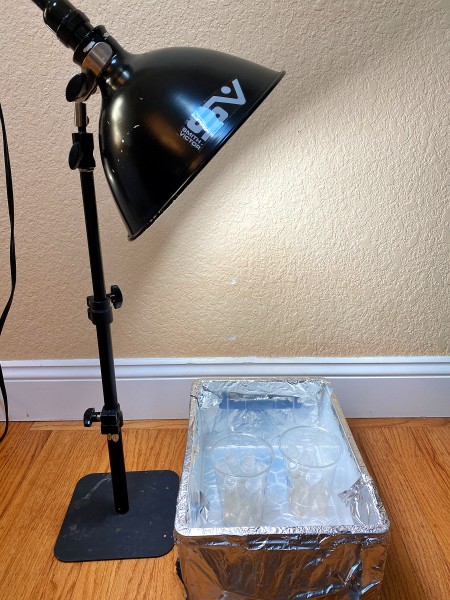
Figure 5. Lamp setup for the dinoflagellates experiment. - To adjust the cultures to a new dark/light cycle, keep the cultures in the dark during the daylight hours. This will allow you to study their bioluminescence (which typically happens during the dinoflagellate's dark cycle) during your normal waking hours. Our suggestion is to keep the cultures in the dark from 8:00 AM to 8:00 PM each day and in the light from 8:00 PM to 8:00 AM. If this timing does not fit with your family's schedule, you can vary it depending on your time availability. Make sure, however, that you keep a consistent 12 hours of light / 12 hours of dark schedule every day.
- Another important variable for the cultures is temperature. It should be between 68–78°F (20–26°C).
- Follow steps 1 and 2 of the "Making Observations" section below to check the cultures for bioluminescence every evening around 7:00 PM (or an hour before you switch to their light cycle). They should be most active at the end of their dark cycle. If they are glowing at this time for two days in a row, you are ready to start with your experiment. It can take up to a week for the cultures to get used to a new dark/light cycle. If they do not glow after more than 10 days at the new dark/light cycle, your culture might have died.

- To start your experiments, place one clean plastic cup in each of the three boxes near the middle. The cups will be used to keep the cultures upright. Glue or tape the cups in the boxes so that they won't fall over. Label the boxes as follows:
- Dark
- Light
- Light/Dark
- Label your nine culture test tubes as follows:
- A: Dark
- B: Dark
- C: Dark
- D: Light
- E: Light
- F: Light
- G: Light/Dark
- H: Light/Dark
- I: Light/Dark
- Wrap tubes A, B, and C in aluminum foil.
- These will be kept in constant darkness.
- Place tubes A, B, and C in the plastic cup in the box marked Dark. It is ok if the test tubes are not completely upright—leaning against the side of the cup is fine.
- Place the top on the Dark box and set it aside.
- Place tubes D, E, and F in the plastic cup in the box labeled Light. It is ok if the test tubes are not completely upright—leaning against the side of the cup is fine.
- Put the lamp with a compact fluorescent (CFL) or LED bulb in an area where it can stay on 24 hours a day.
- Place the Light box under the lamp.
- Turn on the lamp.
- Do not put the top on the Light box.
- These tubes will be kept in constant light.
- The cell cultures will be taken out of the light for brief periods of time, described later in the procedure, to determine if they will produce bioluminescence in response to mechanical stress.
- The Dark box should be placed next to the Light box, also under the lamp.
- Keep the boxes in the same area to minimize variations in temperature, etc.
- The boxes will be heated equally since they are both under the lamp.
- Keep the lid on the Dark box at all times so as not to expose these dinoflagellate cultures to any light.
- Place tubes G, H and I in the cup in the box labeled Light/Dark.
- These cultures will be kept in darkness for 12 hours of the day and in light for 12 hours of the day, and in light for part of the day.
- Keep tubes G, H, and I in the dark during the daylight hours and in the light during night.
- Cover tubes G, H, and I with aluminum foil in the morning. Place the wrapped tubes in the Light/Dark box and cover the box with the lid.
- Place the Light/Dark box near the other two boxes, also under the lamp.
- Unwrap tubes G, H, and I in the evening. Unwrap them at the same times each day. Our suggestion is to continue with the same dark/light cycle as before. For example, keeping them in the dark from 8:00 AM to 8:00 PM each day and in the light from 8:00 PM to 8:00 AM or whatever schedule you settled on previously.
- Expose the Light/Dark tubes to the lamp light during the night.
- Re-wrap them in aluminum foil in the morning and place the lid back on the Light/Dark box.
/-/https/www.sciencebuddies.org/cdn/Files/19645/6/dinoflagellates-lamp-setup.jpg)
/-/https/www.sciencebuddies.org/cdn/Files/19425/14/warning_outline_icon-red-small.png)
Making Observations
Now that you have your dinoflagellate cultures set up, you can determine how the light and dark conditions affect their bioluminescence. The bioluminescence of the cultures can be viewed in a darkened room.
Create a scale for how bright the cultures glow. You will rank the brightness on a scale from 1 to 4, with 4 being the brightest.
- Take the cultures into a dark room several times a day at the same times each day. You can have a dim light on, such as a nightlight or a flashlight, to help you work in the room. Keep the light several feet away from the cultures. Keep track of which tubes belong in which boxes.
- To make observations, you will need to unwrap the tubes wrapped with aluminum foil. Make sure to wrap them again afterward.
- To stimulate bioluminescence, make sure the caps are tight on the test tubes and, one at a time, turn the test tube upside down three times. You should see a clear blue light where the bubble in the tube is moving through the culture. This region has the highest mechanical stress. Do not shake the cultures too much, otherwise, they will die. Record your observations and brightness ranking in your lab notebook.
- Test all of the cultures for bioluminescence. Record all observations and brightness rankings in your lab notebook. Try to treat each tube in the same way so that you can compare the relative amount of light produced.
- Observe each of the cultures at least four times per day for five days. Space each observation several hours apart. Keep track of dates, times, and all data in your lab notebook.
- Make sure you observe the light/dark culture during both its light phase and its dark phase. Aim for once before the light cycle starts, twice during the light cycle and again after the dark cycle starts.
Analyzing Your Data
- Graph your data.
- Graph the time on the x-axis and the brightness score on the y-axis.
- Suggestion: Divide the x-axis into 24 hours, with noon in the middle. Mark the period of darkness for the light/dark cycle with a black rectangle under the x-axis. Add bars for the bioluminescent scores to the graph at the appropriate times. Use different colors for the all-light, all-dark, and light/dark cultures.
- How does varying their light exposure affect the bioluminescence of the dinoflagellates?
- Repeat the procedure at least two more times so that you have three sets of data. You can reuse the cultures you already have for the second and third trial.

Ask an Expert
Global Goals
The United Nations Sustainable Development Goals (UNSDGs) are a blueprint to achieve a better and more sustainable future for all.
/-/https/www.sciencebuddies.org/cdn/Files/19757/5/E-WEB-Goal-14.png)
Variations
- Switch the cultures that have been in constant light (or constant darkness) to the light/dark cycle. How long does it take for their bioluminescent cycle to become fully adjusted to the new light/dark timing? For example, switch a culture that has been in constant darkness for 3 days to a dark/light cycle, and then record its bioluminescence for 7 days. Make a new graph for each day.
- Look more carefully at when the cultures become bioluminescent in the light dark cycle. Check their bioluminescence every half hour two hours before and after you change to the dark or the light cycle. Graph your data.
- Try other light/dark cycles and determine how the Pyrocystis cells respond. For example, 4 hours of darkness, followed by 20 hours of light, or 8 hours light/16 hours of darkness. How quickly do the cultures respond to a change in the light/dark cycle?
- Borrow some beakers, magnetic stir plate, and some stir bars from your school lab and investigate how the rate of rotation of the stir bar affects the amount of light produced. Set up an electronic measuring device to measure the light produced (see the Science Buddies project How Bright Is Your Glow Stick? Measure It! for an example circuit).
- Study the dinoflagellates under a microscope. Can you see any microscopic changes that follow a circadian rhythm? If so, what affect does altering the light/dark cycles have on these changes?
Careers
If you like this project, you might enjoy exploring these related careers:
/-/https/careerdiscovery.sciencebuddies.org/cdn/Files/1416/17/unsplash-FY3vXNBl1v4.jpg)

/-/https/careerdiscovery.sciencebuddies.org/cdn/Files/947/17/pexels-photo-3825412.jpg)

/-/https/img.youtube.com/vi/QBRy_9f5sps/0.jpg)
/-/https/img.youtube.com/vi/-vTBn11SE9c/0.jpg)
/-/https/img.youtube.com/vi/XwJQJnY6iUs/0.jpg)