/-/https/www.sciencebuddies.org/cdn/Files/21464/5/sb-logo.png)
/-/https/www.sciencebuddies.org/cdn/Files/21464/5/sb-logo.png)
Abstract
Have you ever wondered why silver jewelry that starts out nice and shiny turns brownish-black and dull over time? The brownish-black stuff is called silver tarnish, and it is the result of a chemical reaction on the silver's surface. Luckily, there are many ways to clean tarnished silver and make it shiny again! In this science project, you will explore how to clean tarnished silver using electrochemistry. The electrochemical silver cleaning reaction requires aluminum and a salt solution. Your task will be to find out how much salt you need to get the reaction going. Once you have optimized the reaction, you can use it on your own tarnished silver pieces.Summary
/-/https/i.ytimg.com/vi/tl73_mQ60Zc/maxresdefault.jpg)
Objective
To investigate the effect of the electrolyte concentration on the electrochemical silver cleaning reaction.
Introduction
/-/https/www.sciencebuddies.org/cdn/Files/19656/6/tarnished-silver-spoons-thumbnail.jpg)
When you think of silver, you probably picture shiny jewelry, coins, or silverware. Silver has been used for thousands of years to make valuable objects like the ones shown in Figure 1. This is because silver is a precious metal. It is not only beautiful to look at, with its shiny surface, but it is also fairly rare and very long-lasting.
/-/https/www.sciencebuddies.org/cdn/Files/19655/6/silver-objects-three.jpg)
Figure 1. A ceremonial cup (left), silverware (middle top), jewelry (middle bottom), and coins (right) are all valuable objects made of silver.
Silver has one major drawback, though. It does not stay shiny for long. If you have silver jewelry or other silver objects in your home, you might have noticed that over time the silvery shine disappears and the surface of the silver becomes brownish-black and dull, as shown in Figure 2. The dark coating is silver sulfide (Ag2S), also known as silver tarnish, and it is the result of a chemical reaction between silver, oxygen from the air, and sulfur-containing gases from atmospheric pollution, as shown in Equation 1.
Equation 1:/-/https/www.sciencebuddies.org/cdn/Files/19657/6/tarnished-silver-spoons.jpg)
Figure 2. Silver spoons covered in silver tarnish.
The silver tarnishing reaction is a special type of chemical reaction called a reduction-oxidation (redox) reaction. Redox reactions are chemical reactions that involve the transfer of electrons (negatively charged particles) from one reaction partner to another. The flow of electrons creates an electric current, or electricity. Many batteries run on redox reactions in which chemical energy is converted to electrical energy. In the silver tarnishing reaction, silver loses electrons. Those electrons are transferred to the oxygen. You can find details on the electron transfer processes in the silver tarnishing reaction in the Technical Note.
Once silver is tarnished, how can you get rid of the dark coating and make it shiny again? For many generations, the solution was to rub the tarnish off the silver mechanically. This meant hours and hours of scrubbing with a silver polish that worked similarly to very fine-grained sandpaper. Today silver is mostly cleaned chemically. Chemical dips used to clean silver contain chemicals that dissolve the silver sulfide.
With polishing and chemical dips, a small amount of the silver is lost in the cleaning process. You might wonder if there is a way to reverse the chemical reaction that made the silver tarnish instead. Yes, there is! This method is called electrochemical silver cleaning, and it uses electrochemistry. Electrochemistry is a branch of chemistry that studies how chemical processes like redox reactions relate to electricity. Using electrochemistry, we can give the electrons that the silver has lost in the tarnishing process back to the silver! This means that no silver is lost during the silver cleaning. But how can we do that?
Electrochemical silver cleaning makes use of the fact that different metals have different tendencies to lose or gain electrons (Figure 3). The tendency of a metal to either gain or lose electrons in a reaction is measured by its redox potential. The redox potentials of different metals vary (Figure 3). Some metals want to give off free electrons, and others want to receive electrons. One metal that tends to lose electrons easily is aluminum. Aluminum also has a higher affinity to sulfide than silver does. This means if you put tarnished silver in contact with aluminum in a salt solution, the following reaction happens.
Equation 2:As you can see from the equation, in the reaction, the sulfur atoms transfer from the silver to the aluminum, forming aluminum sulfide. In the process, the aluminum loses electrons. At the same time, the silver receives electrons from the aluminum and is freed from the sulfide. For this reaction to happen, it is important that the silver and aluminum touch each other so the electrons can flow between them. The flow of electrons from the aluminum to the silver results from the redox potential difference (or voltage) between the two metals. Since this silver cleaning reaction results in an electric current, this setup could be called a "silver cleaning battery."
/-/https/www.sciencebuddies.org/cdn/Files/19658/6/electrochemical-series.png)
Figure 3. The electrochemical series is an arrangement of metals according to their redox potential, or the tendency to lose electrons to form positive ions. (s = solid, aq = aqueous, e = electron)
We also need the salt solution in order to keep the electrons flowing between the silver and aluminum, because it contains ions, which are electrically charged particles that can conduct electricity. Ions conduct electricity in solution because they can move. For example, in water with table salt (NaCl), conductivity comes from moving sodium (Na+) and chloride (Cl-) ions. If you have more ions in the solution, the electrical conductivity of the solution increases. In electrochemistry, a solution that conducts electricity is called an electrolyte. An electrolyte is important because it allows ions to move between the two metals to balance out the charges of the electrochemical reaction. In the silver cleaning reaction, the electrolyte also allows the aluminum cations and the sulfide anions generated during the redox reaction to move freely between the two metals. Again, you can find more details on the electrochemical reactions in the Technical Note.
In this science project, you will investigate how important the salt solution is for electrochemical silver cleaning. As mentioned above, the electrolyte must contain electrically charged particles (ions) in order to carry charges from one metal to another. What if the electrolyte solution does not contain any ions or only contains a few? You will find out by changing the salt concentration of the electrolyte in your silver cleaning reaction. How do you think this will affect the silver cleaning process?
Silver tarnishing reaction
Let's have a look at what happens in the silver tarnishing reaction on a molecular level. When silver (Ag) reacts with oxygen (O2) in the presence of hydrogen sulfide (H2S), it gets oxidized. In chemistry, oxidation means losing electrons. Electrons are particles that have a negative electric charge. Thus, by losing an electron, the silver becomes a positively charged silver ion, also called a cation (Equation 3).
Equation 3:The silver cations bond with the negatively charged sulfur anions from the hydrogen sulfide gas (H2S) in the air to create silver sulfide (Ag2S), which makes the black tarnish on the silver surface (Equation 4).
Equation 4:Since electrons transfer between the silver and oxygen in this reaction, it is a reduction-oxidation (redox) reaction.
Now let's look into the electrochemical reactions happening during the silver cleaning process.
Once in contact with the electrolyte (salt solution), the aluminum metal loses its electrons and is oxidized to form aluminum ions (Equation 5) that are released into the electrolyte.
Equation 5:The silver sulfide on the surface of the silver object receives the electrons from the aluminum and is reduced to solid silver (Equation 6). A reduction in electrochemistry refers to the gain of electrons.
Equation 6:The aluminum ions then bond with the sulfide ions to create aluminum sulfide (Equation 7).
Equation 7:Equation 8 summarizes all these individual reactions and represents the combined redox reaction happening during silver cleaning.
Equation 8:Now we have discussed the redox reaction that happens during silver cleaning and explained how the transfer of electrons between the individual reaction partners restores the silver. However, there is a second reaction happening together with the redox reaction. This reaction is called a hydrolysis reaction. A hydrolysis reaction is a chemical reaction where water breaks down the chemical bonds that exist between a particular substance—in this case, aluminum sulfide. In the presence of water, the aluminum sulfide will immediately hydrolyze to form aluminum hydroxide and hydrogen sulfide, as shown in Equation 9.
Equation 9:This is why sometimes the overall reaction of the electrochemical silver cleaning is written as shown in Equation 10.
Equation 10:You should be able to smell the hydrogen sulfide gas produced during the silver cleaning. It has a strong odor similar to rotten eggs.
Figure 4 summarizes the reactions that occur during the electrochemical silver cleaning.
/-/https/www.sciencebuddies.org/cdn/Files/19659/8/diagram-electrochemical-silver-cleaning.png)
Figure 4. Diagram of the electrochemical reactions that occur during the silver cleaning process.
Terms and Concepts
- Silver tarnish
- Reduction-oxidation (redox) reaction
- Electron
- Electric current
- Electrochemistry
- Redox potential
- Voltage
- Electric current
- Electrochemical series
- Ion
- Conductivity
- Electrolyte
- Oxidation
- Cation
- Anion
- Reduction
- Hydrolysis
- Passivation
Questions
- Why does silver turn black over time?
- What are the different methods to clean tarnished silver?
- What is a redox reaction?
- What are the chemical reactions that happen during electrochemical silver cleaning?
- What is the function of an electrolyte?
Bibliography
- Inaba, M. (1996). Tarnishing of Silver: A Short Review. Victoria and Albert Museum. Retrieved May 15, 2023.
- Selwyn, L. (2019). Silver - Care and Tarnish Removal. Canadian Conservation Institute. Retrieved May 12, 2023.
- Specialty Steel Industry of North America. (n.d.) Galvanic Corrosion. Retrieved May 12, 2023.
Materials and Equipment
- Silver rounds (10). Ideally, you want to use the same-sized silver object for each experiment.
- Nitrile gloves
- Rubbing alcohol
- Paper towel
- Dish soap
- Eggs (9)
- Pot
- Water
- Stove
- Measuring cup
- Resealable plastic bags (3)
- Aluminum foil. The aluminum should not be coated, but pure aluminum.
- Shallow plastic or glass container, about 4 inch x 4 inch size, that can fit 1 cup of water
- Table salt (sodium chloride), about 10 grams
- Small bowl
- Distilled water, 1 gallon
- Immersion thermometer
- Plastic spoon
- Camera or smartphone
- Timer
- Pen or pencil
- Lab notebook
Disclaimer: Science Buddies participates in affiliate programs with Home Science Tools®, Amazon.com, Carolina Biological, and Jameco Electronics. Proceeds from the affiliate programs help support Science Buddies, a 501(c)(3) public charity, and keep our resources free for everyone. Our top priority is student learning. If you have any comments (positive or negative) related to purchases you've made for science projects from recommendations on our site, please let us know. Write to us at [email protected].
Experimental Procedure
/-/https/www.sciencebuddies.org/cdn/Files/20483/6/icon-flask.png)
Tarnishing the Silver
The benefit of using the silver rounds listed in the Materials and Equipment section is that you will have the same size object for each experiment. You can create silver tarnish on the silver rounds by following the steps below or watching the silver tarnish video.
- Put on the nitrile gloves. You want to handle the silver rounds with gloves to prevent any grease from your skin from getting on the silver surface.
- Clean all 10 silver rounds with warm water and a little bit of dish soap. Dry the silver pieces with a paper towel.
- Pour a little of the rubbing alcohol onto a paper towel and clean your silver rounds with it. The alcohol will remove grease from the silver's surface.
- Boil nine eggs for about 15 to 20 minutes in a pot of water.
- While the eggs are boiling, prepare three resealable plastic bags.
- Take the boiled eggs out of the water and, while still hot, remove their shells. Place three eggs in each resealable plastic bag.
- Seal the plastic bags and mash the eggs with your hands, breaking them into small pieces. The egg yolks naturally contain sulfur and will release hydrogen sulfide gas, which will initiate the silver tarnishing reaction.
- Open the plastic bags. Put a piece of paper towel next to the mashed eggs in each plastic bag. Place three silver rounds on top of the paper towel in each bag, ensuring that the rounds do not touch the eggs, and seal the plastic bags again (Figure 5). Keep one silver round untarnished as a control for comparisons later.
- Leave the silver rounds in the plastic bags overnight.
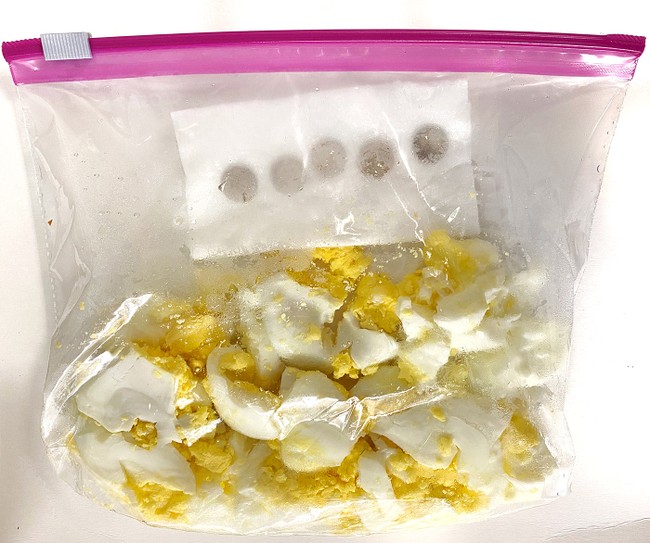
Figure 5. The hydrogen sulfide from the eggs will tarnish the silver rounds. Note: In this picture, there are five silver rounds in the bag. You will only place three silver rounds in each bag. - Remove the silver rounds from the bags. The color of their surface should have changed from shiny silver to yellow, reddish-brown, or black, as shown in Figure 6. This is the silver tarnish produced in the presence of hydrogen sulfide from the egg.
- If you do not see any silver tarnish, leave the silver rounds in the plastic bag with the eggs longer. If one or more silver rounds are less tarnished than the others, put them back into their bags until all the tarnishes look similar. You want to start out with silver rounds that have about the same amount of tarnish so you can compare the different experimental conditions.
- Briefly rinse all the tarnished silver rounds with water and wipe them with a paper towel to remove any egg from their surface. Figure 6 shows an example of tarnished silver rounds. Yours might look a bit different.
/-/https/www.sciencebuddies.org/cdn/Files/19663/6/silver-rounds-with-eggs.jpg)
/-/https/www.sciencebuddies.org/cdn/Files/19664/6/tarnished-silver-rounds.jpg)
Figure 6. Tarnished silver rounds.
Conducting the Electrochemical Silver Cleaning
In this project, you will make your electrolyte by adding table salt to distilled water. In the water, the salt will form ions that make the electrolyte conductive. You will measure how long it takes for tarnished silver to get clean, depending on the electrolyte concentration. Follow the steps below or watch the silver tarnish video.
- Make a data table like Table 1 to record your data.
| Water temperature (°C) | 0 g salt | 0.2 g salt | 2 g salt | |
|---|---|---|---|---|
| Measured time Trial 1 | ||||
| Measured time Trial 2 | ||||
| Measured time Trial 3 | ||||
| Average measured time |
- Cut a roughly 10 cm x 10 cm (4 inch x 4 inch) piece of aluminum foil to fit the measurements of your container. Crumple the piece of aluminum into a ball and then open it up again into a flat sheet. The crumpling helps crack the non-reactive oxide layer on the aluminum's surface, which forms due to a spontaneous oxidation of the aluminum in the presence of oxygen in the air. This process is called passivation.
- Line the bottom of your container or tray with the aluminum sheet. Make sure the shiny side of the aluminum foil is facing up. Flatten the aluminum piece with your fingers. It should be as flat as possible to create a good contact surface for the tarnished silver rounds (Figure 7).
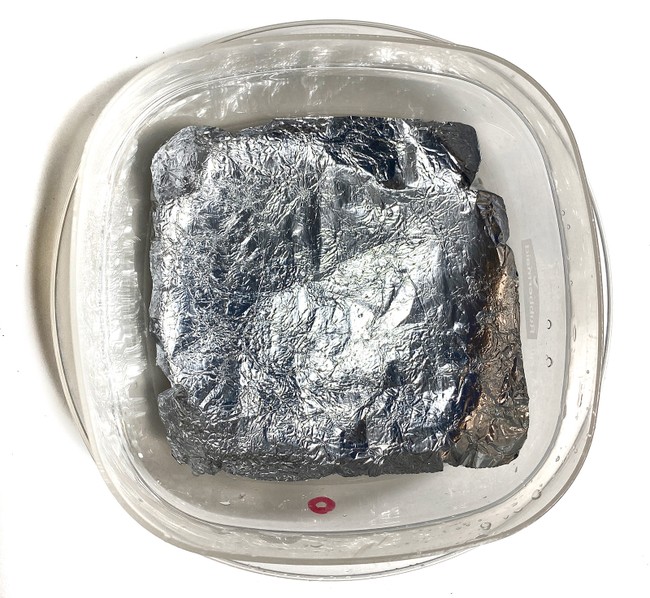
Figure 7. Container lined with a piece of aluminum foil. - Choose one of the tarnished silver rounds and place it next to the untarnished silver round. Take a "before cleaning" picture of both silver rounds next to each other. You might want to use it for your display board. Keep the untarnished silver round next to your container. You will need it to decide when your tarnished silver is clean again.
- The silver cleaning reaction can happen very fast. To get a good time measurement, you will do a video recording of the reaction. Place a camera or smartphone so that it shows a closeup of the container with the aluminum foil, as shown in Figure 7.
- Weigh 2 g of table salt into a small bowl and add it to the container.
- Boil one cup of distilled water in a pot. Once it is boiling, immediately add it to the container with the aluminum foil. Mix with a plastic spoon until all the salt has dissolved.
- Measure the temperature of the water. It should be around 70°C (176°F). Record the temperature in your data table and immediately continue with the next step. You want to start the reaction while the water is still hot.
- At the same time, start your timer and place your chosen tarnished silver round on top of the aluminum foil in the solution. Make sure the silver round lies flat on the aluminum foil (Figure 8). Press the silver round slightly onto the aluminum foil so it makes good contact. Good contact between the two metals is important for the reaction to happen.
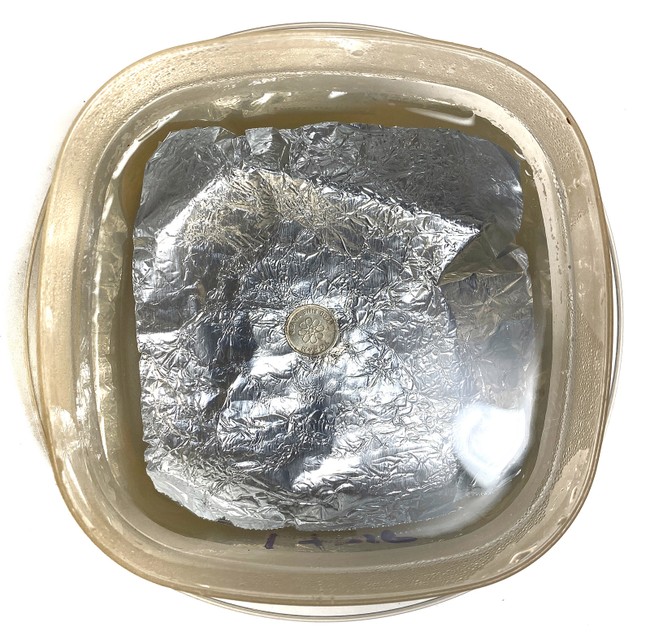
Figure 8. Close-up view of the silver round on top of the aluminum foil in the electrolyte solution. - Observe the silver round in the solution closely. If the silver cleaning reaction occurs, it can happen within seconds, minutes, or hours, depending on the reaction conditions. As soon as the silver round in the container looks the same as the untarnished silver round (control), stop the timer and stop the camera recording. Note: If the silver cleaning takes longer than 30 minutes, stop the video recording and continue using your timer to measure the cleaning time. Check on the silver round every 5 minutes and stop the timer when it looks shiny again. If no reaction has occurred within 2 hours, stop the timer and record the cleaning time as greater than 2 hours (7,200 seconds) in your data table.
- Take the silver round out of the solution. Compare it to the untarnished silver round. Write your observations in your lab notebook. Take an "after cleaning" picture of the cleaned and untarnished silver rounds next to each other. Make sure to label them in the picture so you know which one is which. You might want to use it for your display board.
- If you used your timer to measure the silver cleaning time, record the silver cleaning time in your data table. If you used the video to record the silver cleaning time, you will need to get the silver cleaning time from the video.
- View the video. Write down the time when the tarnished silver round first touched the aluminum foil and the time when the tarnish was fully removed from the silver round.
- Calculate the difference between these two times. This is your silver cleaning time. For example, if in the video the silver round first touched the aluminum foil at 1:28 minutes video runtime (88 seconds) and the silver tarnish was fully removed at 1:58 video runtime (118 seconds), then the silver cleaning time in the video was 118 s - 88 s = 30 seconds.
- Record the cleaning time in seconds in your data table.
- Clean out your container. Rinse it with water and dry it with a cloth or paper towel. Before you discard the aluminum foil, have a close look at it. Compare it to a new piece of aluminum. Did its appearance change during the chemical reaction? If yes, can you explain why?
- Repeat steps 2–14 two more times with the same electrolyte concentration and two new tarnished silver rounds. Make sure the water temperature is the same as for the previous trial.
- Now you will lower the electrolyte concentration. Repeat steps 2–14 three times with a different tarnished silver round for each trial. This time, instead of 2 g salt, use 0.2 g salt to make your electrolyte.
- Finally, repeat steps 2–15 another three times, but this time add no salt to the electrolyte and just use distilled water.
/-/https/www.sciencebuddies.org/cdn/Files/19665/6/container-aluminum-foil.jpg)
/-/https/www.sciencebuddies.org/cdn/Files/19666/6/container-aluminum-foil-silver-round.jpg)
Analyzing Your Data
- Review the results in your data table. Calculate the average silver cleaning time from all your three trials.
- Add the times for all three trials and divide the result by three.
- Record your results in the data table.
- Repeat the average calculation for each electrolyte concentration.
- Visualize your data by making a bar graph. Put the salt concentration on the x-axis (horizontal axis) and the silver cleaning time in seconds on the y-axis.
- Use your data and graph to answer the following questions.
- How did the silver cleaning time change with different electrolyte concentrations?
- Based on your results, how important do you think the salt concentration or conductivity of the electrolyte is for the silver cleaning reaction?
- What happened when the electrolyte was not electrically conductive at all?
- Is there a possibility that other factors could have affected your test results? If yes, which ones?

Ask an Expert
Global Goals
The United Nations Sustainable Development Goals (UNSDGs) are a blueprint to achieve a better and more sustainable future for all.
/-/https/www.sciencebuddies.org/cdn/Files/19752/5/E-WEB-Goal-09.png)
Variations
- The results of your project gave you a pretty good idea of how the electrolyte concentration affects the silver cleaning time. Temperature is another factor that affects the electrochemical reaction. Repeat the experiment and test different electrolyte temperatures. How does the silver cleaning time change if the electrolyte solution is cold versus hot?
- You might have found that even a little salt is enough to get the silver cleaning reaction going. Try to find out how much salt is actually needed for a reaction to occur. Decrease the salt concentrations even further. How low can you go?
- Table salt is just one possibility to make the electrolyte conductive. Try other salts, like baking soda or Epsom salt. Do these also work? How does your reaction change with different salts?
- Do you have tarnished silver jewelry at home? Instead of tarnishing the silver rounds and using these for this science project, use the silver cleaning battery to make your jewelry shiny again!
- What happens if you replace the aluminum with another metal? Can you also remove silver tarnish by placing the silver pieces on copper or stainless steel sheets? Test it to find out! You might want to research the redox potentials of metals and review the electrochemical series to find their standard reduction potentials to make sense of your results.
- If you are wondering what other types of chemical reactions can be turned into electrical energy, you might be interested in these other battery projects from Science Buddies:
Careers
If you like this project, you might enjoy exploring these related careers:
/-/https/careerdiscovery.sciencebuddies.org/cdn/Files/1107/19/pexels-photo-3938023.jpg)

/-/https/careerdiscovery.sciencebuddies.org/cdn/Files/20209/5/chemical-engineer-citgo.jpg)
/-/https/careerdiscovery.sciencebuddies.org/cdn/Files/1429/17/unsplash-4pM4nhHyo9M.jpg)
/-/https/careerdiscovery.sciencebuddies.org/cdn/Files/1223/17/iStock-971549326.jpg)

/-/https/img.youtube.com/vi/s2Jud7F478I/0.jpg)
/-/https/img.youtube.com/vi/_uruQS6EJyI/0.jpg)
/-/https/img.youtube.com/vi/ugv0iWn4G2U/0.jpg)