/-/https/www.sciencebuddies.org/cdn/Files/21464/5/sb-logo.png)
/-/https/www.sciencebuddies.org/cdn/Files/21464/5/sb-logo.png)
Abstract
This is a simple "kitchen chemistry" project about acid/base chemistry. Scientists measure the acidity or alkalinity of a solution using a logarithmic scale called the pH scale. In this project you'll learn about the pH scale, and you'll make your own pH indicator paper using a pH-sensitive dye that you'll extract from red cabbage. You can use your pH paper to measure the acidity/alkalinity of various household solutions.Summary
Andrew Olson, Ph.D., Science Buddies
/-/https/www.sciencebuddies.org/cdn/Files/3095/5/Chem_img124.png)
Objective
The goal of this project is to make your own pH indicator paper, and use it to measure the acidity and alkalinity of various solutions from around your house.
Introduction
In this project you will learn how to make your own pH paper that you can use to find out if a solution is acidic or basic (alkaline). What does it mean for a solution to be acidic or alkaline?
It all has to do with hydrogen ions (abbreviated with the chemical symbol H+). In water (H2O), a small number of the molecules dissociate (split up). Some of the water molecules lose a hydrogen and become hydroxyl ions (OH−). The "lost" hydrogen ions join up with water molecules to form hydronium ions (H3O+). For simplicity, hydronium ions are referred to as hydrogen ions H+. In pure water, there are an equal number of hydrogen ions and hydroxyl ions. The solution is neither acidic or basic.
An acid is a substance that donates hydrogen ions. Because of this, when an acid is dissolved in water, the balance between hydrogen ions and hydroxyl ions is shifted. Now there are more hydrogen ions than hydroxyl ions in the solution. This kind of solution is acidic.
A base is a substance that accepts hydrogen ions. When a base is dissolved in water, the balance between hydrogen ions and hydroxyl ions shifts the opposite way. Because the base "soaks up" hydrogen ions, the result is a solution with more hydroxyl ions than hydrogen ions. This kind of solution is alkaline.
Acidity and alkalinity are measured with a logarithmic scale called pH. Here's why: A strongly acidic solution can have one hundred million million (100,000,000,000,000) times more hydrogen ions than a strongly basic solution! The flip side, of course, is that a strongly basic solution can have 100,000,000,000,000 times more hydroxide ions than a strongly acidic solution. Moreover, the hydrogen ion and hydroxide ion concentrations in everyday solutions can vary over that entire range. In order to deal with these large numbers more easily, scientists use a logarithmic scale, the pH scale. Each one-unit change in the pH scale corresponds to a ten-fold change in hydrogen ion concentration. The pH scale ranges from 0 to 14. It's a lot easier to use a logarithmic scale instead of always having to write down all those zeros! By the way, notice how one hundred million million is a one with fourteen zeros after it? It's not coincidence, it's logarithms!
To be more precise, pH is the negative logarithm of the hydrogen ion concentration:
The square brackets around the H+ automatically mean "concentration" to a chemist. What the equation means is just what we said before: for each 1-unit change in pH, the hydrogen ion concentration changes ten-fold. Pure water has a neutral pH of 7. pH values lower than 7 are acidic, and pH values higher than 7 are alkaline (basic). Table 1 has examples of substances with different pH values (Decelles, 2002; Environment Canada, 2002; EPA, date unknown).
Table 1. The pH Scale: Some Examples
| pH Value | H+ Concentration Relative to Pure Water |
Example |
| 0 | 10 000 000 | battery acid |
| 1 | 1 000 000 | sulfuric acid |
| 2 | 100 000 | lemon juice, vinegar |
| 3 | 10 000 | orange juice, soda |
| 4 | 1 000 | tomato juice, acid rain |
| 5 | 100 | black coffee, bananas |
| 6 | 10 | urine, milk |
| 7 | 1 | pure water |
| 8 | 0.1 | sea water, eggs |
| 9 | 0.01 | baking soda |
| 10 | 0.001 | Great Salt Lake, milk of magnesia |
| 11 | 0.000 1 | ammonia solution |
| 12 | 0.000 01 | soapy water |
| 13 | 0.000 001 | bleach, oven cleaner |
| 14 | 0.000 000 1 | liquid drain cleaner |
In this project you will make your own pH paper from a colored indicator that you will extract from red cabbage by cooking it in water. Once you have the indicator solution, you can soak some lab filter paper in it. Then allow the paper to dry. When the paper is dry, you can cut it into strips, and you'll have pH paper that will change color. It will turn greenish when exposed to bases, and reddish when exposed to acids. How green or how red? That's your job! Use different solutions that you have around the house to find out how the color change corresponds to changes in pH.
Terms and Concepts
To do this project, you should do research that enables you to understand the following terms and concepts:
- Acids
- Bases
- Logarithms
- pH
- pH indicators
Questions
- What value of pH is neutral?
- What range of pH values is acidic?
- What range of pH values is basic?
- What color is red cabbage pH paper when dipped in acidic solutions?
- What color is red cabbage pH paper when dipped in basic solutions?
Bibliography
References about acids, bases and the pH scale:
- Science Buddies Staff (2012). Acids, Bases, and the pH Scale. Retrieved July 15, 2021.
- Bogren, S. et al. (n.d.). Acids, Bases and pH Scale. Retrieved July 14, 2021.
This document (which you'll need to save on you computer to view) has instructions for making several different-colored pH indicators, including beet juice, phenolphthalein (from laxative tablets), red cabbage, and turmeric:
- Massengale, C. (n.d.). Making pH Indicators. Retrieved July 22, 2010.
These webpages have a quick review of exponents and logarithms:
- University of Minnesota. (2004). What Is an Exponent?. Retrieved July 12, 2007.
- University of Minnesota. (2004). What Is a Logarithm?. Retrieved July 12, 2007.
Materials and Equipment
To do this experiment you will need the following materials and equipment:
- Red cabbage leaves
- 1-quart cooking pot
- Water
- 1-quart bowl
- Strainer
- Lab filter paper; can be ordered from our partner Amazon.com. Note: Coffee filter paper will not work. For more information on which papers will and won't work, see our Paper Chromatography Resources guide.
- Acidic and basic solutions to test, for example:
- Lemon juice, vinegar
- Orange juice, soda
- Tomato juice, acid rain
- Black coffee, bananas
- Milk, saliva
- Pure water
- Sea water, eggs
- Baking soda solution
- Milk of magnesia
- Ammonia solution
- Soapy water
Disclaimer: Science Buddies participates in affiliate programs with Home Science Tools®, Amazon.com, Carolina Biological, and Jameco Electronics. Proceeds from the affiliate programs help support Science Buddies, a 501(c)(3) public charity, and keep our resources free for everyone. Our top priority is student learning. If you have any comments (positive or negative) related to purchases you've made for science projects from recommendations on our site, please let us know. Write to us at [email protected].
Experimental Procedure
/-/https/www.sciencebuddies.org/cdn/Files/20483/6/icon-flask.png)
- Adult supervision required.
- Do not mix strong acids and bases.
- Use appropriate caution when testing the pH of household cleaning solutions (like ammonia). Avoid skin contact, and follow all precautions on the product label.
- Do your background research so that you are knowledgeable about the terms, concepts, and questions, above.
-
Prepare a red cabbage indicator solution (the "Experiments with Acids and Bases" webpage (Carboni, 2004) has great pictures illustrating all of the steps)
- Slice a head of cabbage at approximately 3 cm (1 in) intervals, or peel the leaves from the head and tear them into pieces.
- Place the leaves in the cooking pot and cover with water.
- Cook on medium heat for half an hour (low boil is good).
- Allow the cooked cabbage to cool. Then pour off the liquid into a bowl. You can pour through a strainer to catch the cabbage pieces, as shown in Figure 1 below, or hold them back with a large, flat ladle with holes.
- The solution is a deep blue, but will change color when the pH changes. (You can experiment with using the liquid as a pH indicator.)
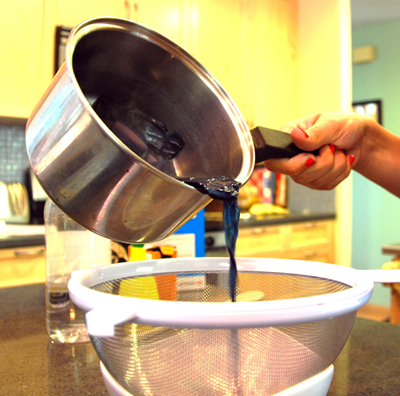
Figure 1. Use a strainer, as in this picture, to separate the blue indicator liquid from the cooked cabbage leaves.
-
Here's how to make pH paper using the red cabbage solution and lab filter paper:
- As shown in Figure 2 below, soak 5 sheets of filter paper in the red cabbage solution for about 30 minutes
- Drain the excess solution from the sheets of filter paper, and set them out in a single layer on some paper towels to dry overnight. To speed up the drying process, you can put them on a cookie sheet and put them in your oven at low temperature (150-200°F).
- When the sheets of filter paper are dry, cut them into strips (for example, 2.5 cm x 11 cm).
- The strips are now ready to test the pH of various solutions. They start out blue, but will turn green in basic solutions and red in acidic solutions.
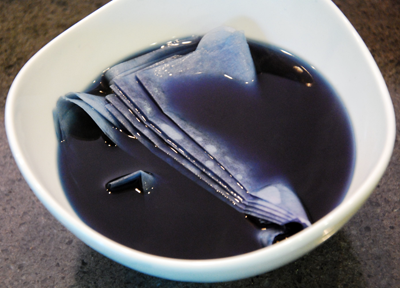
Figure 2. Sheets of lab filter paper should be soaked in the cabbage solution for 30 minutes before draining and drying.
-
Use the strips to test the acidity/alkalinity of various solutions around your house. For example:
- Lemon juice, vinegar
- Orange juice, soda
- Tomato juice, acid rain
- Black coffee, bananas
- Milk, saliva
- Pure water
- Sea water, eggs
- Baking soda solution
- Milk of magnesia
- Ammonia solution
- Soapy water
- Note: if you test the pH of saliva, do not put the pH paper in your mouth! Instead, spit some saliva into a clean container and dip the paper into the saliva.
-
After testing, put the pH strips in order of increasing pH of the solution tested.
- You can use the table in the Introduction as a guide.
- The Variations section has some additional suggestions for independent confirmations of the pH readings.
- Do you see a gradual change in color as the pH of the tested solutions varies? Can you match specific colors to certain pH levels? Over what range of pH does the color continue to change? How accurately do you think you can determine the pH of a solution with your test papers? Within 1, 2, or 3 pH units?
/-/https/www.sciencebuddies.org/cdn/Files/3095/5/Chem_img124.png)
/-/https/www.sciencebuddies.org/cdn/Files/3096/5/Chem_img125.png)

Ask an Expert
Global Goals
The United Nations Sustainable Development Goals (UNSDGs) are a blueprint to achieve a better and more sustainable future for all.
/-/https/www.sciencebuddies.org/cdn/Files/19752/5/E-WEB-Goal-09.png)
Variations
- Compare the performance of your homemade pH paper with commercial pH paper (can be found in a well-stocked tropical fish store). Or, buy an inexpensive pH meter and use it to calibrate your homemade pH paper. Use the table in the Introduction to make a series of different solutions, form low to high pH. Measure the pH of each solution with the pH meter (rinse off the tip between solutions), and write down the results. Now check each solution with your pH paper. Can you see color differences that correspond to the measured changes in pH? Over what pH range do you see color changes? How large does the shift in pH need to be in order to see a change in color?
- Try making pH indicator solutions (and/or indicator papers) from other natural dyes: for example beet juice, phenolphthalein, or turmeric powder (Beckham, date unknown; Krampf, 2006). Test your household solutions with each of the indicators. Does the additional information from multiple indicators give you a better measure of the pH of your solutions? Hint:Make sure to do some background reading on each of the natural dyes you try. Some may only change color in very limited pH ranges, if at all.
- Does the pH of your saliva change after eating various types of food? If so, how much time does it take to return to normal? Design an experiment to find out. Again, do not put the pH paper in your mouth. Instead, spit some saliva into a clean container and dip the pH paper into the saliva. Also, don't try changing the pH of your saliva with anything non-edible!
- What is the pH of rainwater in your area? Can you measure it with your pH paper or pH indicator solutions?
- For a simpler experiment that uses a pH indicator solution instead of pH paper, see the Science Buddies project Cabbage Chemistry.
Careers
If you like this project, you might enjoy exploring these related careers:
/-/https/careerdiscovery.sciencebuddies.org/cdn/Files/20209/5/chemical-engineer-citgo.jpg)

/-/https/careerdiscovery.sciencebuddies.org/cdn/Files/1429/17/unsplash-4pM4nhHyo9M.jpg)

/-/https/img.youtube.com/vi/D54yMlIMN80/0.jpg)
/-/https/img.youtube.com/vi/SV2huMdNs9c/0.jpg)
/-/https/img.youtube.com/vi/8smNcRl_YZk/0.jpg)