
A Cool Way to Make Electricity: Solar Cell Power Output vs. Temperature
Abstract
Solar cells provide a clean way of making electricity directly from sunlight. In this project you will build a simple circuit and experimental setup to investigate whether the power output of a solar cell changes with ambient temperature.Summary
Andrew Olson, PhD, Science Buddies
Edited by Ben Finio, PhD, Science Buddies
Objective
The goal of this project is to measure how the power output of a solar cell varies with ambient temperature.
Introduction
Solar cells (or photovoltaic cells) are devices that can generate electricity directly from sunlight. You may have seen arrays of solar cells on a roof in your neighborhood, or perhaps a much smaller array powering an emergency phone along a highway. In this project you will investigate how power output from a solar cell changes with temperature.
Terms and Concepts
To do this project, you should do research that enables you to understand the following terms and concepts:
- Solar (or photovoltaic) cell
- Voltage
- Current
- Open-circuit voltage
- Short-circuit current
- Power
Questions
- Do you think solar cells work better when they are hot or cold?
- Do you think the voltage output of a solar cell will increase or decrease when the temperature increases? What about the current?
Bibliography
- Solar Action Alliance. (n.d.). Solar 101/Basics. Retrieved August 10, 2016.
- Highlights for Children Staff. (n.d.). How Solar Panels Work. Highlights Kids: Science Questions. Retrieved August 15, 2014.
- On this page you can build virtual circuits with batteries and resistors, then test your circuit by throwing a switch to light up a bulb. If there's too much current, the virtual light bulb blows up; too little current, and the bulb won't light. When you get the current right, the bulb glows brightly.
Physics Department, University of Oregon. (1999). Ohm's Law. Retrieved January 9, 2006. - This link may give you more ideas on how to go about doing this project:
Smith, M. (2002). How temperature affects a solar cell. MadSci Network. Retrieved January 9, 2006.
Materials and Equipment
Some of the components needed for this project are available from Jameco Electronics:
- 6 V, 150 mA solar cell with alligator clip leads, part #2260041
- Digital multimeter. See our multimeter tutorial if you do not know how to use a multimeter.
- Infrared thermometer. Several infrared thermometers are available from Jameco Electronics but they are fairly expensive. Cheaper infrared thermometers are available from Amazon.com.
- Light source. If possible, you can do the project outside in direct sunlight. If you do the project inside, use a high-wattage incandescent bulb (preferably 150 W) or an equivalent CFL or LED bulb. (Note: because of the spectrum of light emitted, solar cells do not generate as much power from CFL or LED bulbs, but you will still be able to make measurements for purposes of a science project).
- Quart-sized resealable plastic bag
- Hot and cold tap water
- Ice
Experimental Procedure
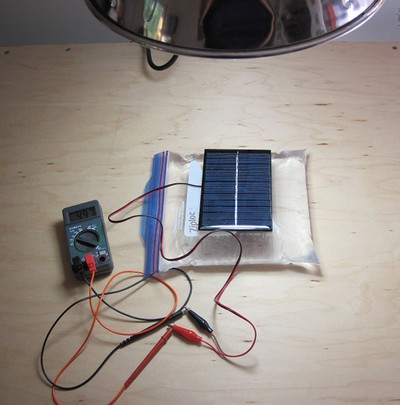
- Set up your experiment, as shown in Figure 1.
- Set up your lamp a fixed distance from where you will test the solar cell. If you are doing the project outside, set up your experiment in an area with direct sunlight.
- Connect your multimeter's leads to the solar cell's alligator clip leads. For this experiment, you will need to toggle between reading voltage and current. If you need help using a multimeter, check out the Science Buddies reference How to Use a Multimeter.
- Cover the exposed solder joints on the back of the solar cell with electrical tape. This will help protect the panel from condensation when you put it on top of a bag filled with ice water.
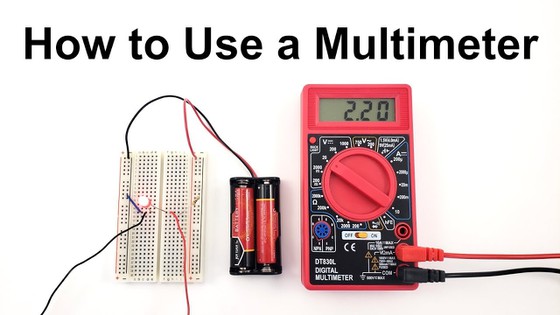
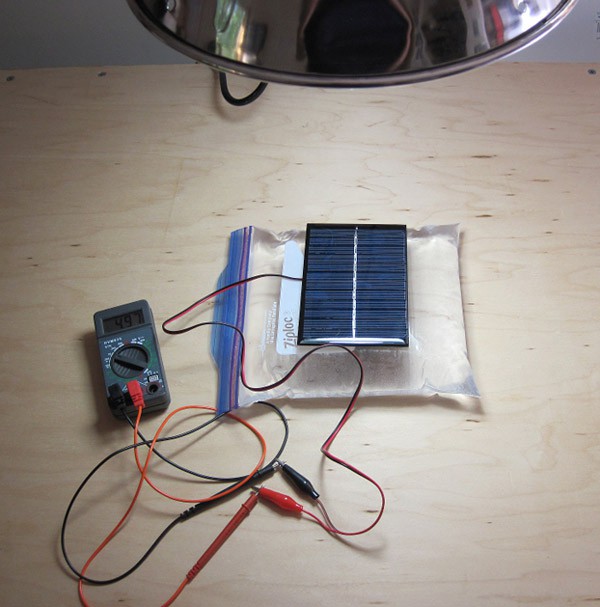
Figure 1. Experimental setup to measure how temperature affects the output of a solar cell. In this picture, the solar cell is cooled by a bag of ice water.
- Prepare a data table in your lab notebook with columns to record solar cell temperature, open-circuit voltage, and short-circuit current.
- Fill a resealable plastic bag with ice water. Try to make sure there is almost no air left in the bag. This will help make sure the solar cell is in direct contact with the cold water, instead of sitting on top of an air bubble that will act as an insulator.
- Prepare to place the solar cell directly on top of the plastic bag. The solar cell will start to cool quickly, so you will need to be ready to take measurements.
- As the solar cell cools, record your data:
- Use the infrared thermometer to measure the temperature of the surface of the solar cell. Make sure you take your measurement from the same spot each time.
- Use the multimeter to measure the cell's open-circuit voltage.
- Use the multimeter to measure the cell's short-circuit current.
- Keep recording data as the solar cell cools, until its temperature has stabilized. How long this takes will depend on the conditions where you do the experiment (for example, the ice will melt much faster if you do the experiment outside on a hot, sunny day).
- Wipe any condensation off the solar cell, empty out the plastic bag, and wait for them to come back to room temperature.
- Fill the plastic bag with hot tap water (not boiling water, you do not want to melt the bag). Again, leave as little air as possible in the bag.
- Repeat steps 4–5 with hot water. Keep recording data until the cell stops heating up and its temperature stabilizes.
- Repeat steps 3–8 two more times, for a total of three trials. Make sure you record all your data.
- Make two scatter plots: one of open-circuit voltage vs. temperature, and one of short-circuit current vs. temperature. How do voltage and current vary with the solar cell's temperature? Do your results match your predictions?

Ask an Expert
Global Connections
The United Nations Sustainable Development Goals (UNSDGs) are a blueprint to achieve a better and more sustainable future for all.

Variations
- This project has you measure open-circuit voltage and short-circuit current, which are the maximum values the solar cell can supply. In reality, which the solar cell is attached to a load, both of those values will drop. Attach the solar cell to a fixed load like a resistor, and repeat the experiment. Calculate the power output of the solar cell (power = current × voltage, or P=IV) under load. How does the power output change with temperature?
- Test solar cell power output as a function of the angle of the incoming light. Keep the distance and brightness of the light source constant, but vary the angle of the incoming light. Make a graph of your results (power vs. angle). If you've taken trigonometry, see if you can figure out the mathematical function that explains the results. Explain why.
- Another variation would be to measure the power output of the solar cell as a function of the intensity of the incoming light (see the Science Buddies project How Does Solar Cell Output Vary with Incident Light Intensity?). To vary the intensity of the light, you could use light bulbs of the same size and shape, but different wattage. For a more advanced project, you could do background research to learn how to measure the intensity of the incoming light, perhaps using a photographic light meter.
- A more advanced project idea would be to measure the power output of the solar cell as a function of the color of the incoming light. You should do background research to learn how light energy varies with wavelength. You will also need to know the spectral characteristics of your light source. For this reason, it would be a good idea to use sunlight for this project. You can get a booklet with 100 color filters for about $10 plus shipping. A search on "color filter booklet" should turn up multiple sources.
Careers
If you like this project, you might enjoy exploring these related careers: