/-/https/www.sciencebuddies.org/Files/21464/5/sb-logo.png)
/-/https/www.sciencebuddies.org/Files/21464/5/sb-logo.png)
Abstract
When your parents were kids, they probably wore polyester. Static cling was a major household issue! Now everybody wears cotton, which does not get static cling nearly as much. Why are some materials more susceptible to static cling than others? Investigate how well different materials produce static electricity by making a homemade electroscope and testing it out in this science project.Summary
Sara Agee, Ph.D. and Teisha Rowland, Ph.D., Science Buddies
This idea was adapted from a project on how to build an electroscope on the ZOOM science activities website hosted by PBS Kids:
- PBS Kids. (n.d.). Science Rocks! Electroscope ZOOM, WGBH Educational Foundation, Boston, MA. Retrieved March 28, 2006.
- Styrofoam™ is a trademark of The Dow Chemical Company
/-/https/www.sciencebuddies.org/Files/2423/5/Elec_img022.jpg)
Objective
Make an electroscope to test several objects made out of different materials to see which ones produce, or conduct, the most static electricity.
Introduction
Static electricity is the build-up of electrical charge in an object. Sometimes static electricity can suddenly discharge, like when a bolt of lightning flashes through the sky. Other times, static electricity can cause objects to cling to each other, like socks fresh out of the dryer. The static cling is an attraction between two objects with different electrical charges, positive (+) and negative (-). You can read more about electricity in the Science Buddies Electricity, Magnetism, & Electromagnetism Tutorial.
You can create static electricity by rubbing one object against another object. This is because the rubbing releases negative charges, called electrons. The electrons can build up to produce a static charge. For example, when you shuffle your feet across a carpet you are creating many surface contacts between your feet and the carpet, allowing electrons to transfer to you you, building up a static charge on your skin. You can suddenly discharge the static charge as a shock when you touch a friend or some objects. Similarly, when you rub a balloon on your head it causes opposite static charges to build up in your hair and in the balloon. When you pull the balloon slowly away from your head, as shown in Figure 1, below, you can see these two static charges attracting each other - your hair stands on end, and tries to stick to the balloon!
/-/https/www.sciencebuddies.org/Files/2423/5/Elec_img022.jpg)
Figure 1. Static electricity makes your hair stand up! (NASA, 2004)
How can static electricity be measured? One way is to use an electroscope. An electroscope is a scientific instrument that detects if there is an electrical charge, and it can show how big the electrical charge is. A drawing of one type of electroscope is shown in Figure 2, below. How does it work? An electrical charge is transferred to the electroscope (by touching it, as shown with the dark green rod), and the electrical charge goes into two separate metal pieces on the electroscope. In the drawing below, these two pieces are in yellow, and represent two thin pieces of gold. The electrical charge makes both of these pieces have the same charge. While objects that have opposite charges are attracted to each other (like the balloon and your hair), objects that have the same charge (such as in the electroscope) are actually repelled by, or pushed away from, each other. In the electroscope drawing, the two pieces of gold have become charged with the same charge (they are either both negatively charged, or both positively charged), so they are pushed apart from each other. The bigger the charge, the further apart the two pieces are pushed. If the gold pieces have no charge (in other words, they are neutral), or they have opposite charges, then they will hang straight down, touching each other.
/-/https/www.sciencebuddies.org/Files/5498/5/Electroscope_diagram.jpg)
Diagram of an electroscope consisting of a metal hook protuding from the wall of a sphere. A gold sheet hangs over the hook within the sphere, and a green rod is used to transfer an electrical charge to the part of the hook that protrudes from the outside of the sphere. The charge travels down the hook and into the gold sheet, which causes both sides of the sheet to separate.
Figure 2. This is a drawing of a simple electroscope. When the electroscope receives an electrical charge (from the green rod at the top), the two gold pieces (in yellow) push apart from each other. The bigger the charge the electroscope receives, the further apart the gold pieces are pushed. If the gold pieces have no electrical charge, they will hang straight down, touching each other. (Image credit: User Stw)
In this science project you will build a homemade electroscope to test several objects made out of different materials to see which ones produce, or conduct, the most static electricity. Then you will put your results together to formulate a triboelectric series, which is an ordered list that describes the type of charge an object has as a result of static electricity. The results may shock you!
Terms and Concepts
- Static electricity
- Electrical charge
- Electrons
- Electroscope
- Neutral
- Triboelectric series
Questions
- How can static electricity be measured?
- How do different materials react to static electricity?
- Which materials are neutral and which ones are charged?
- How does an electroscope work?
Bibliography
This idea was adapted from a project on how to build an electroscope on the ZOOM science activities website hosted by PBS Kids:
- PBS Kids. (n.d.). Science Rocks! Electroscope. ZOOM, WGBH Educational Foundation, Boston, MA. Retrieved March 28, 2006.
- PBS Kids. (n.d.). Electroscope. ZOOM, WGBH Educational Foundation. Retrieved December 11, 2013.
To find out more about static electricity, check out these websites:
- Science Made Simple. (n.d.). What is Static Electricity?. Retrieved December 12, 2013.
- Binns, C. (April 17, 2006). The Shocking Truth Behind Static Electricity. Live Science. Retrieved December 12, 2013.
- Kurtus, R. (April 13, 2008). Effect of Materials on Static Electricity. Ron Kurtus' School for Champions. Retrieved December 12, 2013.
For help creating graphs, try this website:
- National Center for Education Statistics, (n.d.). Create a Graph. Retrieved June 25, 2020.
Materials and Equipment
- Styrofoam™ cup
- Sharp pencil or skewer
- Plastic drinking straw
- Aluminum pie pan
- Tape
- Optional: Clay
- Scissors
- Thread
- Aluminum foil
- Styrofoam plate. Alternatively, the Styrofoam lid from a take-out food container would work too.
- Balloon
- A desk or table that is not metal. For example, a wooden, plastic, or glass desk or table would work. This is because these materials do not conduct electricity as well as metal does.
- Wooden ruler, metric (a plastic ruler is more likely to build up its own static electricity and affect your measurements, so a wooden ruler is recommended)
- Different materials to test (at least 3). They should be no larger than the plate, or be able to be folded to be this small, and be able to be laid flat. Small samples of different fabrics are usually available at stores that sell fabric. For example, you could pick at least three of the following materials:
- Polyester
- Nylon
- Cotton
- Wool
- Silk
- Aluminum
- Plastic wrap
- Plastic, such as a flat, plastic comb
- Copper
- Wood
- Tissue paper
- Lab notebook
Experimental Procedure
/-/https/www.sciencebuddies.org/Files/20483/6/icon-flask.png)
Note: This electroscope works best in dry conditions, and may not work in humid conditions. Try to avoid doing this experiment in a room with a humidifier or on rainy, foggy, or muggy days.
-
First you will make an electroscope to test for the presence of static electricity in different materials. Your electroscope will look different from the one in Figure 2 in the Introduction, but it will work the same way. Instead of using two gold pieces, your electroscope will use an aluminum pan and an aluminum ball on a string. When it is finished, your electroscope will look like the one in Figure 6. We will explain more about how this design works in a moment. Here is how to make the electroscope:
- Make two holes near the bottom of a Styrofoam cup on opposite sides. A good way to do this is by pushing a sharp pencil or skewer through the cup.
-
Push a plastic straw through both of the holes in the cup so that your setup now looks like Figure 3.
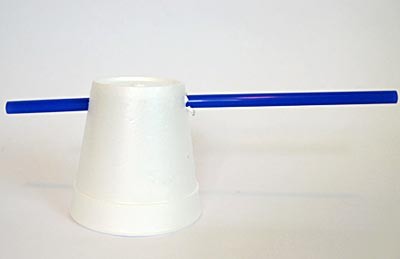
Figure 3. After making a two holes in the cup, push a plastic straw through both of them.
- Either securely tape the cup's opening to the aluminum pan, as shown in Figure 4, or use clay to hold the cup to the pan. If you are using clay, stick four little balls of clay (each about 2 centimeters [cm] in diameter) to the rim of the cup, then turn the cup upside down and stick it to the bottom of the aluminum pie pan using the clay.
-
Carefully adjust the straw's position so that one end of the straw is right above the edge of the pan, as
shown in Figure 4.
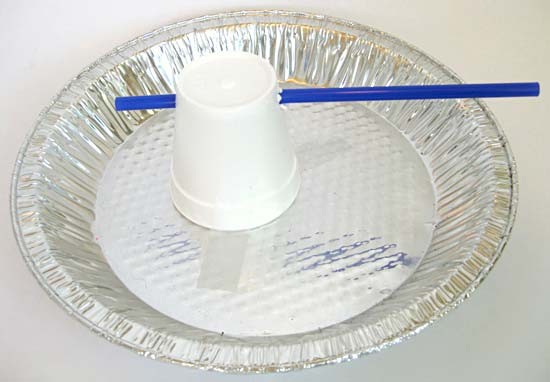
Figure 4. Secure the cup's top to the aluminum pan by either using tape, as shown here, or small balls of clay. Carefully move the straw so that one end is right above the pan's edge.
- Cut a piece of thread with a length that is about two or three times the distance between the straw and the pan's edge. Tie a few knots in one end of the thread.
-
Cut a square of aluminum foil that is about 3 cm on each side. Use it to make a ball around the knots in the thread, as shown in Figure 5. The ball should be about the size of a marble or a little smaller. It should be just tight enough so it does not fall off the thread.
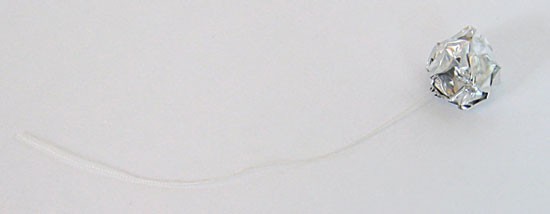
Figure 5. Make a small ball of aluminum foil fit securely over the knots on the end of the piece of thread.
-
Tape the thread to the tip of the straw so that the ball of foil hangs straight down from the straw, just touching the edge of the pan, as shown in Figure 6. Adjust the straw's position if needed. If the end of the thread without the ball is dangling down and touching the pan, cut the dangling part off so it does not touch the pan.
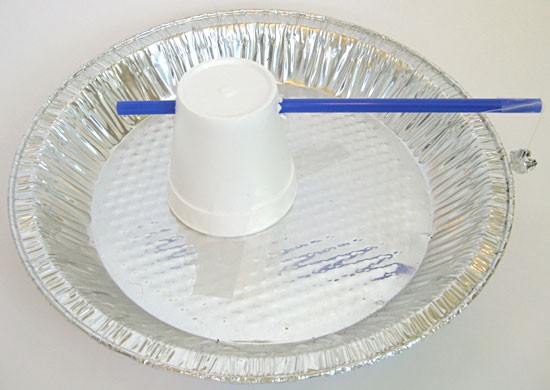
Figure 6. When you are finished, your electroscope should look similar to this one. Make sure the ball of aluminum foil is touching the edge of the aluminum foil pan.
- If the straw seems loose at all, tape the straw to the cup (or wedge in some clay) so the straw does not move around when you use the electroscope.
-
To test the electroscope, create some static electricity by rubbing a blown-up balloon on a Styrofoam plate or the Styrofoam lid from a take-out food box. Rub the Styrofoam plate about 20 times with the balloon.
- When you rub the balloon on the Styrofoam plate, the plate gets an electrical charge, which means there is a buildup of electrons (on either object, the balloon or the plate). Even though the plate is charged, the electrons stay where they are because Styrofoam does not conduct electricity.
-
Once you have charged the Styrofoam plate, quickly place the plate on a desk or table (make sure not to use a metal surface). Then place the electroscope on top of the Styrofoam plate. Be sure to only hold the electroscope by the foam cup and not the aluminum pan, otherwise it will not work! You should see the aluminum foil ball move away from the edge of the pan, as shown in Figure 7.
- What is happening? When an object, like the Styrofoam plate, gets an electrical charge, it can be either positive or negative. (If an object has a lot of electrons, it can have a negative charge, but if it does not have many electrons, it can have a positive charge. Whether an object tends to gain or loses electrons depends on the type of material it is made out of.) When a charged object (like the charged plate) touches the aluminum pan, the charge (or electrons) easily moves through the metal pan. Since the aluminum ball is touching the pan, the ball gets the same charge as the pan. This means that both the ball and pan have the same charge (they are either both positively or negatively charged). Because objects that have the same charge are repelled by each other, the ball is pushed away from the pan.
- If you are unsure of how this works, re-read the Introduction in the Background section.
/-/https/www.sciencebuddies.org/Files/5499/7/electroscope_static_electricity_setup.jpg)
/-/https/www.sciencebuddies.org/Files/5500/5/electroscope_static_electricity_pan.jpg)
/-/https/www.sciencebuddies.org/Files/5501/5/electroscope_ball.jpg)
/-/https/www.sciencebuddies.org/Files/5502/6/electroscope_static_electricity.jpg)
/-/https/www.sciencebuddies.org/Files/5503/5/electroscope_styrofoam.jpg)
Figure 7. After putting the electroscope on the charged Styrofoam plate, the aluminum ball should move away from the aluminum pan, as shown here.
- Use a wooden ruler to measure the distance between the foil ball and the pan. The more charge there is, the more distance there will be. Be careful not to touch the ball or the edge of the plate with the ruler (or your body) when you measure this distance. In your lab notebook, make a data table like Table 1, and record your results in it. (This will be Trial 1 using Styrofoam.) In your data table, only list the objects you actually test.
- Now, touch the ball with your finger. What happens? Record any observations in the data table in your lab notebook.
| Object | Type of Material | Trial Number | Distance Between Ball and Pan (cm) | Average Distance Between Ball and Pan (cm) | Observations |
| Styrofoam plate | Styrofoam | 1 | |||
| 2 | |||||
| 3 | |||||
| Wool hat | Wool | 1 | |||
| 2 | |||||
| 3 | |||||
| Tissue paper | Tissue | 1 | |||
| 2 | |||||
| 3 | |||||
| Piece of cotton fabric | Cotton | 1 | |||
| 2 | |||||
| 3 |
-
Now that you know your electroscope works, you will use it to test the static electricity present in different materials. See the Materials section for a list of different materials to try. You will want to try at least three different types of materials. To test a material, do the following:
- Discharge your electroscope by touching the pan with your finger.
- Rub the object you want to test about 20 times with the balloon.
-
Once you have charged the object, quickly lift up the electroscope (holding it by its Styrofoam cup) and place the object on top of the Styrofoam plate so that the object is laying flat on the plate. Make sure the object is not touching the table. Then place the electroscope on top of the object, as shown in Figure 8.
- Note: Putting the object on top of the Styrofoam plate will help prevent the electric charge from leaving the object before it can go into the electroscope.
- Use the wooden ruler to measure the distance between the foil ball and the pan, making sure not to touch the pan or ball with your ruler (or your body). Record your results in your data table. Then touch the ball with your finger and record your observations.
- Repeat steps 6.a. to 6.d. two more times for the same object so that you have done three trials using the same material.
- Repeat steps 6.a. to 6.e. for each object you want to test. Be sure to do two more trials using the Styrofoam plate (as you did in steps 2 to 5) so that you have done three trials with it. When you are done, you should have done a total of three trials with each object/material.
/-/https/www.sciencebuddies.org/Files/5504/5/electroscope_tissue_paper.jpg)
Figure 8. To test a charged object, lay it flat in between the electroscope and the Styrofoam plate, as shown here using pink tissue paper.
-
Once you are done testing, for each object calculate the average distance between the ball and the pan for the three trials. Record your results in your data table.
- For example, if when testing the Styrofoam plate you measured the distance to be about 0.5 cm in trial 1, 0.75 cm in trial 2, and 0.5 cm in trial 3, the average distance would be about 0.6 cm (since 0.5 cm + 0.75 cm + 0.5 cm equals 1.75 cm, and when divided by three this equals 0.6 cm).
-
Make a bar graph of your results.
- On the x-axis (the horizontal axis) put the material that was tested, and on the y-axis (the vertical axis) put the average distance between the ball and the pan. Make a bar for each material you tested.
- You can make a graph by hand or by using a computer program such as Create a Graph.
-
Analyze your results.
- Which materials were the most electrically charged (had the largest distance between the ball and plate) and which were the least charged?
- Arrange the materials from most charged to least charged. This is a Triboelectric series, and can be written as an ordered list or chart. How do common objects rank in the series? You can do some additional research on Triboelectric series, such as by looking at the resources in the Bibliography, and see how your results compare to other established series. What are some similarities, and what are some differences?

Ask an Expert
Variations
- Some objects become negatively charged and other objects become positively charged with static electricity. Does this kind of electroscope detect both types? How can you tell the difference between the two? Try to discover a way to sort the charged items into positively and negatively charged items.
- Static electricity is formed when many surface contacts are made between two objects. Conduct an experiment to test if the amount of static electricity formed is related to the amount of rubbing two objects experience. See the related project, Rubbing Up Against Static Electricity.
- Static electricity is not good when it gets in your clothes! How do dryer sheets work? Try an experiment rubbing an object with a dryer sheet (like Bounce) after rubbing against the balloon. What happens to the electroscope reading after rubbing a charged object against the dryer sheet? Can you detect a difference before and after contact with the dryer sheet? If so, you can compare the results from different products. How do they compare? Which brands are most effective?
- For a more advanced experiment, try investigating static electricity in different conditions, temperatures and humidities (Brynie, 2005).
- In this science project you made a simple homemade electroscope, but there are other methods of making electroscopes. Do some research on how other electroscopes are made and try to test a different electroscope design, or come up with your own!
Careers
If you like this project, you might enjoy exploring these related careers:
/-/https/careerdiscovery.sciencebuddies.org/Files/1429/17/unsplash-4pM4nhHyo9M.jpg)

/-/https/careerdiscovery.sciencebuddies.org/Files/1640/26/Fyysikot_tyossaan.jpg)

/-/https/img.youtube.com/vi/q9X-ez31oiY/0.jpg)
/-/https/img.youtube.com/vi/QBRy_9f5sps/0.jpg)
/-/https/img.youtube.com/vi/GFJSwrSvlN4/0.jpg)