

Abstract
If you lose power, you can probably still access the internet and read the news with a cell phone. But what if the power goes out for so long that your phone battery dies, or if cellular service also goes down? How would you get news from the outside world? In emergencies, you can use a hand-crank radio, which is powered by manually turning a crank. But just how much power do you get when you turn the crank? How long will the radio stay on before you need to charge it again? Try this project to find out!Summary
Sara Agee, Ph.D., Science Buddies

Objective
In this experiment you will investigate how crank powered appliances work by testing how the number of cranks is related to the amount of power produced.
Introduction
Have you used a hand crank powered radio or flashlight? Some products may even contain both devices in one (Figure 1). These appliances can come in handy during power outages or in areas without reliable access to electricity.
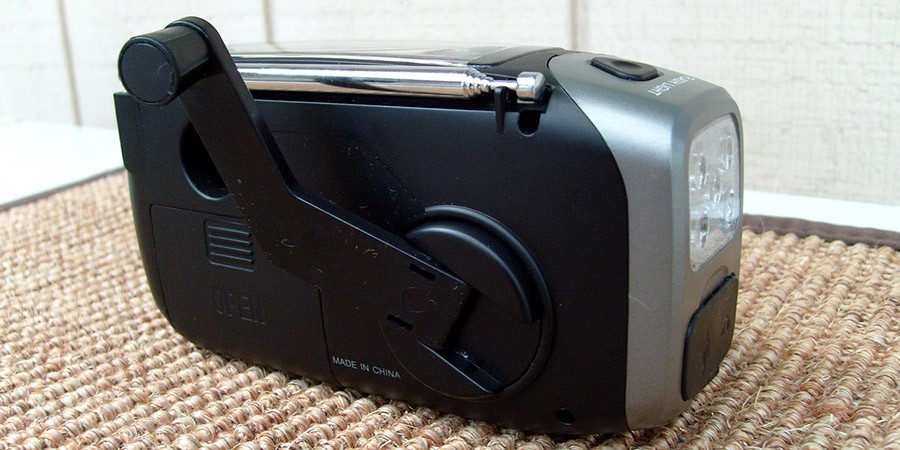
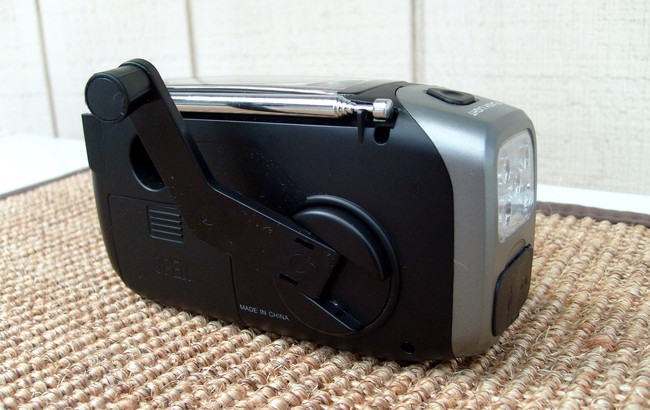 Image Credit: Wikimedia Commons user James Case / Creative Commons Attribution 2.0 Generic
Figure 1. A two-in-one hand crank radio and flashlight. (image credit James Case, CC BY-2.0)
A hand cranked light or radio uses a generator to make electricity to power the device. A generator is usually built using a combination of an electrical coil and a magnet, which will make electricity when they are moved with respect to one another. You provide the movement necessary by cranking, which moves the coil in the generator. Here is a description of how a generator works from the Creative Science Centre:
A generator works by a magnetic field inducing a voltage into a coil of wire. Important points to note are that the voltage increases as the number of turns of wire on the coil, the size of the coil and the strength of the magnetic field increases. The magnetic field (or the coil) needs to be in constant motion to produce/induce the electricity into the coil. This can be done by moving the magnet or by moving the coil—the effect is the same. The coil (or the magnet) needs to move in such a way that the coil continually passes through the magnetic field.
The iron nail is also important in our simple generator as it tends to concentrate the magnetic field. As the coil is wound around the nail it tends to draw in more magnetic flux into the area of the coil which boosts the overall efficiency of the device and increases the voltage that is produced.
The type of wire in the coil is also important. For example, thick wire means there will be less power loss, but the down side is that the coil will get very large when a great number of turns is needed. In a practical generator some trade off has therefore to be found between the size of magnet, coil and the wire (Hare, 2006). You can read more about many of the concepts discussed above in the Science Buddies Electricity, Magnetism, & Electromagnetism Tutorial.
In this experiment you will test the connection between the turning of the coil of a generator and the power produced by using a hand cranked radio. How will the number of turns affect the length of time the radio will play?
Terms and Concepts
To do this type of experiment you should know what the following terms mean. Have an adult help you search the Internet, or take you to your local library to find out more!
- Alternative energy
- Power
- Generator
- Electricity
- Magnet
- Coil
- Charge
Questions
- How do hand crank radios work?
- How do the number of cranks relate to playing time?
- How do the number of cranks relate to the amount of power produced?
Bibliography
- This site describes how an electrical generator is made and gives some background on how generators work:
Hare, J., 2006. Making an Electrical Generator. The Creative Science Centre (CSC) based at the University of Sussex at Brighton. Retrieved November 8, 2023. - This blogger shows us how to turn a hand crank flashlight into an iPod charger:
Hoekstra, M., 2005. How-to Hand Crank Power Your iPod. GeekTechnique.org. Retrieved November 8, 2023. - This site has a java applet you can use to make printable, color graphs of your data:
NCES, 2006. Create a Graph. National Center for Education Statistics (NCES) U.S. Dept. of Education. Retrieved November 8, 2023.
Materials and Equipment
- Hand crank radio (or flashlight)
- Stopwatch
- Notebook and pencil
- Graph paper
Experimental Procedure
- For this experiment you will need a hand cranked radio, which can be found with outdoor/camping or emergency supplies. You can also use a hand cranked flashlight, but this makes the experiment a bit more challenging because you have to watch the light until it goes out. With a radio, you can listen for the radio to stop playing while doing another quiet activity.
-
You will need to make a data table in your notebook before you begin:
Number of Cranks Playing Time (minutes:seconds) 5 10 15 etc. - Crank the radio five times, let go and start your stop watch. When the radio stops playing, stop the stop watch and record the time in your data table. (If you are using a flashlight, watch the light and record the time the light turns off.)
- Crank the radio ten times, let go and start your stop watch. When the radio stops playing, stop the stop watch and record the time in your data table.
- Continue the procedure, each time adding five more cranks and timing the play time with your stop watch. Write each result in your data table.
- Make a graph of your data. You can either make a bar graph or a line graph. You can make your graph by hand, or use a site like Create A Graph to make your graph on the computer.
- What do your results mean? Does the data increase, or decrease? Does cranking the radio more times give it more power?

Ask an Expert
Global Connections
The United Nations Sustainable Development Goals (UNSDGs) are a blueprint to achieve a better and more sustainable future for all.

Variations
- For a more advanced experiment, you can do several trials of the experiment and graph all of your results. By making a dot-plot of your results, you can use a ruler to draw a line of best fit through your data. By measuring the slope of this line, you can make an equation for the relationship between cranks and power in this type of appliance.
- If your parents agree, try taking apart the radio and investigating the crank mechanism. Can you remove it from the device and try to use it to power some other device? Can you repeat the experiment using a voltmeter (available at Amazon.com) to quantify the data in another way? Read about this inventor's story of building a Hand Cranked iPod Charger. What other hand cranked appliances can you invent?
Careers
If you like this project, you might enjoy exploring these related careers:






.jpg)