/-/https/www.sciencebuddies.org/cdn/Files/21464/5/sb-logo.png)
/-/https/www.sciencebuddies.org/cdn/Files/21464/5/sb-logo.png)
Abstract
Do you know how much power is used every day in your home? What you might not realize is that making simple changes can save you energy, power, and money. What would you do with extra money? Put it in the bank or get something that you really want? In this science fair project, you will investigate the different uses of electricity in your home and determine if there are simple changes that you can make to save energy and money.Summary
Michelle Maranowski, PhD, Science Buddies
- Kill a WattTM is a registered trademark of P3 International.
/-/https/www.sciencebuddies.org/cdn/Files/3478/5/Energy_img007.jpg)
Objective
To investigate the different uses of electricity in your home and to find ways to save power and energy.
Introduction
Saving energy in your home is a great idea for several reasons. First, a large percentage of the energy that most people currently use comes from burning fossil fuels. Fossil fuels contain hydrogen and carbon, which are known as hydrocarbons. Most of the energy contained in fossil fuels comes from the combustion of their hydrogen. The carbon that is released is a source of pollution. Carbon combines with the oxygen in the air to create carbon monoxide (CO) and carbon dioxide (CO2). Nitrogen oxides (NOx) and sulfur oxides (SOx) are also created by burning fossil fuels and contribute to acid rain. If we cut down on burning fossil fuels, we cut down on greenhouse gas emissions. In the year 2002, 39% of the world's energy came from petroleum, 24% of the world's energy came from coal, and 23% of the world's energy came from natural gas—all fossil fuels (Scheckel). In 2002, most of the electricity used in the United States was created by burning coal.
While helping the environment is a great reason to save energy, another great reason to save energy is to save money. Saving a few dollars every month doesn't sound exciting, but at the end of the year, your family could end up with several hundred dollars. That could mean a pretty cool family vacation or maybe your parents would let you spend some on a video game or new gaming system!
The amount of energy that you and your family use in your house is recorded by the power company. The power company charges your family for the number of kilowatt-hours (kWh) that your household consumes. Every house or apartment that is supplied with electric energy has a watt-hour meter outside on the side of the building, which keeps track of the amount of energy that is consumed.
Consumption is the amount of power used by an appliance or a whole house or apartment over time. The amount of electric energy that you consume is also known as power consumption. Power consumption is the product of the power that you use, measured in kilowatts, and the total time in which you used that power, measured in hours. You can read more about electricity and electrical power in the Electricity, Magnetism, & Electromagnetism Tutorial.
There are many things that affect power consumption in your home: the kinds of appliances that you have and how energy-efficient they are, how often and how long you use the appliances, and your own personal habits. For example, many people heat their homes excessively during winter. You can save energy by setting the thermostat in your home to 68°F in the winter and to 78°F in the summer. Sometimes people go to sleep with all of the lights on. If you have a 100-watt (W) lightbulb in your lamp and you leave it on for 1 hour while you sleep, you are losing 0.1 kWh. If you leave the 100-W lightbulb on for 10 hours, you will lose 1 kWh. It doesn't sound like much, but if the light was left on every night for the whole year, it would add up to a lot of wasted energy. You could save a few kilowatt-hours by turning off the lights at night or switching over to more energy-efficient lightbulbs.
In this science fair project, you will find out how much energy appliances in your household consume in one day. Try to investigate three or four different appliances. You might be surprised to see that some of the appliances that you choose are using energy even when they appear to be off. These appliances are called phantom loads. Once you have found out how much energy your household uses in a day, try making improvements to your power consumption. They don't have to be big changes. You could just try eliminating phantom loads. Remember that many small efforts can lead to big change!
Terms and Concepts
- Fossil fuel
- Acid rain
- Greenhouse gas
- Energy
- Kilowatt-hour (kWh)
- Power consumption
- Thermostat
- Phantom load
- Power
- Nonrenewable energy source
- Renewable energy source
Questions
- What is a fossil fuel?
- What are greenhouse gases and how are they formed? What effects do they have on the environment?
- What is the difference between energy and power?
Bibliography
The following resource offers a good introduction on energy, power, and saving energy. It also has good ideas on saving energy in your home.
- Scheckel, Thomas. The Home Energy Diet: How to Save Money by Making Your House Energy Smart. Canada: New Society Publishers, 2005.
To help you understand the terminology used when discussing energy and power, check out the following website.
- Rathjen, Don. (2001). Watt's a Joule. Science Wire. Retrieved June 16, 2008.
Read the following Wikipedia entry to learn how to use your home's watt-hour meter to calculate power consumption:
- Wikipedia Contributors. (2013, April 7). Electricity meters. Wikipedia: The Free Encyclopedia. Retrieved April 11, 2013.
To learn about energy efficiency and a wide range of alternative energies watch this NOVA program:
- NOVA. (2011, April 20). Power Surge. Retrieved April 11, 2013.
For help creating a graph, visit this website:
- National Center for Education Statistics. (n.d.). Create a Graph. Retrieved August 19, 2008.
Materials and Equipment
- An electricity usage monitor, like the P3 International P4400 Kill a WattTM Electricity Usage Monitor; these units can be purchased from Amazon.com.
- Access to your home's watt-hour meter
- Timer
- Lab notebook
- Graph paper
Experimental Procedure
/-/https/www.sciencebuddies.org/cdn/Files/20483/6/icon-flask.png)
- To start this project, you should open up the Kill a Watt meter and read the accompanying instructions. Read and understand the maximum electrical ratings of the meter. Write down the maximum electrical ratings in your lab notebook.
- There are several different buttons on the Kill a Watt meter. For the purpose of this science fair project, you will use the KWH/Hour button. The KWH/Hour button is a toggle button that toggles between measuring the power consumption of an appliance (remember that KWH stands for kilowatt-hour) and how long it is on (hours). You will be using the KWH function to track each appliance's power consumption.
- Decide which appliances you would like to study. You could observe your family for a few days to see which appliances they use most to help you decide which appliances to choose.
- Find out the electrical ratings for the appliances. The electrical ratings of an appliance tell you the maximum voltage and current that the appliance can handle without being damaged. You can find this out by looking at the back of the appliance or under the appliance for a metal plate with the values, or you can read through the appliance's instruction manual. Write the appliance's ratings in your lab notebook. Compare the electrical ratings of the appliance to the electrical ratings of the Kill a Watt meter. The electrical ratings of the appliance must be less than those of the Kill a Watt meter.
-
Plug the Kill a Watt meter into a wall plug. Do not plug in an appliance that uses more current or voltage than the meter can safely handle. If you are measuring an appliance that uses more voltage or current than the Kill a Watt meter is rated for, the meter could be damaged. Plug the appliance you want to study into the Kill a Watt meter.
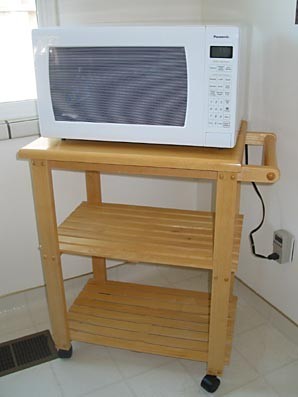
Figure 1. The Kill a Watt meter is testing the power consumption of a microwave oven.
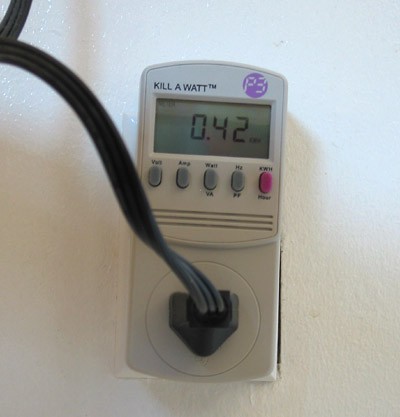
Figure 2. Energy is being supplied to the microwave oven through the Kill a Watt meter.
- At the beginning of the first day, note down the appliance that you are working on in your lab notebook. Create a data table like the one below. Keep track of how long the appliance is on every time you use it during that day. If you are not home all the time, or if there are several people who use the appliance, have whoever is using the appliance note down in your lab notebook how long they used the appliance each time that they used it. Total all of the "on" time readings to get the total daily "on" hours. Note this in your lab notebook.
-
When the day is over, press the KWH/Hour button to take a power consumption reading. Make sure that you are reading power consumption (KWH), and not the time. Record the power consumption in the data table in your lab notebook.
Note: If you are interested in calculating how much power is consumed by an appliance that can't be measured by the Kill a Watt meter (such as ceiling lights, which don't have a wall plug to connect to) you can learn how to read your home's watt-hour meter. The following website has a section on how to read your watt-hour meter:
http://en.wikipedia.org/w/index.php?title=Electricity_meter&oldid=218702465. If you decide to use this method to calculate how much power is consumed by the ceiling lights (or other hard-to-measure appliances), just remember to turn off all of the other appliances in your house prior to measurement. This way you will know that all of the power is being consumed by the appliance you are interested in.
- The Wikipedia entry above details how to calculate power by counting how long it takes for one revolution of the aluminum disc. You can estimate how many revolutions would occur during 1 hour and then arrive at how much power is consumed in 1 hour. You can take this one step further and estimate the power consumption in one day at your house. This means that you must take into account how long the appliance is on during the day.
- Repeat steps 4–7 for each of your appliances. To get more-accurate data, take measurements on three different days. This will give you a good idea of how long the appliance is used and peak usage times.
- Once you have found out the power consumption for all of your appliances (or test subjects that could not be tested with the Kill a Watt), you can find the average power consumption of each one. Then if you assume that you use all of these appliances every day, you can estimate your household's daily average power consumption by summing all of the averages. Record your findings in the data table in your lab notebook.
- Plot the information that you have collected. Plot the daily power consumption of each appliance, by day, on a bar chart. You can also plot the average daily power consumption, by appliance, on a bar chart. If you would like help in plotting your information, go to the following website: https://nces.ed.gov/nceskids/CreateAGraph/default.aspx.
-
Here are some questions to help you understand the information that you have collected:
- Which appliance uses the most energy?
- Which appliance uses the least energy?
- Which appliance in your house is the easiest to improve?
- Which appliance in your house is the hardest to change?
- Can you eliminate phantom loads?
/-/https/www.sciencebuddies.org/cdn/Files/3477/5/Energy_img006.jpg)
/-/https/www.sciencebuddies.org/cdn/Files/3478/5/Energy_img007.jpg)
| Appliance | Total Daily "On" Hours | Daily Power Consumption (KWH) (reading from the Kill a Watt meter) |
| Appliance 1 | Day 1 | |
| Day 2 | ||
| Day 3 | ||
| Average | Average | |
| Appliance 2 | Day 1 | |
| Day 2 | ||
| Day 3 | ||
| Average | Average | |
| Appliance 3 | Day 1 | |
| Day 2 | ||
| Day 3 | ||
| Average | Average | |
| Appliance 4 | Day 1 | |
| Day 2 | ||
| Day 3 | ||
| Average | Average | |
| Estimated Household Daily Average Power Consumption: | ||

Ask an Expert
Global Goals
The United Nations Sustainable Development Goals (UNSDGs) are a blueprint to achieve a better and more sustainable future for all.
/-/https/www.sciencebuddies.org/cdn/Files/19755/5/E-WEB-Goal-12.png)
Variations
- Implement some changes to try and decrease your household's power consumption. You will have to look at the power bill before and after to see if there is an improvement. Remember, even a few dollars count.
Careers
If you like this project, you might enjoy exploring these related careers:
/-/https/careerdiscovery.sciencebuddies.org/cdn/Files/1261/17/iStock-1250621440.jpg)

/-/https/careerdiscovery.sciencebuddies.org/cdn/Files/1242/20/iStock-113511101.jpg)
/-/https/careerdiscovery.sciencebuddies.org/cdn/Files/1215/23/iStock-1170740969.jpg)
/-/https/careerdiscovery.sciencebuddies.org/cdn/Files/1832/17/iStock-1158126977.jpg)
/-/https/careerdiscovery.sciencebuddies.org/cdn/Files/1678/17/unsplash-WEDDt-u3q3o.jpg)

/-/https/img.youtube.com/vi/-xMj-Q1S7_g/0.jpg)
/-/https/img.youtube.com/vi/dt_eIeKJYbE/0.jpg)
/-/https/img.youtube.com/vi/JkFkUTxMkCk/0.jpg)