
Abstract
You might know that lead can be toxic, and that you can get lead poisoning from eating or inhaling old paint dust. Lead is called a heavy metal, and there are other sources of heavy metals that can be toxic, too. Silver, copper, mercury, nickel, cadmium, arsenic, and chromium are all heavy metals that can be toxic in certain environments. In this experiment, find out if one common heavy metal, copper, can be toxic to an aquatic environment.Summary
Damon Kawamoto, Science Buddies Summer Science Fellow, 2011
Teisha Rowland, Ph.D., and Sara Agee, Ph.D., Science Buddies


Objective
In this experiment you will test the effects of the heavy metal copper (Cu) on an aquatic environment containing snails and plants.
Introduction
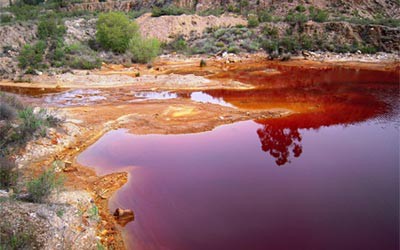
You might know that lead can be toxic, and that you can get lead poisoning from eating or inhaling old paint dust. Lead is called a heavy metal, and there are other sources of heavy metals that can be toxic, too. Silver, copper, mercury, nickel, cadmium, arsenic, and chromium are all heavy metals that can be toxic in certain environments.
"Toxic metals, including "heavy metals," are individual metals and metal compounds that have been shown to negatively affect people's health. In very small amounts many of these metals are necessary to support life. However, in larger amounts, they become toxic. They may build up in biological systems and become a significant health hazard." (OSHA, 2004)
In this science fair project, you will find out if one common heavy metal, copper (Cu), can be toxic to an aquatic environment. You will use copper because it is one of the heavy metals that is easy to find and it is not very toxic to humans. You will use copper sulfate as a source of copper that is soluble, meaning it will dissolve, or turn into a solution, when mixed with water.
The amount of an ion in solution is often measured in parts per million (ppm). This means that if there is 1 ppm ion in solution, then there is 1 milligram (mg) of the ion present in each liter (L) of solution. Heavy metals release free ions in solution that are very potent, and can cause an effect at very low doses.
In this project, a good range of concentrations to test your copper solutions at is 0 ppm (no copper sulfate added) to 0.4 ppm (with increments of 0.1 ppm). These are very low concentrations so it takes some careful planning to make the solutions. We will show you here how to make a copper ion solution with the lowest ion concentration you will be testing: 0.1 ppm.
Making a copper sulfate solution with a concentration of 0.1 ppm means that you will need 0.1 mg of the copper sulfate in one liter of water. However, it is very difficult to measure 0.1 mg. To give some perspective, a new U.S. dollar bill weighs 1 g. If a dollar bill were cut into 1,000 pieces, each piece would weigh 1 mg. If each of those pieces were further cut into ten pieces, cutting the dollar bill into a total of 10,000 pieces, then each piece would weigh 0.1 mg. This is the amount of copper sulfate needed in one liter of water to make a 0.1 ppm solution. It should now be clear why it would be hard to accurately weigh out something this small!
This is why we need another way to make a copper solution with a concentration of 0.1 ppm. Specifically, you will be making a solution that is at a much higher concentration than you will be testing, called a stock solution, and then you will be diluting the stock solution to create the concentrations you want to test.
First, 1 gram (g) of copper sulfate will be weighed out and mixed with 2 liters (L) of water. This can be written as:
2 L water
This means that 0.5 g (or 500 mg) of copper sulfate will be dissolved into 1 L of water, creating a copper solution with a concentration of 500 ppm. How are we going to decrease the concentration even more? We can take one drop of this solution and dilute it with more water. There are about 20 drops of water in 1 milliliter (mL). Knowing this, we can figure out how much copper sulfate will be in one drop of water using the following calculation:
2 L water
1000 ml water
20 drops water
1 drop water
This tells us that there is 0.000025 grams (which equals 0.025 mg) of copper sulfate in one drop of water. This means that four drops of water have 0.1 mg of copper sulfate. Because a 0.1 ppm solution is 0.1 mg dissolved in 1 L water, if we mix four drops of the 500 ppm copper sulfate solution (0.1 mg) with 1 L of water, we will have a copper sulfate solution with a concentration of 0.1 ppm.
The 0.1 ppm copper sulfate solution will be the lowest concentration of copper that you will test in your experimental aquatic environments. You will add increasing amounts of copper (by adding additional drops) to the experimental environments to test effects of increased concentrations of copper. After each experimental environment has had copper added to it, you will add a number of aquatic organisms, specifically duckweed and snails, to each environment. How will adding copper affect the organisms in each environment?
Terms and Concepts
To do this type of experiment you should know what the following terms mean. Have an adult help you search the internet, or take you to your local library to find out more!
- heavy metals and their sources
- copper (coins, pipes, wiring, fungicide, pesticide)
- lead (old paint, fishing weights)
- nickel (coins, batteries)
- mercury (thermometers, fluorescent light tubes)
- arsenic (pesticides and rodenticides)
- cadmium (batteries)
- chromium (chrome plating, batteries, toner, paint)
- environmental toxicity
- aquatic environments
- soluble
- insoluble
- solution
- parts per million (ppm)
- concentrations
- stock solution
Questions
- How will soluble copper affect an aquatic ecosystem?
- Will all of the organisms be affected similarly or differently?
- How much copper will cause an effect?
Bibliography
This project was adapted from the Duckweed Bio-Assay protocol from Cornell University:
- EIP, Date unknown. Assessing Toxic Risk: Student Edition, Environmental Inquiry Program (EIP), Cornell University. Retrieved July 3, 2006.
These resources describes health issues related to heavy metals:
- OSHA, 2004. Safety and Health Topics: Toxic Metals. U.S. Dept. of Labor, Occupational Safety and Health (OSHA). Retrieved July 3, 2006.
At this site, you can find out the toxicity of different chemical compounds:
- Habeck, M., 2006. Toxics, Eco-USA.net. Retrieved July 3, 2006.
Heavy metals are often used in agriculture as pesticides. Learn more about pesticide use and ecotoxicity from the Pesticide Action Network (PAN):
- PAN, 2006. The PAN Pesticides Database, Pesticide Action Network (PAN), San Francisco, CA. Retrieved July 3, 2006.
Materials and Equipment
- You will need these items from Heavy Metals and Aquatic Environments kit, available from Carolina Biological Supply Company, a Science Buddies Approved Supplier:
- Copper sulfate pentahydrate (1 gram). Alternatively, you can purchase powdered copper sulfate pentahydrate from Amazon.com or often from a pet store, nursery, or hardware store for treating plants for pests, algae infestations, or fungal infections. Wear safety goggles and gloves and have adult supervision when handling and measuring the copper sulfate granules. Note: If you are ordering this chemical through Carolina Biological Supply Company, the chemical must be ordered by a teacher and shipped to a school or business address, so plan accordingly.
- Safety goggles
- Small pond snails (at least 15). Alternatively, these may be available at a pond or aquarium supply store.
- Duckweed (at least 50). Alternatively, these may be available at a pond or aquarium supply store.
- You will also need to gather these items, not included in the kit:
- Large, reusable plastic containers with lids, 6 cups / 48 oz volume (e.g. Glad or Zip-lock) (5)
- Empty recycled milk container with lid, 1 gallon (cleaned and rinsed thoroughly)
- Permanent marker
- Disposable gloves (at least 1 pair). Can be purchased at a local drug store or pharmacy, or through an online supplier like Carolina Biological Supply Company. If you are allergic to latex, use vinyl or polyethylene gloves.
- Piece of scratch paper
- Kitchen scale, such as the Fast Weigh MS-500-BLK Digital Pocket Scale, 500 by 0.1 G available from Amazon.com.
- Bottled water (7 L)
- Medicine dropper or pipet
- Lab notebook
Disclaimer: Science Buddies participates in affiliate programs with Home Science Tools, Amazon.com, Carolina Biological, and Jameco Electronics. Proceeds from the affiliate programs help support Science Buddies, a 501(c)(3) public charity, and keep our resources free for everyone. Our top priority is student learning. If you have any comments (positive or negative) related to purchases you've made for science projects from recommendations on our site, please let us know. Write to us at scibuddy@sciencebuddies.org.
Experimental Procedure
- Rinse each container thoroughly with water. Do not use soap because it can coat the plastic container and may be harmful to the organisms in your experiment.
- Prepare the stock copper solution. A stock solution is a solution that is at a higher concentration than you use in your tests, and it is used to make solutions with lower concentrations (the concentrations you want to test).
- Label the 1 gallon milk container "Copper sulfate solution (500 ppm)" using the permanent marker. Add 2 L of bottled water to the 1 gallon milk container.
- Put on safety goggles and gloves. Take the copper sulfate, the 1 gallon milk container with the water, and the scale to a well-ventilated area.
- Lay a piece of scratch paper on the scale. Being careful not to let the copper sulfate touch your bare skin or the scale (it can touch the paper), measure out 1 gram of copper sulfate.
- Carefully create a funnel using the scratch paper to pour the copper sulfate into the 1 gallon milk container with the water. Secure the lid on the container and carefully shake it until the copper sulfate dissolves.
- The copper sulfate may take a couple of minutes to dissolve in the water.
- You will be creating six experimental aquatic environments, and each one will have a different concentration of copper ions in it, as shown in Table 1. Using the permanent marker, label each of the 5 cup plastic containers with the concentration of the copper ion solution you will put in it (in ppm).
| Water in Each Plastic Container (mL) | Drops of Copper Sulfate Solution to Add (500 ppm) | Total Copper Ion Concentration in the Plastic Container (ppm) |
| 1,000 ml | 0 | 0 ppm |
| 1,000 ml | 4 | 0.1 ppm |
| 1,000 ml | 8 | 0.2 ppm |
| 1,000 ml | 12 | 0.3 ppm |
| 1,000 ml | 16 | 0.4 ppm |
- Add 1000 ml (1 L) of water to each plastic container.
- To each plastic container, add drops of the copper sulfate solution (500 ppm) according to Table 1 above. Add the solution slowly, one drop at a time.
- Add at least three snails (more would be better as it would provide more robust data; make sure to keep the number constant between test conditions) to each container, making sure that they are right side up at the bottom of the container. This will help you see if they are alive or not.
- Put 10 duckweed plants into each container. Make sure that each duckweed plant has a stem (the part sticking down) and exactly two leaves (the part that floats).
- You will be counting the number of leaves on each duckweed plant to see if it grows new leaves over time or not.
- For each container, record the number of snails in it and the total number of leaves on the duckweed plants in it (this should be 20 for the first day).
- Observe the animals every day for 5 days and write down your observations in your lab notebook in data tables like Tables 2 and 3. For each observation, count the number of snails that are still alive and the total number of leaves on the duckweed plants in each container.
| Copper Sulfate Concentration | Number of Snails Living | ||||
| Day 1 | Day 2 | Day 3 | Day 4 | Day 5 | |
| 0 ppm | |||||
| 0.1 ppm | |||||
| 0.2 ppm | |||||
| 0.3 ppm | |||||
| 0.4 ppm | |||||
| Copper Sulfate Concentration | Number of Leaves on the Duckweed Plants | ||||
| Day 1 | Day 2 | Day 3 | Day 4 | Day 5 | |
| 0 ppm | 20 | ||||
| 0.1 ppm | 20 | ||||
| 0.2 ppm | 20 | ||||
| 0.3 ppm | 20 | ||||
| 0.4 ppm | 20 | ||||
- Make graphs of your results
- On the bottom (x-axis) of the graphs, put the concentration of copper (in ppm), and on the left (y-axis) of the graphs put the number of snails living, for graph number 1, or the total number of leaves on the duckweed plants, for graph number 2, at the end of the experiment (Day 5).
- Also make graphs of the snails and leaves over time. Put the time (in days) on the X-axis and either the number of snails living, for graph number 3, or the total number of leaves on the duckweed plants, for graph number 4, on the Y-axis.
- Examine your graphs. What effect did the arsenic have on the snails? What about on the duckweed? How did the arsenic concentration impact the effect?
- As you may see from your own data, copper pentahydrate sulfate needs to be disposed of responsibly. Dispose of it according to your local guidelines for pesticide disposal.

Ask an Expert
Global Connections
The United Nations Sustainable Development Goals (UNSDGs) are a blueprint to achieve a better and more sustainable future for all.

Variations
- Some water plants can remove contaminating heavy metals from aquatic environments. Others are poisoned by them. Do an experiment comparing different species of aquatic plants for this ability. Use a copper test kit to test the water each day after the plants have been added.
- We used copper sulfate because it is highly soluble. Can other sources of copper be a problem? Try other sources of elemental copper, like pipes, wires, and metal sheets. Also try other metal products that are weak toxins, like aluminum (foil, cans) or zinc (coins, wires). Are any of these common sources of metals toxic to aquatic life? It is important not to do experiments with lead or mercury, because they can be very toxic and cause developmental defects in children.
- Try these other Science Buddies experiments to test the effects of toxins on aquatic environments:
Careers
If you like this project, you might enjoy exploring these related careers: