
Abstract
Have you ever eaten half an apple and saved the other half for later, only to find that, by time you were ready to eat it, the apple did not look as tasty anymore? It may have turned brown and shriveled, and, if left out long enough, it may have spoiled. Do you think you could have prevented the other half from spoiling, or made it spoil less, if you had stored it differently, such as in the refrigerator in a food wrapping? In this cooking and food science project, you will investigate which type of wrapping will keep sliced apples placed in the fridge the freshest and least spoiled.Summary
Teisha Rowland, PhD, Science Buddies
Objective
To investigate which type of food wrapping will keep sliced apples placed in the refrigerator the least spoiled and freshest.
Introduction
Ever cut an apple into pieces and let some pieces sit out for a while? After a few hours, you may have found that the apple was less appealing than when you first ate it. The apple may have changed in appearance; it may have turned brown, shriveled up a little, felt and smelled different, and no longer been tasty.
Apples turn brown because of a chemical process called oxidation, which happens when oxygen interacts with another substance. In the case of the apple, when it is cut, oxygen can interact with certain proteins, called enzymes, in the flesh of the apple. These interactions cause many other interactions, which eventually lead to the forming of brown-colored chemicals. These chemicals are what make the cut apple turn brown over time.
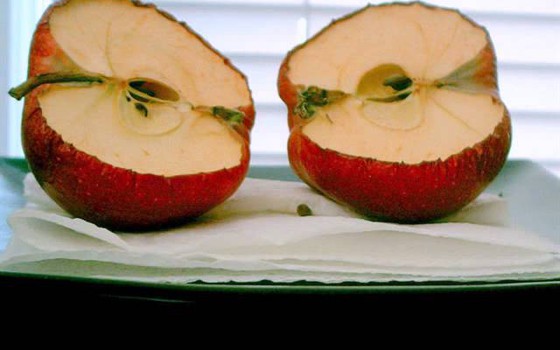
As a piece of apple turns brown, you may have noticed that it can also shrivel up a little, or desiccate. Desiccation is the process by which something loses water and dries up. The skin of the apple helps keep liquid inside of the apple, but when the apple is cut open, its skin can no longer protect it, and it slowly loses water. Unless it is specially prepared, a desiccated piece of apple is not nearly as appealing as a plump, juicy piece of apple. Watch this time-lapse video to see what happens to two apple halves when they are left out in a room for six days.
If a piece of apple is left out long enough, it may spoil. Spoiled food can look, feel, and smell unpleasant, and can make you very sick if you eat it. Food becomes spoiled because microorganisms start living in the food. These microorganisms can include different types of fungus, such as mold and yeast, and bacteria. They can cause food to decay and develop unpleasant odors, tastes, and textures. Sometimes food can even look perfectly good to eat, but can harbor pathogenic microorganisms that can cause illness and are hard to detect. Examples of pathogenic microorganisms include Salmonella and some types of E. coli bacteria.
In this cooking and food science project, you will investigate which types of food wrapping keep sliced apples the freshest in the refrigerator: aluminum foil, wax paper, plastic wrap, or plastic sealable bags. Throwing away food is a waste of money. Save your family money by investigating how to keep your food fresh longer.
Terms and Concepts
- Oxidation
- Enzymes
- Desiccation
- Spoilage
- Microorganisms
- Fungus
- Bacteria
- Pathogenic microorganisms
Questions
- Which food wrapping do you think will keep your apple slices the freshest?
- Why do you think some wrappings might keep an apple slice fresher than other wrappings?
- Watch the time-lapse video from the Introduction again. Why do you think the skin of the apple curls around where the apple has been cut?
- Why do you think some methods other than wrapping the apple slices, such as rubbing them with lemon juice, preserve the color and surface of the apple slices?
Bibliography
You can do further research by visiting the following websites, which give information about apple oxidation and preservation:
- Helmenstine, Anne Marie. (Dec 3, 2018). Why Do Apple Slices Turn Brown?. ThoughtCo. Retrieved March 3, 2021.
- Ashish. (Feb 1, 2021). Why Do Apples Turn Brown? How To Keep Apples From Turning Brown?. Science ABC. Retrieved March 3, 2021.
For more advanced information on apple oxidation, visit the following website:
- McLandsborough, L. (2007, July 30). Why do apple slices turn brown after being cut? Scientific American. Retrieved May 10, 2012.
For help creating graphs, try this website:
- National Center for Education Statistics, (n.d.). Create a Graph. Retrieved June 25, 2020.
Materials and Equipment
- Apples, all the same type (4). Make sure the apples do not have any bruises or dents on the outside and that each looks similar to the other.
- Optional: Adult volunteer
- Clean cutting board
- Knife
- Optional: Kitchen scale or digital scale, such as the Fast Weigh MS-500-BLK Digital Pocket Scale, 500 by 0.1 G, available from Amazon.com
- Optional: Permanent marker
- Aluminum foil (about 60 cm [2 ft.])
- Wax paper (about 60 cm [2 ft.] or three sheets that are 25 cm [10 inches] squared each)
- Plastic wrap (about 60 cm [2 ft.])
- Sealable plastic bags (3)
- Refrigerator
- Optional: Plates
- Lab notebook
- Graph paper
Disclaimer: Science Buddies participates in affiliate programs with Home Science Tools, Amazon.com, Carolina Biological, and Jameco Electronics. Proceeds from the affiliate programs help support Science Buddies, a 501(c)(3) public charity, and keep our resources free for everyone. Our top priority is student learning. If you have any comments (positive or negative) related to purchases you've made for science projects from recommendations on our site, please let us know. Write to us at scibuddy@sciencebuddies.org.
Experimental Procedure
Testing Different Wrappings on Apple Slices
-
Cut the four apples into quarters, lengthwise from the stem to the base. You should end up with 16 apple quarters. Try to cut the apples so that each quarter is as similar in size and shape as possible. You may need to ask for help from an adult volunteer to cut the apples into quarters.
- Wash your hands with soap to make sure they are clean.
-
To cut the apple into quarters, place the apple on a recently cleaned cutting board with the stem at the top. Carefully cut down from the stem to the base, going through the middle of the entire apple. Take each apple half and cut it in half again, cutting along the core of the apple (from the stem to the base).
- Each apple quarter should look like the one in Figure 1 below.
- Do not let the blade of the knife touch anything other than the apples while you are cutting them (except the clean cutting board). If anything touches the blade it could contaminate the apple slices.
- Try not to touch the cut surfaces of the apple slices with your hands. This may also contaminate the apple slices.
-
As an optional step, you could weigh each apple slice before wrapping it, and then weigh each slice after you unwrap it to see if it lost weight.
- If you choose to do this, you will need a way to keep track of each apple slice. Using a permanent marker, you could write a number on the back of each apple slice (on its skin, not on the pulp).
- Write down the weight for each apple slice in your lab notebook with the apple slice's number.
- When you wrap the apple slices, write down in your lab notebook which apple slice was covered with which wrapping.
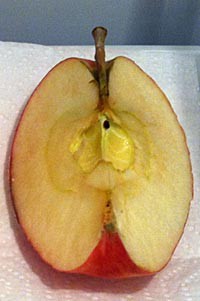 Image Credit: Teisha Rowland, Science Buddies / Science Buddies
Figure 1. Cut all of the four apples into quarters similar to this one. (Note: Only one quarter from each apple will have the stem, unless the stem is also cut into pieces.)
-
Wrap the apple quarters in the four different wrappings. Leave three apple quarters unwrapped.
-
You will wrap three separate apple quarters in each of the different wrappings.
- Testing three apple quarters separately with each wrapping will show that your results are reproducible.
-
Wrap each of three apple quarters in aluminum foil, each of three quarters in wax paper, and each of three in plastic wrap. Put each of three apple quarters in sealable plastic bags (one apple quarter per bag). Leave three apple quarters unwrapped.
- Wrap the apple slices so that each slice is completely covered in one piece of wrapping.
- Try to have only one layer of wrapping on the cut surface of each apple slice. If there is extra wrapping, fold it around the skin of the apple slice.
- After you put an apple slice in a sealable plastic bag, squeeze the air out of the bag and then seal it closed.
- Because you need 15 apple quarters for this project but created 16, you will have one extra apple quarter. Enjoy it now as a tasty, healthy snack!
-
You will wrap three separate apple quarters in each of the different wrappings.
-
Place all of the apple slices in the refrigerator.
-
Placing the apple slices on glass, ceramic, or plastic plates in the refrigerator may make them easier to manage.
- If you use plates, make sure to place all of the apple slices on plates.
-
Place the apple slices in the same area of the refrigerator.
- This will help make sure that the apple slices are kept in the same conditions if, for example, one part of the refrigerator is slightly colder than another part.
- If other people usually use the refrigerator, make sure that the apple slices are not in an area that would get in the way.
- Arrange the apple slices so that they are lying on their skin side, as shown in Figure 1 above.
- Space the apple slices out so that none of them touches the other.
- If other people usually use the refrigerator, let them know that you are conducting an experiment and not to move the apple slices or eat them!
-
Placing the apple slices on glass, ceramic, or plastic plates in the refrigerator may make them easier to manage.
-
Keep the apple slices in the refrigerator for six days. Each day, take a look at them to see how they are changing, but do not touch or move them. Write any observations in your lab notebook.
- You of course will be unable to see the apple slices in the aluminum foil and wax paper, but, without touching or moving them, you can look at the ones that are unwrapped, in plastic wrap, or in plastic bags. How do the apple slices change over time in the refrigerator? Do you see any changes to the wax paper on the apple slices?
- After the apple slices have been in the refrigerator for six days, take them out of the refrigerator.
- Group the apple slices by the wrapping they are wrapped in. Group the three unwrapped apple slices together.
-
Unwrap each apple slice to see how fresh each apple slice looks.
- Make sure to keep the apple slices together in their groups so you know which wrapping each apple slice was wrapped in.
- When you unwrap the apple slices, what do you notice about them? Do some look browner or more dried out than others? Do some seem slimy? Do some of them stick to the wrapping more than others? How do they smell — do any of them smell more than others? Do they smell like anything in particular, like cheese or spoiled fruit juice? Be careful not to put your nose too close to the slices as you do not want any pathogenic bacteria entering your nose! Write your observations in your lab notebook in a data table like Table 1 below.
-
On a scale of 1 to 5, try to rate each apple slice by how fresh it seems, with 1 the freshest and 5 the least fresh of all of the apple slices you tested. Write the ratings in your data table.
- Because there are 15 apple slices, you will probably give a number of them the same rating.
-
Overall, which wrapping group has the freshest-looking apple slices? Which wrapping group has the least fresh-looking slices?
- Rank the groups by how fresh they seem, with 1 the freshest and 5 the least fresh group.
- Tip: Looking at the ratings you assigned to each individual apple slice might help you rank the groups.
- Write the rankings in your data table.
-
If you weighed the apple slices before wrapping them, weigh them again now after they are unwrapped.
- Write down the weight for each apple slice in your lab notebook with the apple slice's number.
- How did the weight of the apple slices change? Did all of the apple slices lose weight, did only some, or did none? If some apple slices lost more weight than others, why do you think this is? Does the change in weight correlate with the wrapping the slice was in or how dried out each apple slice appeared to be?
| Wrapping | Apple slice | How brown was it? | How dried out was it? | Did it stick to the wrapping? | Did it smell strongly, or did it not smell much? | Overall, how fresh was the apple slice? (1 = freshest; 5 = least fresh) |
Overall, how fresh was the wrapping group? (1 = freshest; 5 = least fresh) |
| Aluminum foil | #1 | ||||||
| #2 | |||||||
| #3 | |||||||
| Wax paper | #1 | ||||||
| #2 | |||||||
| #3 | |||||||
| Plastic wrap | #1 | ||||||
| #2 | |||||||
| #3 | |||||||
| Plastic sealable bag | #1 | ||||||
| #2 | |||||||
| #3 | |||||||
| No wrapping | #1 | ||||||
| #2 | |||||||
| #3 |
- When you are done analyzing the apple slices, you can compost them or throw them in the trash. Do not eat the apple slices, even if they look edible, because they can have dangerous pathogenic microorganisms!
-
Make a bar graph using your rankings for the different wrapping groups from your data table.
- You can make a bar graph by hand or use a website like Create A Graph to make a graph on the computer and print it.
- Put the name of each wrapping on the x-axis (the horizontal axis going across) and its overall group rank, from 1 to 5, on the y-axis (the vertical axis going up and down).
-
Why do you think the wrapping that had the freshest-looking apple slices overall was able to keep the apple slices the freshest? Why do you think the wrapping that had the least fresh-looking apple slices did not keep the apple slices fresh?
- Tip: Re-read the Introduction and think about oxidation.

Ask an Expert
Global Connections
The United Nations Sustainable Development Goals (UNSDGs) are a blueprint to achieve a better and more sustainable future for all.

Variations
- Lemon juice, vitamin C, sugar syrup, and other substances are used to prevent apples from turning brown. Do some background research to find out how these and other substances prevent apples from browning. How effective are these substances at keeping apple slices fresh? To find out, repeat this science project but compare different substances instead of different food wrappings.
- Does temperature affect how fresh apple slices stay? Do this science project again, but put unwrapped apple slices at different temperatures, such as in the freezer, the refrigerator, or at room temperature. Does one temperature keep the apple slices fresher than the other temperatures?
- Some types of apples brown easier than others. Repeat this science project but instead of investigating different food wrappings, investigate how well apple slices from different types of apples stay fresh. Which types of apples brown the least?
- As you learned in the Introduction, if apple slices are exposed to oxygen, they can undergo oxidation and turn brown. Think of some different ways you can prevent the apple slices from being exposed to oxygen. Devise a way to test how effective the different ways are at preventing the apple slices from browning.
- Microorganisms, such as bacteria and fungus, can cause food spoilage. Do the freshest-looking apple slices in this science project actually have fewer microorganisms on their cut surfaces than the apple slices that look the least fresh? You can investigate the microorganisms on an apple slice by taking a clean cotton swab, rubbing it along the cut surfaces of the apple slice, and then gently swiping the swab across the surface of an agar plate. Seal the plates and leave them someplace warm for one to two days, until you see colonies of bacteria or fungus. Did the wrapping that kept the apple slices the freshest also make apple slices with the least amount of microorganisms? For science projects that grow microorganisms on agar plates and related resources, see:
- For another science project on investigating produce spoilage, see Save Those Spoiling Strawberries!
- Dried apples can make a tasty snack. At the same time, they show how cut apples can become desiccated over time. Find out how to make dried apple snacks, then weigh the apples before and after they have been dried. How long did it take for the apples to dry? How much weight did they lose? Do all types of apples dry the same way?
Careers
If you like this project, you might enjoy exploring these related careers:




Related Links
- Science Fair Project Guide
- Other Ideas Like This
- Cooking & Food Science Project Ideas
- My Favorites
- Microbiology Techniques & Troubleshooting
- Microorganisms Safety Guide