

Summary
Areas of Science
Difficulty
Time Required
Average (6-10 days)
Prerequisites
None
Material Availability
Readily available
Cost
Low ($20 - $50)
Safety
Minor injury possible. Use caution when using a stovetop. Hot chocolate can burn. Use care when working with hot chocolate. Adult supervision recommended.
*Note:
For this science project you will need to develop your own experimental procedure. Use the information in the summary tab as a starting place. If you would like to discuss your ideas or need help troubleshooting, use the Ask An Expert forum. Our Experts won't do the work for you, but they will make suggestions and offer guidance if you come to them with specific questions.
If you want a Project Idea with full instructions, please pick one without an asterisk (*) at the end of the title.
If you want a Project Idea with full instructions, please pick one without an asterisk (*) at the end of the title.
Abstract
Nut clusters, chocolate-dipped candies, and chocolate-dipped strawberries are just some of the delicious goodies that have a thin, rich layer of chocolate wrapped around them. But how do pastry and candy chefs make these delectable treats? The first step is to melt and temper chocolate. Tempering is a process in which the cocoa butter in chocolate is hardened into a specific crystalline pattern. When the cocoa butter molecules are in this pattern, the chocolate is shiny and breaks with a sharp snap. Tempering chocolate is an art and a science. It is a science because the tempering is temperature dependent. If the temperature of the melted chocolate is too high, the chocolate will burn. If the temperature of the melted chocolate is too low, it might never harden properly. In this science fair project, investigate how different temperatures affect the resulting melted chocolate. After tempering, brush some of the chocolate on wax paper. Does the chocolate harden or does it stay soft? Is it shiny or blotchy? Can you peel it off or does it stick to the paper? Try tempering dark chocolate and white chocolate. Is there a difference in the tempering temperature for each one? Once you have figured out the tempering process of your favorite chocolate, use your recipe to cover nuts, strawberries, or your favorite treat. Share your goodies with your friends and family and let everyone know that your science fair project has a sweet ending.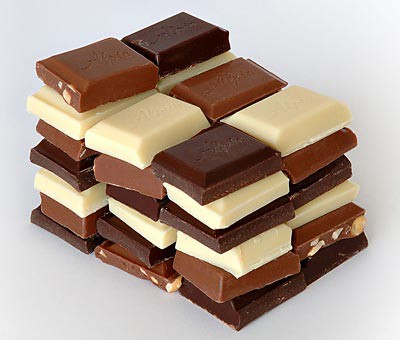 Image Credit: Wikipedia / Creative Commons license
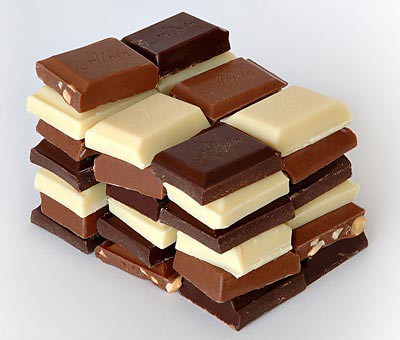
Figure 1. Stacks of various kinds of chocolate. (Wikipedia, 2008.)
Bibliography
This website from the Exploratorium in San Francisco has information on various aspects of chocolate.
- Spadaccini, J. (n.d.). The Sweet Lure of Chocolate. Exploratorium Magazine Online. Retrieved October 16, 2008.
- Corriher, S. (1999, March 1). Food Science: Why Temper Chocolate? Fine Cooking, Vol. 31. Retrieved October 16, 2008.
- Chu, M. (2006, November 12). Tempering Chocolate. Retrieved October 16, 2008.

Ask an Expert
Do you have specific questions about your science project? Our team of volunteer scientists can help. Our Experts won't do the work for you, but they will make suggestions, offer guidance, and help you troubleshoot.
Careers
If you like this project, you might enjoy exploring these related careers:
Career Profile
There is a fraction of the world's population that doesn't have enough to eat or doesn't have access to food that is nutritionally rich. Food scientists or technologists work to find new sources of food that have the right nutrition levels and that are safe for human consumption. In fact, our nation's food supply depends on food scientists and technologists that test and develop foods that meet and exceed government food safety standards. If you are interested in combining biology, chemistry,…
Read more

Career Profile
What makes it possible to create high-technology objects like computers and sports gear? It's the materials inside those products. Materials scientists and engineers develop materials, like metals, ceramics, polymers, and composites, that other engineers need for their designs. Materials scientists and engineers think atomically (meaning they understand things at the nanoscale level), but they design microscopically (at the level of a microscope), and their materials are used macroscopically…
Read more

Career Profile
Good taste, texture, quality, and safety are all very important in the food industry. Food science technicians test and catalog the physical and chemical properties of food to help ensure these aspects.
Read more

Related Links

Cite This Page
General citation information is provided here. Be sure to check the formatting, including capitalization, for the method you are using and update your citation, as needed.MLA Style
Science Buddies Staff.
"Temper, Temper, Temper! The Science of Tempering Chocolate." Science Buddies,
23 June 2020,
https://www.sciencebuddies.org/science-fair-projects/project-ideas/FoodSci_p038/cooking-food-science/tempering-chocolate.
Accessed 26 Apr. 2024.
APA Style
Science Buddies Staff.
(2020, June 23).
Temper, Temper, Temper! The Science of Tempering Chocolate.
Retrieved from
https://www.sciencebuddies.org/science-fair-projects/project-ideas/FoodSci_p038/cooking-food-science/tempering-chocolate
Last edit date: 2020-06-23
Explore Our Science Videos
Explore Enzyme Activity!
Solar Panel Angle for the Junior Solar Sprint
Two-Stage Balloon Rocket Introduction