

Abstract
Have you ever watched an inexperienced video game player pick up a controller and start playing a game? Often the player bumbles around trying to figure out which button makes the onscreen character jump, run, turn left, or perform other actions. Some games are different though, they have control schemes that are more real-world based. For example, most modern Mario Kart games give you the option of steering with a joystick or turning the entire controller like a steering wheel, which is more similar to driving a car. Do inexperienced players perform better when using real-world-based control schemes rather than abstract control schemes? Find out with this out-of-control science fair project!Summary
Sandra Slutz, PhD, Science Buddies

Objective
Determine if inexperienced video game players perform better with abstract control schemes or controls built using natural mapping.Introduction
Have you ever noticed that it can be really easy to learn how to play some video games, while it can take a long time before you learn which button does what on other video games? It is the job of video game designers to decide which buttons perform which actions in a video game. This set of decisions is called the game's control scheme.
Video game designers try to make the control schemes as fun and easy to learn as possible, but it can be challenging, especially when there are a lot of different actions the player can perform. Sometimes the control schemes seem abstract and random to the user. Other control schemes are familiar to experienced players, because they are industry standards. For example, for most modern games, the left control stick (or cross pad) on the controller is used to move the character, while the right control stick is more often used for changing the camera angle. Still other control schemes seem easy to learn because they are based on familiar real-world actions. For example, in some sports simulator games the player swings the controller to simulate swinging a tennis racket or a golf club, using the same motion as he or she would swing an actual tennis racket or golf club. This real-world-mimicking type of control scheme takes advantage of natural mapping. The goal of natural mapping is to make control schemes feel so natural that the user instinctively uses the correct controls without having to rely on remembering which button does what.
Sometimes, natural mapping is possible using the existing controller. This is the case for some sports and exercise games. In other cases, the existing controller isn't a very good representation for the actions that the game designers want you to perform. For example, in the video game Guitar Hero, the goal is to play music like a rock star, but the standard console controllers aren't at all guitar-like, so it is difficult to use natural mapping to build a control scheme which mimics the actions of a real guitar player. To solve this problem, video game makers sometimes use peripherals. A peripheral is a piece of hardware that gets plugged into a computer or game console to expand the available actions. A printer is a common example of a computer peripheral. In the case of Guitar Hero, the game can be (and is most often) played with a guitar-shaped peripheral.
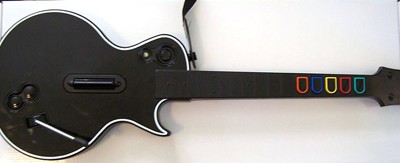 Image Credit: Wikipedia / released into the public domain by the original photographer
Figure 1. This guitar peripheral came bundled with the Xbox 360 version of Guitar Hero III and allowed the player to use a natural-mapping control scheme to compete for rock star bragging rights. (Chipotlehero, 2007.)
In theory, natural mapping should make learning to play a game easier. But does the theory actually translate into higher game scores? You can find out by testing some inexperienced game players in this science fair project. You'll need to find a video game that can be played using both a natural-mapping control scheme and a more abstract control scheme. For example, Guitar Hero can be played with the guitar peripheral (this would be the natural-mapping control scheme) or with a regular controller (this would be the abstract control scheme). Then you'll have your inexperienced video game players play the game first using one, then the other control scheme, and compare how well they score with each control scheme. It is important to use inexperienced players for this experiment because the abstract control scheme may use some industry standards, which would be familiar to experienced players. And if the player was already familiar with the controls, you wouldn't actually be measuring how easy it is to learn the control scheme. So have fun introducing your friends and family to video games!
Terms and Concepts
- Control scheme
- Industry standard
- Natural mapping
- Peripheral
Questions
- What are some everyday (non-video game) examples of natural mapping?
- What kind of factors do video game designers take into consideration when they are designing control schemes?
- What are some examples of video games, aside from the ones mentioned in the Introduction, that use control schemes based on natural mapping?
Bibliography
- Wikipedia Contributors. (2008, July 17). Natural mapping. Wikipedia: The Free Encyclopedia. Retrieved August 13, 2008.
For help creating graphs, try this website:
- National Center for Education Statistics. (n.d.). Create a Graph. Retrieved August 13, 2008.
Materials and Equipment
-
You should already have access to the following:
- Video or computer game that can be played with both a control scheme based on natural mapping and a more abstract control scheme. Some examples include Mario Kart (joystick vs motion-control steering) and Guitar Hero (with and without the guitar peripheral).
- Video game console or computer that will play the game you choose
- Normal video game controller for the abstract control scheme and any peripheral needed to play the game using the natural-mapping control scheme
- Volunteers who are inexperienced at playing video games (at least 6)
- Lab notebook
- Graph paper
Experimental Procedure
Choosing a Video or Computer Game
To do this science fair project, you will first need to choose a video or computer game that can be played with both a control scheme based on natural mapping and a control scheme that is more abstract.
- The two examples listed in the Materials & Equipment section are good choices for this science fair project; however, other equally good choices are being released all the time.
-
If you choose a game not listed in the Materials & Equipment section, make sure:
-
The game can be played using a natural-mapping control scheme.
- The natural-mapping control scheme allows the user to control the onscreen action by mimicking a real-world action, like strumming a guitar, swinging a bat, or turning a steering wheel.
- These control schemes often use a special peripheral to achieve this real-world simulation. Make sure you have the peripheral if it is necessary.
- The game can also be played using a traditional controller, where pressing buttons control the onscreen action, without the user physically mimicking the real-world action.
-
The game can be played using a natural-mapping control scheme.
Testing the Experiment
-
To start this science fair project you'll need to find at least six volunteers who are inexperienced video game players.
- Choose people who either never play video games, or who play less than 5 hours a month.
- The age of the individuals doesn't matter, so if your friends are all video game players, try asking adults who don't play video games.
- Show your first volunteer how to play the video game using the control scheme based on natural mapping. Let him or her practice for 5 minutes.
- After the short practice, have him or her play the first level of the game. Write down the score in your lab notebook in a data table like the one below.
- Show the volunteer how to use the abstract control scheme, and have him or her practice for another 5 minutes. Then have the volunteer repeat the first level, this time using the abstract control scheme. Record the score in your data table.
- Have the volunteer repeat steps 3 and 4 for two more game levels. In the end, he or she will have played a total of three different game levels, once with each control scheme.
-
Repeat steps 3-5 for your second and third volunteers.
- Remember to use the same game levels for all your volunteers.
-
For the fourth, fifth, and sixth volunteers, have them do steps 3-5, except they should play each level using the abstract control scheme first and the natural-mapping control scheme second.
- If you have more than six volunteers, make sure half of them use the natural-mapping control scheme first, and half of them use the abstract control scheme first.
- This will allow you to determine if a player's score is always higher the second time he or she play the level, regardless of which control scheme he or she uses.
- Remember to use the same game levels for all your volunteers.
| Volunteer | Control Scheme Used First | Level One |
Level Two |
Level Three |
|||
| Natural Control Scheme Score | Abstract Control Scheme Score | Natural Control Scheme Score | Abstract Control Scheme Score | Natural Control Scheme Score | Abstract Control Scheme Score | ||
| 1 | Natural | ||||||
| 2 | Natural | ||||||
| 3 | Natural | ||||||
| 4 | Abstract | ||||||
| 5 | Abstract | ||||||
| 6 | Abstract | ||||||
Analyzing the Data
-
For each volunteer, calculate the difference between how well they scored using the natural-mapping control scheme and how well they scored using the abstract control scheme.
- To make this calculation, subtract the Abstract Control Scheme Score from the Natural Control Scheme Score, as shown in Equation 1, below.
- Calculate the difference in score for each level and record the results in a data table in your lab notebook, like the one below.
- If the Difference in Scores is a positive number, the volunteer scored higher on the level when using the natural-mapping control scheme. If it is a negative number, the volunteer scored higher using the abstract control scheme.
Equation 1.
| Volunteer | Control Scheme Used 1st | Difference In Scores for Level One |
Difference in Scores for Level Two |
Difference in Scores for Level Three |
Average Difference in Scores |
| 1 | Natural | ||||
| 2 | Natural | ||||
| 3 | Natural | ||||
| 4 | Abstract | ||||
| 5 | Abstract | ||||
| 6 | Abstract |
-
For each volunteer, calculate the average Difference in Scores across all three levels, as shown in Equation 2.
Equation 2: -
Graph the Average Difference in Scores for each volunteer in a bar graph.
- You can make the graph by hand or use a website like Create a Graph to make the graph on the computer and print it.
- What does the graph tell you? Do inexperienced video game players score better with natural-mapping or abstract control schemes? Do they always score better the second time they play a level, regardless of the type of control scheme used first?

Ask an Expert
Variations
- Try the experiment above with both experienced and inexperienced video game players. Compare the results between the two groups. Does natural mapping affect both groups in the same way? Note: Make sure to have at least six people in each group for accurate comparisons.
- Does a game feel more fun if the control scheme is based on natural mapping? Have volunteers play the same video game twice, once using the controls based on natural mapping, and again using the more abstract controls. Then give them a survey to determine which play experience was more fun. For help on how to make the survey, consult the Designing a Survey page.
Careers
If you like this project, you might enjoy exploring these related careers: