Abstract
Some characteristics, like the shape of your hairline or whether your earlobes are attached or detached, are inherited from your parents. In this science project you will see how writing these characteristics onto a family tree can help you determine how they are inheritedSummary
Sandra Slutz, PhD, Science Buddies
Teisha Rowland, PhD, Science Buddies
Objective
Use pedigree analysis to determine how several human physical traits are inherited.
Introduction
Do you have the same hair color or eye color as your mother? Do people say you look just like your grandfather when he was your age? When we look at members of a family it is easy to see that some physical characteristics or traits are shared, but what are the rules that govern the inheritance of these traits?
It was Gregor Mendel, an Augustinian friar and scientist, who first discovered in the 1860's that some traits are passed down from generation to generation, in very clear and predictable patterns. Today we know that offspring inherit half of their DNA from each parent. This results in two copies of every gene. Many genes come in several different versions, called alleles. Alleles are changes in the actual DNA sequence of the gene. When you have two identical alleles you are said to be homozygous for that gene. People with two different alleles are heterozygous for that gene. Whatever set of alleles a person has is called their genotype. The actual trait, such as red, black, or blond hair, which results from a combination of alleles, is referred to as the phenotype.
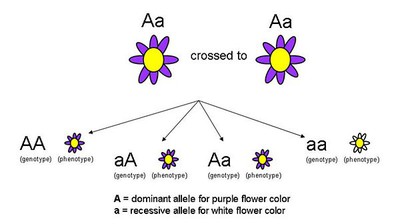
Mendelian traits— the kind of characteristics Mendel first studied— are due to a single gene. Some of such a gene's alleles are dominant, meaning that if you have even one copy of that allele, you will display that trait. Mendel took pea plants, which bred true, meaning for generation after generation they had the same phenotypes. (Today we know that they bred true because they were homozygous for the traits Mendel was looking at). He took a true-breeding purple flowered plant and crossed it to a true-breeding white flowered plant and saw that the offspring all had purple flowers. The purple allele was dominant— a single copy of that allele was sufficient. He then took these offspring and crossed them to one another. This crossing is shown in Figure 1 below, where the top flowers ("Aa") are these heterozygous parents. He found that their offspring occasionally had white flowers. That is because the white allele was recessive, which means you need two copies of that allele to display a certain trait. The offspring that inherited the white allele from both parents displayed the white phenotype.
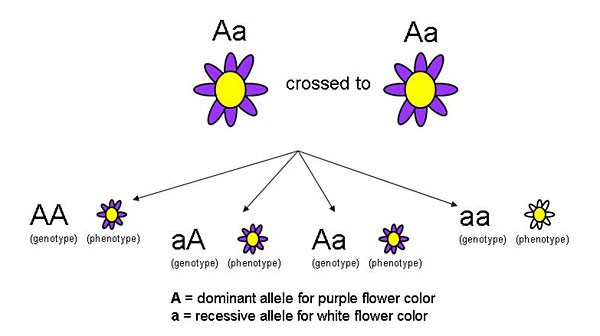 Image Credit: Science Buddies, Sandra Slutz / Science Buddies
Just like Mendel observed generations of related pea plants to determine the mode of inheritance for flower color and other physical traits, scientists can examine generations within a family and discover the mode of inheritance for human traits. To do this, scientists create family trees, called pedigrees, showing as many generations of a family as they can and marking who had which phenotype. Two pedigree examples are shown in Figure 2 below. In order for scientists to understand each other's pedigrees, they use a standard set of symbols and notations. For example, males are always designated by a square and females are always designated by a circle.
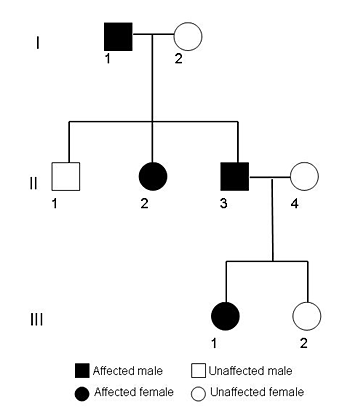 Image Credit: Science Buddies, Sandra Slutz / Science Buddies
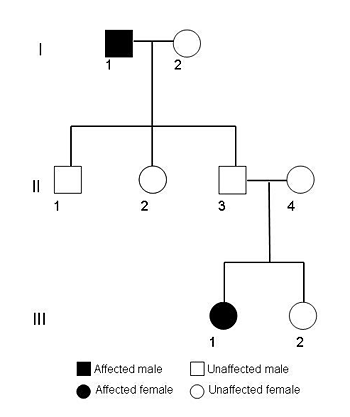 Image Credit: Science Buddies, Sandra Slutz / Science Buddies
In this genetics and genomics science project, you will create pedigrees for four human physical traits to determine which phenotypes are dominant and which are recessive. While it has been recently found that these four traits may not be Mendelian traits (meaning they may be caused by more than one gene, based on more than two alleles, or affected by factors other than genetics), they are still considered to be primarily based on genetics and you can investigate them to try and determine which are dominant and which are recessive. Here are the four traits you will investigate:
- Do you have attached earlobes or detached earlobes? See Figure 3 below for an example of each.
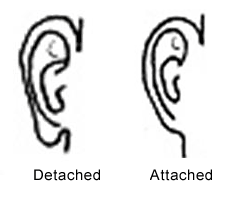 Image Credit: NASA / Public Domain
- Some people's hairlines come to a V-shaped point above their forehead. This is called a widow's peak. See Figure 4 below for an example. Do you have one or not?
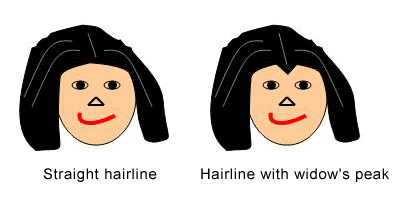 Image Credit: Science Buddies, Sandra Slutz / Science Buddies
- Take a look at your hands. Do you have little hairs on your second joints, also called the mid-digits? Some people have hair on their mid-digits, called mid-digit hair, and some people do not have any hair there, as shown in Figure 5 below.
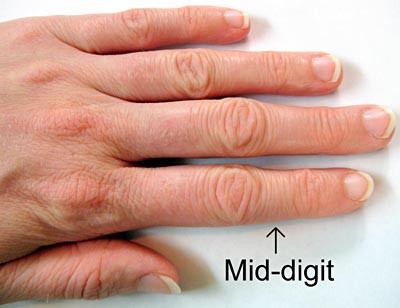 Image Credit: Teisha Rowland, Science Buddies / Science Buddies
- Make a fist with your thumb sticking up. Is your thumb straight or curved? A curved thumb is also known as a hitchhiker's thumb. A slightly curved thumb is shown in Figure 6 below.
 Image Credit: Teisha Rowland, Science Buddies / Science Buddies
Terms and Concepts
- DNA
- Gene
- Allele
- Homozygous
- Heterozygous
- Genotype
- Phenotype
- Mendelian trait
- Dominant
- Recessive
- Mode of inheritance
- Pedigree
- Attached earlobe
- Detached earlobe
- Widow's peak
- Mid-digit hair
- Hitchhiker's thumb
Questions
- What is a Mendelian trait?
- What are the different modes of inheritance for a Mendelian trait?
- How do you draw a pedigree?
Bibliography
For a fun and interactive way to learn about dominant and recessive traits try:
- Education Development Center, Inc. (2002). Weblab: Mendel's Peas. Retrieved February 19, 2008.
Here you can read different discussions on dominant and recessive alleles in humans:
- The Tech Museum of Innovation. (n.d.). Dominant vs. Recessive. Stanford at The Tech: Understanding Genetics. Retrieved May 15, 2013.
Here is a resource for learning how to create pedigrees:
- National Human Genome Research Institute. (n.d.). Your Family Health History. National Institutes of Health. Retrieved May 15, 2013.
Materials and Equipment
- Paper
- Pen
- Optional: Access to a photocopier
- Lab notebook
Experimental Procedure
Before starting this science project, you should go through your reference material and familiarize yourself with the proper way to draw a human pedigree.
- To start this science project, you should draw a pedigree showing the different members of your family.
- Include as many family members as you can get data from. The more people and generations you include, the more likely it is that you will have enough information to determine the mode of inheritance. Ideally you should include multiple people from at least three generations (such as you and your siblings, your parents and possibly their siblings, and your grandparents).
- You might need help from your parents to figure out all the relationships.
- If you have access to a photocopier, make three copies of the pedigree so that you have four copies total, one for each trait you are going to evaluate. If photocopying is not an option, manually copy the pedigree.
- Determine the phenotype of each person on your pedigree for each of the four traits. Use a separate pedigree for each trait. Here are some tips to consider as you fill out the pedigrees:
- When determining if a person's earlobes are attached or detached, keep in mind that there can be a range of attachment. Do your best to decide if it looks like the earlobe is attached or detached. You can write additional observations in your lab notebook.
- Widow's peaks can vary considerably. When determining if a person has a widow's peak, count any sort of V-shaped hairline as a widow's peak.
- You may need to have a person pull their hair back to look for a widow's peak.
- When looking to see if someone has mid-digit hair, you may need to look closely at their hands. If they have any hair on the mid-digit, even one tiny strand, then they have mid-digit hair.
- If a person does not have mid-digit hair and does a lot of work with their hands, you may want to make a note of this in your lab notebook because doing a lot of manual hand work may also wear a person's mid-digit hair away.
- When determining if someone has a hitchhiker's thumb, keep in mind that people's thumbs come in a wide range of curvedness, from completely straight to very curved. Do your best to decide if a person's thumb looks curved or straight. You can write additional observations in your lab notebook.
- From your pedigrees, can you deduce the mode of inheritance for each trait or at least some of the traits? In other words, can you tell if any of the traits are dominant or recessive? If you do not have enough information to determine the mode of inheritance of a particular trait, try making a pedigree for another family.

Ask an Expert
Global Connections
The United Nations Sustainable Development Goals (UNSDGs) are a blueprint to achieve a better and more sustainable future for all.

Variations
- Through this science project, you recorded the phenotypes of various family members for a variety of traits, and you determined the mode of inheritance for these traits. Now, using this information, predict your own genotype for these traits. Depending on the genotype of your future mate, what possible phenotypes could your children have?
- Through your bibliographic research, did you discover any other well-known genetic traits in humans? What are they? Do the pedigree analysis for any of those that seem interesting.
- Most characteristics are multigenic, meaning that the observed phenotype is due to the action of several genes in combination. Eye color is an example of a multigenic trait. Do some bibliographic research to learn about how eye color is inherited. Once you know how it is inherited, draw your family pedigree for eye color. Can you use the pedigree and your knowledge about how eye color is inherited to determine the possible genotypes of the family members in your pedigree?
- Discovering the mode of inheritance of a trait can sometimes be very difficult. For example, people have long debated whether handedness (i.e. being left-handed or right-handed) is a genetic trait. The resource below discusses one such scientific theory on handedness. Read this resource and then analyze handedness and hair whorls in your pedigree.
Does your data support or refute this theory?
- Brodie, C. (2004). Head in Hand. Retrieved May 15, 2013, from http://www.americanscientist.org/issues/pub/2004/1/head-in-hand
Careers
If you like this project, you might enjoy exploring these related careers: