
Summary
Marie E. Jenkins
Edited by Ben Finio, PhD, Science Buddies
If you want a Project Idea with full instructions, please pick one without an asterisk (*) at the end of the title.
Abstract
Soil liquefaction is a phenomenon where soil that is saturated with water suddenly loses its strength and behaves like a liquid. This usually occurs due to sudden, large stresses on the soil — for example, from an earthquake. This can be very dangerous for buildings sitting on top of the soil, as they can suddenly sink into the ground! The embedded video explains soil liquefaction in more detail.
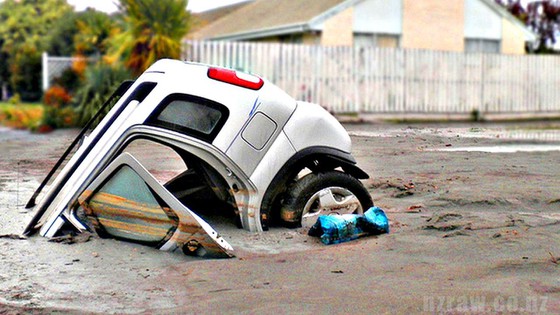
Is there a way to prevent soil liquefaction? Do you think adding certain materials to sandy soil could minimize the effects of soil liquefaction? You can do an experiment to test this at home using some PVC pipe, wooden dowels, sandy soil, and various "filler" materials (leaves, gravel, Styrofoam® balls — use your imagination!). Here is a rough outline of the procedure you can follow to test this at home. Remember, since this is an abbreviated project idea, you will need to come up with the detailed procedure on your own.
- Drill four holes in a piece of PVC pipe. The holes should be equally spaced vertically and should be sized to fit the dowels that you will be using in the experiment.
- Cover the bottom of the pipe with mosquito netting or cheesecloth, which will allow water to seep in while keeping the soil in the pipe.
- Fill the pipe with soil.
- Saturate the soil with water by placing the bottom of the pipe in a container filled with water and letting the water seep into the pipe from the bottom. You will probably need to leave the pipe in the water overnight to give it time to fully saturate. Make sure you use the same amount of water each time.
- Once the soil is saturated, seal the bottom of the pipe with duct tape to keep the soil and water from seeping out.
- Quickly insert the four dowels into the holes.
- Place weights on the soil at the top of the pipe.
- Wait at least one hour for the soil to settle. To assist the settling of the soil, tap the pipe lightly two to three times.
- Drop the pipe three times on a hard surface from a height of approximately two inches to simulate an earthquake. Alternatively, if you have access to a shake table, this could also be used to simulate the effects of an earthquake. If using a shake table, you will need to make sure that the pipe remains vertical while on the shake table.
- Pull out the dowels using a force-measuring device (such as a spring scale) to determine the level of contact forces in the soil.
- Repeat steps 3-10, this time mixing one of your additives in with the soil. Make sure to thoroughly clean the PVC pipe and dowels between each trial. If you have enough pieces of pipe and dowels, you could do all the trials at once instead.
The Bibliography has more information about soil liquefaction to help you get started with your research.
Bibliography
The Soil Liquefaction Web Site from the University of Washington offers a great introduction to liquefaction: http://www.ce.washington.edu/~liquefaction/html/main.html
The US Geological Survey web site also has some general information on earthquakes and liquefaction that is written specifically for students grades 7-12: http://earthquake.usgs.gov/learn/kids/

Ask an Expert
Global Connections
The United Nations Sustainable Development Goals (UNSDGs) are a blueprint to achieve a better and more sustainable future for all.

Careers
If you like this project, you might enjoy exploring these related careers: