
Lichenometry: An Accessible Method for Dating Recent History (Geological and Manmade)
Summary
Idea from Olivia Kurz, Massachusetts State Science Fair
If you want a Project Idea with full instructions, please pick one without an asterisk (*) at the end of the title.
Abstract
Have you ever noticed an old stone wall and wondered how long it has been there? If there is lichen growing on the wall, the lichen has most likely been living there since the time the wall was made, so if you could figure out how old the lichen is then you could deduce the age of the wall. Geologies use this method, called lichenometry, and other methods to establish dates and temporal sequences as they seek to construct a history from the available evidence. In this geology science project, you will use lichenometry as a method for dating relatively recent events in your area, such as the formation of a manmade or geological feature or a disturbance in your area (for example, the building of a stone wall, the occurrence of a rock slide, or when a road was cut).
A trained geologist can "read" ancient history in layers of rocks. The ability to establish dates and temporal sequences of rock formations is, in fact, essential for piecing together the earth's history. Most of the methods used for dating rocks rely on specialized equipment that can measure the presence or relative proportion of specific isotopes in the rock. In this science project, you will use lichenometry, a much more accessible method for dating relatively recent events (up to hundreds of years ago, or perhaps as many as ten thousand years ago). The method is used with lichen species that exhibit predictable growth behavior, and is based on measuring the size of lichen colonies on exposed rock surfaces. All else being equal, those surfaces that have been undisturbed for longer times will have colonies with larger diameters. Since lichen growth rates are dependent on local conditions, growth rates must be calibrated locally. This can be done either by measuring growth rates from year to year (obviously, you will not have time for this!), or by measuring the size of colonies with known dates of origin. The method was first developed by Roland Beschel in the 1950s, by measuring lichen diameters on gravestones of different ages. The burial dates from the gravestones were taken as the starting point for lichen growth, and used to create a graph of lichen diameter vs. age. The graph could then be used to date local gravestones or rocks with unknown dates, by measuring the diameter of lichen colonies.
You can see that this method is fairly simple, at least on the surface. All you need is a ruler and some lichen-bearing rocks with a known history, right? Think for a moment about the assumptions being made. Do lichens really grow at a steady rate? Do you have to make measurements using only one type of rock? How close must the known and unknown rocks be in order for the growth rates to be comparable? Is lichen growth rate determined mostly by local climate, or microclimate? What about changes in climate over time? It is starting to look a little more complicated, as most things do when you start looking close enough. With careful methodology, however, lichenometry can be a reliable method for dating rocks.
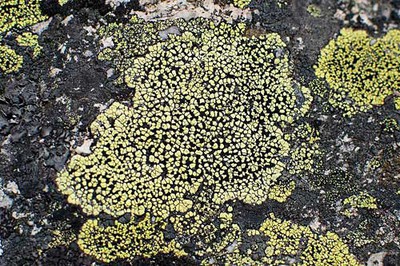
You will want to start this science project by doing background research to develop your expertise on the biology of lichens and on the methods of lichenometry. When doing your research on lichen biology, be sure to figure out the following terms: symbiosis, symbiont, mycobiont, photobiont, and thallus. You will also want to learn about the different lichen forms (foliose, fructiose, crustose, and squamulose) and determine which are suitable for lichenometry. As part of your background research, you may also find it helpful to seek out a mentor in your local area and find a field guide for identifying lichens. Determine whether there are local lichen species with suitable growth patterns for dating. The species most often used in scientific studies is Rhizocarpon geographicum, which is shown in Figure 1. Other possibilities are Aspicilia and Lecidea species. Learn to identify these local species of lichens with suitable growth patterns and determine site(s) for performing your local calibration. For an accurate calibration, you will need to know the age of the features and/or disturbances at your site(s). You may want to consider using lichens growing on gravestones to do this (the original calibration approach used). Collect multiple lichen diameter measurements for each known time period to smooth out random variations. Graph your calibration results (lichen diameter vs. age) and use them to date other sites. Are you surprised by the age of the other sites, or does the age fit with the history you know of the area? If you know the history of at least some of the additional sites, you will be able to test, and possibly refine, your calibration data. Do your additional results give you more confidence in the method? Why or why not? Can you think of ways to improve your methodology? Try them out and see if your calibration is improved.
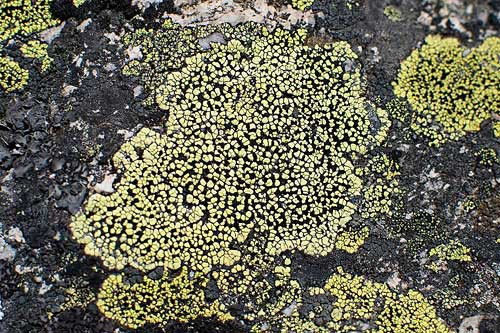 Image Credit: Wikimedia Commons / Creative Commons Attribution-Share Alike 3.0 Unported
Figure 1.The species of lichen most often used in scientific studies, Rhizocarpon geographicum, also known as "map lichen," is shown here (the yellow-green, black-speckled lichen).
Bibliography
Here are a few websites that will help you get started gathering information about lichen biology, lichenometry, and different lichen species:- Brodo, I. M., Sharnoff, S. D., and Sharnoff, S. (n.d.). Lichens of North America. Retrieved March 5, 2013.

Ask an Expert
Variations
- Here is a variation that will take you into the area of Environmental Science. Some lichen species are quite sensitive to air pollution. The U.S. Forest Service has conducted a multi-year, national study to use lichen data as an indicator of air quality. While many of the methods employed in the study are beyond the scope of a science fair project, one conclusion was that lower air quality caused a decrease in diversity of lichen populations, with sensitive species dying out. (See the website below for details.) It might be possible to glean information about air quality by conducting a survey of local lichen populations.
- U.S. Forest Service. (n.d.). National Lichens and Air Quality Database and Clearinghouse. Retrieved March 5, 2013, from http://www.nacse.org/lichenair/
Careers
If you like this project, you might enjoy exploring these related careers: