
Abstract
What do you consider creepy? Clowns? Zombies? Video game characters with jerky movement? In 1970, a roboticist by the name of Masahiro Mori suggested that people are "creeped out" by robots that are almost, but not exactly, humanlike. He called this phenomena the uncanny valley. But researchers are still exploring and defining the uncanny valley. In this science project, you can do your own exploration—just try not to creep your friends out too badly!Summary
Sandra Slutz, PhD, Science Buddies
This science fair project was inspired by the following science fair project, presented at the 2010 California State Science Fair: Karlsson, Dylan J. (2010) Exploring the Uncanny Valley: Stylized Animation vs. Computer Generated Imagery.

Objective
Determine whether or not still images of 3D computer-generated humans are capable of appearing "creepy" to people and thus, falling into the uncanny valley.Introduction
Did you know that the first time DreamWorks did a screen test of the movie Shrek, the children watching it cried and were upset? No, it wasn't the big green ogre, Shrek, that had them scared; it was Princess Fiona! The animators had to go back and change Princess Fiona to be less realistic and more cartoonish. Why? The original character art put Princess Fiona directly in what is known as the uncanny valley. The uncanny valley is part of a theory suggested by Japanese roboticist Masahiro Mori in 1970. Mori suggested that people are increasingly comfortable with robots the more humanlike they look and act, but only up to a point. At that turning point, the robot becomes creepy, as if you are no longer looking at a humanlike machine, but instead, at a person that isn't quite "right." Robots who manage to avoid the creepy factor and act completely human bring out the most favorable reactions from people. Figure 1, below, shows the humanlike continuum; the area in the graph with the dramatic dip in people's comfort with a humanoid robot is known as the uncanny valley.
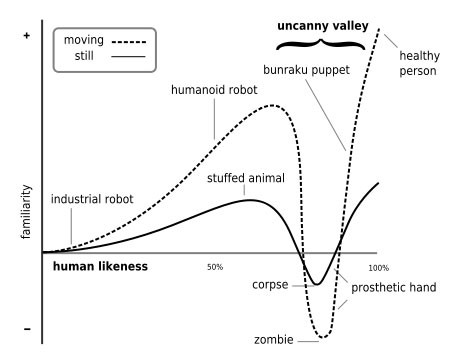 Image Credit: Wikipedia / Public domain
The graph shows an area called the uncanny valley where objects with high human likeness have low familiarity which causes people to become uncomfortable when seeing it. Healthy people are ranked the highest for human likeness and familiarity while industrial robots are ranked the lowest in human likeness and familiarity. The uncanny valley is exemplified by corpses for still objects (high human likeness, low familiarity) and zombies for moving objects (high human likeness, low familiarity).
Figure 1. This graph is a visual depiction of Mori's ideas about what a robot needs to look like in order to trigger a positive versus negative response in people. The y-axis shows familiarity. A negative familiarity is associated with dislike or repulsion, while a positive familiarity is associated with acceptance, comfort, and liking. The x-axis is a continuum, from 0 to 100 percent, of how human and lifelike the robot appears. Note the dramatic dip in familiarity near the end of the human likeness continuum—this is the uncanny valley.
It seems that Mori's uncanny valley might be applicable to more than just robotics. Animated movies and video games appear to follow the same pattern. The Polar Express, from Warner Bros, and Final Fantasy: The Spirit Within were two movies with photorealistic animation that bombed at the box office. Many movie-goers and reviewers complained that the characters looked eerie or creepy.
No one quite knows what cues trigger the uncanny valley reaction, but it is a question with potentially important economic outcomes. The studios that produced both The Polar Express and Final Fantasy: The Spirit Within lost more than 100 million dollars each when the movies flopped!
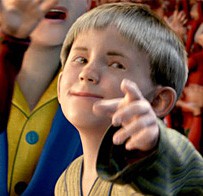
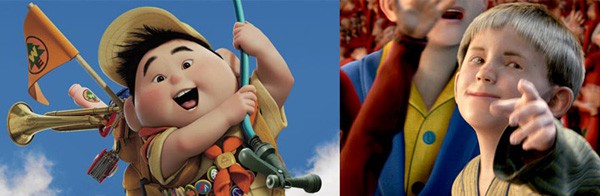 Image Credit: Pixar; Warner Bros. / Copyright Pixar 2009; Copyright 2004 Warner Bros.
Figure 2. Movie-goers found the animated 3D boy from Up! (left) to be appealing and charming, but this animated 3D boy from The Polar Express (right) to be creepy. Why? The answer lies within Mori's uncanny valley. (Images: ©Pixar, 2009 and ©WarnerBros, 2004 respectively.)
In this science project, you'll conduct your own research on the uncanny valley. Can still images of 3D humanoids also fall into the uncanny valley? Look for some computer-generated 3D images that are increasingly humanlike on the Internet, print them out, and see if you can creep out your friends and family.
Terms and Concepts
- Uncanny valley
- Photorealistic animation
- 3D images
- Computer-generated images (CGI)
Questions
- Why are people interested in studying Mori's uncanny valley?
- What are some hypotheses about why the uncanny valley reaction exists?
- What are some tricks animators use to try to avoid the uncanny valley?
Bibliography
- Sofge, E. (2010, January 20). The Truth About Robots and the Uncanny Valley: Analysis. Retrieved October 8, 2010.
- NPR. (2010, March 5). The Uncanny Valley. Retrieved October 13, 2010.
- Butler, M., and Joschko, L. (2007). Final Fantasy or The Incredibles: Ultra-realistic animation, aesthetic engagement and the uncanny valley. Retrieved October 16, 2010.
- Wikipedia Contributors. (2010, September 24). Uncanny valley. Wikipedia: The Free Encyclopedia. Retrieved October 19, 2010.
For help creating graphs, try this website:
- National Center for Education Statistics. (n.d.). Create a Graph. Retrieved June 2, 2009.
Materials and Equipment
- Computer with Internet connection
- Printer
- Lab Notebook
- Volunteers (at least 20 that are your age or older)
Experimental Procedure
- How does age affect the uncanny valley? Are elderly people, middle-aged adults, or younger people more or less likely to identify a computer-generated image as creepy? Repeat this experiment, this time collecting data from different age groups.
- The graph in Figure 1 suggests that the uncanny valley will be more dramatic with moving images than with static (non-moving) images. Design an experiment to test this. Hint: You can create still images from a video clip.
- Are you a good artist? Create your own drawings of a person and systematically vary specific physical features (such as eye size, cheekbone definition, or skin texture) to see which features contribute to the uncanny valley and which do not.
Working with Human Test Subjects
There are special considerations when designing an experiment involving human subjects. Fairs affiliated with Regeneron International Science and Engineering Fair (ISEF) often require an Informed Consent Form (permission sheet) for every participant who is questioned. Consult the rules and regulations of the science fair that you are entering, prior to performing experiments or surveys. Please refer to the Science Buddies documents Projects Involving Human Subjects and Scientific Review Committee for additional important requirements. If you are working with minors, you must get advance permission from the children's parents or guardians (and teachers if you are performing the test while they are in school) to make sure that it is all right for the children to participate in the science fair project. Here are suggested guidelines for obtaining permission for working with minors:
- Write a clear description of your science fair project, what you are studying, and what you hope to learn. Include how the child will be tested. Include a paragraph where you get a parent's or guardian's and/or teacher's signature.
- Print out as many copies as you need for each child you will be surveying.
- Pass out the permission sheet to the children or to the teachers of the children to give to the parents. You must have permission for all the children in order to be able to use them as test subjects.
Procedure
-
Use the Internet to find and print out (one per page) 14 computer-generated 3D images that follow the human
likeness continuum, as defined by Masahiro Mori (see Figure 1 in the Introduction).
The images should be progressively more human and lifelike.
- The first image should be of a computer-generated 3D industrial robot that is not at all human or lifelike.
- Images 2–4 should include increasingly human computer-generated 3D robots; for example, Star Wars' R2-D2 and C-3PO.
- Images 5–6 should consist of movie, television, or video game "people" that are still "cartoonish." For example, computer-generated 3D versions of the Super Mario Brothers or the Simpsons.
-
Images 7–13 should be increasingly human and lifelike 3D computer-generated images.
-
For more-advanced students and those who will not be easily creeped out by these types of images,
you could include pictures in which you specifically define the zombie, corpse, and prosthetic points of Mori's continuum.
If you do this then:
- Image 7 should be of a computer-generated person who seems "corpse-like". This represents the left slope of Mori's hypothetical uncanny valley.
- Image 8 should be of a computer-generated 3D zombie; for example, a character from a Resident Evil movie or video game. Remember, this image should be more humanoid and lifelike than image 7 so that the human likeness factor is always increasing in your series of images.
- Image 9 should be of a computer-generated 3D person with some prosthetic parts.
- Images 10–13 should consist of increasingly lifelike 3D computer-generated images of humans. These images can include animations of real celebrities.
-
For more-advanced students and those who will not be easily creeped out by these types of images,
you could include pictures in which you specifically define the zombie, corpse, and prosthetic points of Mori's continuum.
If you do this then:
- Image 14 should be the healthiest, most lifelike 3D computer-generated image of a person you can find.
- In your lab notebook, write down the order of the images, from least to most human and lifelike.
-
To avoid biasing your volunteers' reactions, you do not want to show your volunteers the images in their proper order.
Shuffle the images so that they are in a random order. In this random order, assign the images letters of the alphabet, A through N.
- In your lab notebook, record the corresponding letter for each image.
-
Starting with image A and ending with image N, show each volunteer an image and have them
immediately rank how creepy the image is on a scale of 1 (not creepy at all) to 10 (very creepy).
- You can have groups of volunteers do this at the same time, as long as each volunteer is recording his or her own reactions on a survey you've created for this purpose and there is no talking among the volunteers.
- Make sure you have informed consent from each of your volunteers. For more details, see the Science Buddies guide to Projects Involving Human Subjects.
- Gather data from at least 20 volunteers that are your age or older. More is better.
- For each image, calculate the average creepiness score from all your volunteers.
- Create a graph with image 1 (least humanlike) through 14 (most humanlike) on the x-axis, and the average creepiness score on the y-axis. Does your data show an uncanny valley? Is it where you expected it to be or not?

Ask an Expert
Global Connections
The United Nations Sustainable Development Goals (UNSDGs) are a blueprint to achieve a better and more sustainable future for all.

Variations
- How does age affect the uncanny valley? Are elderly people, middle-aged adults, or younger people more or less likely to identify a computer-generated image as creepy? Repeat this experiment, this time collecting data from different age groups.
- The graph in Figure 1 suggests that the uncanny valley will be more dramatic with moving images than with static (non-moving) images. Design an experiment to test this. Hint: You can create still images from a video clip.
- Are you a good artist? Create your own drawings of a person and systematically vary specific physical features (such as eye size, cheekbone definition, or skin texture) to see which features contribute to the uncanny valley and which do not.
Careers
If you like this project, you might enjoy exploring these related careers: