/-/https/www.sciencebuddies.org/Files/21464/5/sb-logo.png)
/-/https/www.sciencebuddies.org/Files/21464/5/sb-logo.png)
Abstract
This is a great science fair project for someone who is interested in both mathematics and art. Spidrons are geometric forms made from alternating sequences of equilateral and isosceles (30°, 30°, 120°) triangles. Spidrons were discovered and named by Daniel Erdély in the early 1970's, and have since been studied by mathematicians and artists alike. This project is a great way to learn about the mathematics and art of tiling patterns.Summary
Andrew Olson, PhD, Science Buddies
Sources
This science fair project was inspired by Jason's entry to the 2007 Sciencepalooza, sponsored by Synopsis.
/-/https/www.sciencebuddies.org/Files/1065/10/Math_img070.jpg)
/-/https/www.sciencebuddies.org/Files/3111/5/Math_img068.jpg)
Objective
The goal of this science fair project is to find three or more different ways to tile the plane (i.e. an infinite two-dimensional surface) with spidron-based shapes as the tiling elements.
Introduction
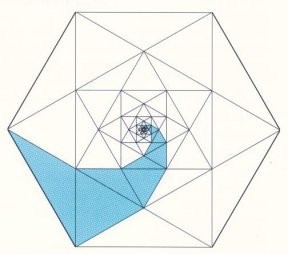
Sometime in the early 1970's, Daniel Erdély was inspired to doodle a sequence of triangles inside a hexagon. He discovered that he could make a pattern of alternating equilateral and isosceles triangles, and that six of these patterns would fill the entire space inside the hexagon (Figure 1). Erdély put two of these patterns together, back-to-back to make a geometric object that he named a spidron (Figure 2).
/-/https/www.sciencebuddies.org/Files/3112/5/Math_img069.jpg)
Figure 1. A single 'arm' of a spidron (blue) inscribed in a hexagon.
/-/https/www.sciencebuddies.org/Files/3111/5/Math_img068.jpg)
Figure 2. An example of the geometric figure that Erdély named a 'spidron.' The upper case letters show the four initial triangles in one 'arm' of the spidron. The lower case letters show the four initial triangles in the other 'arm.' Each arm consists of a sequence of alternating isosceles (A, a, C, c, etc.) and equilateral (B, b, D, d, etc.) triangles.
Erdély continued to experiment with spidrons. He realized, for example, that the sum of the areas of the sequence of triangles following an equilateral triangle in a spidron is equal to the area of the equilateral triangle itself. He also discovered many patterns for tiling two-dimensional space with spidrons, which is what you will try to do in this project. Mathematicians have a special name for tiling: tessellation. Tesselation has important applications in the study of crystals and quasi-crystals in chemistry and materials science. If you are interested in taking your study of spidrons to three dimensions, you will discover, as Erdély did, that spidrons have amazing properties when folded into three dimensional structures. This is a great project for someone with interests in either math or art.
Terms and Concepts
To do this project, you should do research that enables you to understand the following terms and concepts:
- Spidron
- Tiling (also known as tessellation)
- Symmetry
Questions
- How many ways can you find to tesselate (tile) two-dimensional space with spidron arms?
Bibliography
Materials and Equipment
- Several sheets of colored paper
- Origami paper is a good choice.
- Colored copy paper or construction paper could also be used.
- Ruler
- Protractor
- Pencil
- Scissors
- Lab notebook
Experimental Procedure
/-/https/www.sciencebuddies.org/Files/20483/6/icon-flask.png)
- Do your background research so that you are familiar with the terms, concepts, and questions, above.
-
Make a bunch of spidrons using various colors of paper. Here is a simple procedure for constructing single spidron arms (i.e., half-spidrons) by inscribing them in a regular hexagon.
- Draw a regular hexagon.
-
Connect every other vertex with a straight line (gray lines in the illustration below).
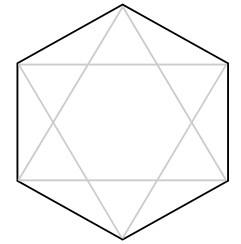
-
The lines you draw will create a smaller regular hexagon, inside the first. Repeat the process of connecting every other vertex with a straight line (orange lines in the illustration below).
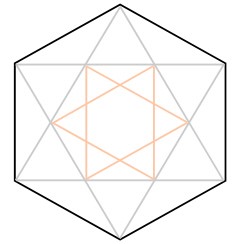
- Repeat the previous step until the inner hexagon becomes too small to continue.
-
You will be able to cut out six spidron arms (colored in blue in the illustration below) from each starting hexagon.
- Tip: remember to make all of your starting hexagons the same size!
- Tip: you could save time by making a spidron arm template from cardstock or cardboard, and then using this with a utility knife to cut spidron arms from colored paper. Careful with knife, and use fresh blades for best results.
- How many different ways can you find to use the half-spidron shapes to make a repeating tiling pattern that could cover a two-dimensional plane? (Remember, simply changing colors doesn't count! You have to find different spatial arrangements of the tiling units.)
/-/https/www.sciencebuddies.org/Files/3113/5/Math_img071.jpg)
/-/https/www.sciencebuddies.org/Files/3114/5/Math_img072.jpg)

Ask an Expert
Variations
- Advanced. Can you prove that the sum of the areas of the sequence of spidron triangles that follow an equilateral triangle is equal to the area of the equilateral triangle itself?
- Advanced. Can you write a computer program that draws spidrons and allows the user to experiment with different spidron tiling patterns?
- Advanced. One of the amazing properties of spidrons is how they can be folded up into three-dimensional shapes by making mountain and valley folds in the right places. Can you make three-dimensional polyhedra based on spidrons? Can your polyhedra be used to tile in three dimensions? If you're into origami, this could be a great project for you!
- Advanced. Can you come up with an equation that describes the outline of a spidron?
Careers
If you like this project, you might enjoy exploring these related careers:
/-/https/careerdiscovery.sciencebuddies.org/Files/1907/18/pexels-photo-3153207.jpg)

/-/https/careerdiscovery.sciencebuddies.org/Files/1442/17/unsplash-TXxiFuQLBKQ.jpg)
/-/https/careerdiscovery.sciencebuddies.org/Files/1353/18/iStock-579224842.jpg)

/-/https/img.youtube.com/vi/SrBNaFWHNN8/0.jpg)
/-/https/img.youtube.com/vi/wFXu2gcvCvE/0.jpg)
/-/https/img.youtube.com/vi/dZhmcai85Y0/0.jpg)