/-/https/www.sciencebuddies.org/cdn/Files/21464/5/sb-logo.png)
/-/https/www.sciencebuddies.org/cdn/Files/21464/5/sb-logo.png)
Abstract
Germs are everywhere! We try and clean our home with disinfectants, but do we really get rid of all the germs? Find out with this "hands-on" experiment.Summary
Sara Agee, Ph.D., Science Buddies
Recommended Project Supplies
/-/https/www.sciencebuddies.org/cdn/Files/12803/5/Science-Buddies-Bacteria-Discovery-Kit.jpg)
Objective
In this science project you will test several disinfectants to see which ones work best to decontaminate the surface of a cutting board.
Introduction
When your mom tells you to wash your hands before dinner, she is thinking about all the germs you might have on your hands from touching the world around you. Germs are everywhere! Germs, or microorganisms, that cause illness and disease can grow on many surfaces called fomites. Here is a good description of fomites and how they harbor germs from the American Society for Microbiology:
"Fomites? What are fomites? This is a term for any inanimate object that can carry disease-causing organisms. Your cutting board, kitchen sink, the change in your pocket and even that pen you keep putting in your mouth are all fomites. Very few things we encounter in our everyday activities are sterile, or microbe-free, including us. At birth, microbes immediately begin colonizing our bodies as they do most every object in the world. They float around until they come in contact with a surface that offers food and shelter. You are most likely to find microbes in and on dark, moist objects that frequently come into contact with food, dirt or vegetation. Bathroom surfaces, hairbrushes, refrigerators, kitchen sinks and cutting boards often have lots of microbes on them. But doorknobs and walls have fewer because they are nutrient-poor and dry.
"Most of the microbes on our bodies and other surfaces are harmless, but some are pathogenic or disease-causing. For this reason, we want to control the number of microbes around us. The odds of becoming infected increase with the number of microbes on surrounding objects. But what can we do to affect the number of microbes on surfaces around us?
"In this activity, you will test a chosen fomite for the presence of microbes and the effects of a disinfectant by growing colonies of bacteria in a medium on petri plates. A medium has food, vitamins and salts that help microbes grow. You usually don't see bacterial colonies like those that form on petri plates on everyday surfaces. That's because there is rarely such a perfect concentration of nutrients on fomites in nature." (ASM, 2001)
/-/https/www.sciencebuddies.org/cdn/Files/2599/3/MicroBio_img016.jpg)
An agar plate showing colonies of microorganisms that have been isolated from a deep-water sponge. (Wikipedia contributors, 2006; original source of image from NOAA Ocean Explorer)
How well do disinfectants work to clean surface bacteria? In this experiment you will use a cutting board as a fomite and test the use of different types of disinfectants. By culturing bacteria from the surface after you have cleaned it, you will find out how well the disinfectant worked. Which disinfectant types will work the best? Consider doing some background research first to understand how the different types of disinfectants affect microbes.
Terms and Concepts
To do this type of experiment you should know what the following terms mean. Have an adult help you search the internet, or take you to your local library to find out more!
- Germs
- Microorganisms
- Bacteria
- Fomite
- Disinfectant
Questions
- How much bacteria can contaminate the surface of a fomite?
- Will the disinfectant work to kill the bacteria?
- Will some disinfectants work better than others?
Bibliography
- American Society for Microbiology (ASM). (n.d.). What is a Microbe? Microbe World. Retrieved July 3, 2014.
- American Society for Microbiology (ASM). (n.d.). Fun with Fomites - Experiment. Retrieved August 28, 2013.
- Wikipedia contributors. (2013, April 12). Bacteria. Simple English Wikipedia. Retrieved August 28, 2013.
- Wikipedia contributors. (2013, July 30). Disinfectant. Wikipedia, the Free Encyclopedia. Retrieved August 28, 2013.
Materials and Equipment 
Recommended Project Supplies
- Bacteria Discovery Kit, available from our partner
Home Science Tools®. Needed from the kit:
- Nutrient agar plates (18)
- Sterile swabs (18)
- Disposable gloves (2 pairs)
- You will also need to gather these items, not included in the kit:
- Isopropyl rubbing alcohol; available in the first aid aisle of grocery stores and pharmacies.
- Tweezer or forceps
- Cotton balls (new package)
- Large plastic cutting board
- Permanent marker
- Slice of lunch meat, like ham, turkey, or bologna
- Small cups for holding disinfectant solutions (7)
- 5 different disinfectant solutions (some examples below) and water as a control:
- Distilled water from an unopened bottle; available in the bottled water aisle of grocery stores.
- 10% bleach (mix 1 part bleach with 9 parts water)
- Rubbing alcohol (take note of what % alcohol makes up the solution you buy) alcohol (mix 7 parts rubbing alcohol with 3 parts water)
- Household cleaners like Lysol, 409, Pine-Sol etc.
- Antibacterial soap
- Cookie sheets or trays
- Paper towels
- Clear tape
- Optional: A digital camera
- Lab notebook
Disclaimer: Science Buddies participates in affiliate programs with Home Science Tools®, Amazon.com, Carolina Biological, and Jameco Electronics. Proceeds from the affiliate programs help support Science Buddies, a 501(c)(3) public charity, and keep our resources free for everyone. Our top priority is student learning. If you have any comments (positive or negative) related to purchases you've made for science projects from recommendations on our site, please let us know. Write to us at [email protected].
Experimental Procedure
/-/https/www.sciencebuddies.org/cdn/Files/20483/6/icon-flask.png)
For health and safety reasons, science fairs regulate what kinds of biological materials can be used in science fair projects. You should check with your science fair's Scientific Review Committee before starting this experiment to make sure your science fair project complies with all local rules. Many science fairs follow Regeneron International Science and Engineering Fair (ISEF) regulations. For more information, visit these Science Buddies pages: Project Involving Potentially Hazardous Biological Agents and Scientific Review Committee. You can also visit the webpage ISEF Rules & Guidelines directly.
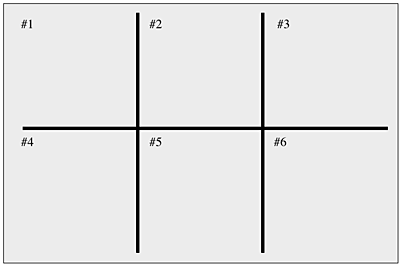
- Using the permanent marker, divide the cutting board into six sections, numbering each section #1-6 like this:
- Put on your gloves and wipe the piece of lunch meat all over the surface of the cutting board. Wipe evenly over the entire surface in circular motions. Leave out overnight, gross!
- The next day you will cleanse each section of the cutting board with a different disinfectant and then culture the bacteria from each section on a nutrient agar plate.
- Wear a new pair of gloves. Prepare your disinfectant solutions by numbering six small cups #1-6 using your permanent marker. Each numbered cup will match one section of your cutting board fomite.
- Fill each cup with a different disinfectant solution and write it in a data table. You should fill the first cup with water as a negative control.
- In your lab notebook, make a data table like Table 1, to record your results in.
/-/https/www.sciencebuddies.org/cdn/Files/2600/3/MicroBio_img017.gif)
| Number | Type of Disinfectant | Number of Colonies | Other Observations | |||
| A | B | C | Average | |||
| 1 | Water (control) | |||||
| 2 | ||||||
| 3 | ||||||
| 4 | ||||||
| 5 | ||||||
| 6 | ||||||
- Using the forceps or tweezers, grab a cotton ball from a NEW, unopened bag of cotton balls. Dip it into one of the solutions, and rub it on the surface of the cutting board in the matching numbered section. Be careful not to let the solution run into another section!
- After each application, throw the cotton ball into the trash and dip your forceps into an extra cup filled with full 70% ethanol or isopropyl rubbing alcohol.
- Repeat steps 7 and 8 until you have applied a different disinfectant to each square of the cutting board. Throw away your gloves. Allow the board to dry completely.
- When all of the sections of the cutting board are dry, you are ready to culture bacteria from each disinfectant treatment. Prepare three nutrient agar plates for each of the cutting board sections by numbering the bottoms of the plates "1a", "1b", "1c", "2a", "2b", "2c", etc. Arrange the plates on cookie sheets or trays lined with clean paper towels. DO NOT open the lids yet or you will contaminate your cultures! Put on a new pair of gloves.
- Use the swabs to transfer a sample from the cutting board to the agar plate. Holding the wooden end of the swab, swipe the cotton end around one section of the cutting board using a circular motion. DO NOT allow the tip of the swab to contact anything else!
- With your free hand, open the lid of the matching nutrient agar plate and swipe the cotton-tipped applicator gently across the agar surface using a zig-zag motion. Immediately replace the lid of the agar plate and secure with a few pieces of clear tape. DO NOT set the lid down while you are streaking the agar because this can contaminate the lid and change your results!
- Repeat steps 11 and 12 until you have swiped each section of the cutting board onto 3 separate nutrient agar plates. Throw away your gloves. Tip: Having 3 samples per cutting board section helps you tell how accurate and repeatable your results are.
- Leave the nutrient agar plates on the cookie sheets or trays in a warm place for 2-4 days, until bacterial colonies are visible.
- Count the number of colonies on each nutrient agar plate and write your results in the data table in your lab notebook, along with any other observations you have. Calculate the average, across plates "a", "b" and "c" for each cutting board section.
- Draw a picture of each plate, noting the size and color of the colonies. If you have a digital camera, you can also take a picture of each plate to put on your Science Fair Project Display Board.
- Graph your results and compare the activities of the different disinfectants. Which sections of the cutting board had the most colonies? Which had the least? Which disinfectants worked the best? The worst? Why do you think you got the results that you did?
Bacterial Safety
Bacteria are all around us in our daily lives and the vast majority of them are not harmful. However, for maximum safety, all bacterial cultures should always be treated as potential hazards. This means that proper handling, cleanup, and disposal are necessary. Below are a few important safety reminders.
- Keep your nose and mouth away from tubes, pipettes, or other tools that come in contact with bacterial cultures, in order to avoid ingesting or inhaling any bacteria.
- Make sure to wash your hands thoroughly after handling bacteria.
- Proper Disposal of Bacterial Cultures
- Bacterial cultures, plates, and disposables that are used to manipulate the bacteria should be soaked in a 10% bleach solution (1 part bleach to 9 parts water) for 1–2 hours.
- Use caution when handling the bleach, as it can ruin your clothes if spilled, and any disinfectant can be harmful if splashed in your eyes.
- After bleach treatment is completed, these items can be placed in your normal household garbage.
- Cleaning Your Work Area
- At the end of your experiment, use a disinfectant, such as 70% ethanol, a 10% bleach solution, or a commercial antibacterial kitchen/bath cleaning solution, to thoroughly clean any surfaces you have used.
- Be aware of the possible hazards of disinfectants and use them carefully.
Explore More!
Interested in the science behind viral outbreaks? Check out Coronavirus.

Ask an Expert
Global Goals
The United Nations Sustainable Development Goals (UNSDGs) are a blueprint to achieve a better and more sustainable future for all.
/-/https/www.sciencebuddies.org/cdn/Files/19746/5/E-WEB-Goal-03.png)
Variations
- Disinfectants work to discourage bacterial growth by killing bacteria or retarding growth processes. There are other ways to affect bacterial growth too, like putting your food in the refrigerator or cooking food to a high temperature. Try testing the growth of bacteria in different temperatures. Will they grow in your refrigerator?
- Bacterial colonies come in all shapes and sizes. This is because there are many different species of bacteria with their own characteristics. A single bacteria may be too small too see without a high powered microscope, but you can see a colony with your naked eye. Take some swipes from around your home too see how many different types of bacteria you can find. Can you use clues found by observing the colonies to tell them apart?
- When we think of bacteria we think about germs. Where do you think the most bacteria in your home are? Try swiping different areas of your home to test how much bacterial contamination is there. Test door handles, toilet seats, and trash can lids. Which places in your house have the most germs? For more information about germs, see the Science Buddies experiment Germ Invasion.
Explore More!
Interested in the science behind viral outbreaks? Check out Coronavirus.
Careers
If you like this project, you might enjoy exploring these related careers:
/-/https/careerdiscovery.sciencebuddies.org/cdn/Files/1486/17/pexels-photo-4033018.jpg)

/-/https/careerdiscovery.sciencebuddies.org/cdn/Files/1390/17/iStock-1217765325.jpg)
/-/https/careerdiscovery.sciencebuddies.org/cdn/Files/1556/17/pexels-photo-4160235.jpg)
/-/https/careerdiscovery.sciencebuddies.org/cdn/Files/962/18/pexels-photo-4299436.jpg)
Contact Us
Our kits are developed in partnership with Home Science Tools®. If you have purchased a kit for this project, Home Science Tools® is pleased to answer any questions.In your email, please follow these instructions:
- Include your Home Science Tools® order number.
- Please describe how you need help as thoroughly as possible:
Examples
Good Question I'm trying to do Experimental Procedure step #5, "Scrape the insulation from the wire. . ." How do I know when I've scraped enough?
Good Question I'm at Experimental Procedure step #7, "Move the magnet back and forth . . ." and the LED is not lighting up.
Bad Question I don't understand the instructions. Help!
Good Question I am purchasing my materials. Can I substitute a 1N34 diode for the 1N25 diode called for in the material list?
Bad Question Can I use a different part?
Contact Support

/-/https/img.youtube.com/vi/6RA9x4wlnW8/0.jpg)
/-/https/img.youtube.com/vi/6fx0PEx0g5k/0.jpg)
/-/https/img.youtube.com/vi/JkEsGXmInKo/0.jpg)