/-/https/www.sciencebuddies.org/cdn/Files/21464/5/sb-logo.png)
/-/https/www.sciencebuddies.org/cdn/Files/21464/5/sb-logo.png)
Abstract
The renowned pianist Vladimir Horowitz once said, "The most important thing is to transform the piano from a percussive instrument into a singing instrument." In this project, you will learn how you can make piano strings sing using sympathetic vibrations. Find out which notes make another one sing the longest by measuring their sound intensities using a smartphone equipped with a sensor app.Summary
Edited by Svenja Lohner, PhD, Science Buddies
Sources
- The Vladimir Horowitz quote in the project description on the Physics home page is from the liner notes to the CD collection, The Magic of Horowitz, Hamburg, Germany: Deutsche Grammophon GmbH, 1989.
- Henderson, T., 2004. Lesson 5: Physics of Musical Instruments: Resonance, The Physics Classroom. Retrieved January 5, 2015.
- Irvine, T., 2000. An Introduction to Music Theory, VibrationData.com Piano Page. Retrieved March 27, 2006.
/-/https/www.sciencebuddies.org/cdn/Files/9001/10/thumbnail-piano-sing-music.jpg)
Objective
The goal of this project is to measure which notes can best induce sympathetic vibrations on an "open" string on the piano.
Introduction
/-/https/www.sciencebuddies.org/cdn/Files/9001/10/thumbnail-piano-sing-music.jpg)
How can you make a piano string sing? What are sympathetic vibrations? This project will show you what and how. You will need a quiet room with a piano, and some knowledge of sound waves and how they are produced.
This is a fairly simple project that explores the science of musical sounds. What exactly do we mean by musical sounds? It will help if we think about it step-by-step. First, we need to understand the basics of sound: how it is produced and how it is perceived. Then we can consider what makes a sound musical.
You will also need to understand some basic properties of waves to get the most out of this project. We will provide a quick introduction here, but for a more complete understanding we recommend some background research on your own. The Bibliography section, below, has some good starting points for researching this project.
What is sound? Sound is a wave, a pattern—simple or complex, depending on the sound—of changing air pressure. Sound is produced by vibrations of objects. The vibrations push and pull on air molecules. The pushes cause a local compression of the air (increase in pressure), and the pulls cause a local rarefaction of the air (decrease in pressure). Since the air molecules are already in constant motion, the compressions and rarefactions starting at the original source are rapidly transmitted through the air as an expanding wave. When you throw a stone into a still pond, you see a pattern of waves rippling out in circles on the surface of the water, centered about the place where the stone went in. Sound waves travel through the air in a similar manner, but in all three dimensions. If you could see them, the pattern of sound waves from the stone hitting the water would resemble an expanding hemisphere. The sound waves from the stone also travel much faster than the rippling water waves from the stone (you hear the sound long before the ripples reach you). The exact speed depends on the number of air molecules and their intrinsic (existing) motion, which are reflected in the air pressure and temperature. At sea level (one atmosphere of pressure) and room temperature (20°C), the speed of sound is about 344 m/s.
Perception of a sound begins when sound pressure waves reach the tympanic membrane (eardrum), a thin, flexible membrane in the middle ear. The pressure waves cause the tympanic membrane to vibrate. The vibrations are amplified by a series of three tiny bones and transmitted to the cochlea. Curled up inside the fluid-filled, snail-shaped cochlea is the organ of Corti, where the vibrations are transduced into nerve impulses by cells called hair cells. Moving along the length of the organ of Corti, each region is sensitive to vibrations of decreasing frequency (i.e., higher pitch). The nerve impulses from the hair cells are conducted to the brain, where they are further processed, leading ultimately to the perception of sound. (Chudler, 2006; Kelly, J.P., 1991)
You have seen that one way to describe a wave is by its speed. In addition to speed, we will also find it useful to describe waves by their frequency, period, and wavelength. Let's start with frequency (f). The top part of Figure 1, below, represents the compressions (darker areas) and rarefactions (lighter areas) of a pure-tone (i.e., single frequency) sound wave traveling in air (Henderson, 2004). If we were to measure the changes in pressure with a detector, and graph the results, we could see how the pressure changes over time, as shown in the bottom part of Figure 1. The peaks in the graph correspond to the compressions (increase in pressure) and the troughs in the graph correspond to the rarefactions (decrease in pressure).
/-/https/www.sciencebuddies.org/cdn/Files/3451/5/Phys_img015.gif)
Sound waves move in a pattern of high density and low density air molecules as they approach a detector. The detector measures the air pressure and sends the data to a monitor that graphs the sound waves as pressure over time. The graph has high peaks when the air molecules are moving closely together and dips in low troughs when the air molecules are spaced further apart.
Figure 1. Illustration of a sound wave as compression and rarefaction of air, and as a graph of pressure vs. time (Henderson, 2004).
Notice how the pressure rises and falls in a regular cycle. The frequency of a wave describes how many cycles of the wave occur per unit time. Frequency is measured in Hertz (Hz), which is the number of cycles per second. Figure 2, below, shows examples of sound waves of two different frequencies (Henderson, 2004).
/-/https/www.sciencebuddies.org/cdn/Files/3452/5/Phys_img016.gif)
The graph of high frequency waves has a wavelength that has 6 peaks and 6 troughs. The low frequency wave graph on the bottom has only 3 peaks and 3 troughs in the same amount of time.
Figure 2. Graphs of high (top) and low (bottom) frequency waves (Henderson, 2004).
Figure 2 also shows the period (T) of the wave, which is the time that elapses during a single cycle of the wave. The period is simply the reciprocal of the frequency (T = 1/f). For a sound wave, the frequency corresponds to the perception of the pitch of the sound. The higher the frequency, the higher the perceived pitch. On average, the frequency range for human hearing is from 20 Hz at the low end to 20,000 Hz at the high end.
The wavelength is the distance (in space) between corresponding points on a single cycle of a wave (e.g., the distance from one compression maximum (crest) to the next). The wavelength (λ), frequency (f), and speed (v) of a wave are related by a simple equation: v = fλ. So if we know any two of these variables (wavelength, frequency, speed), we can calculate the third.
Now it is time to take a look at how sound waves are produced by a musical instrument. For a scientist, it is always a good idea to know as much as you can about your experimental apparatus! Figure 3, below, is a top-down view of an open grand piano.
/-/https/www.sciencebuddies.org/cdn/Files/3454/9/Phys_img025.jpg)
Figure 3. Top view of an open grand piano.
The piano has many tightly-stretched strings which are struck by felt-covered, wooden hammers when a piano key is pressed (more on this later). The diagonal layout of the bass strings provides for maximum length. The strings are stretched over a bridge (above the sinuous green line in the diagram), which transmits their vibrations to the soundboard. The soundboard, with its large area, amplifies the sound of the strings. (One way to see this for yourself is with the mechanism from a music box. First try playing it while holding it in the air. Then, place it in contact with a wood surface, like solid wood table top, and play it again. The music box mechanism causes the table to vibrate. The table has a much larger surface area in contact with the air. The sound is greatly amplified by the wood.) The cast iron frame of the piano bears the load of the strings, whose combined tension can total 20 tons.
The mechanism that transmits the force of the pianist's fingers on the keys to the hammers that strike the strings is called the action. It is a complicated mechanism (see the Bibliography for references that show how the action works in detail) but, basically, here is how it works. A piano key is a long lever. Inside the piano, when you press on a key, the other end of the lever initiates two actions: 1) a damper (small felt pad that silences the string) is lifted from the string and 2) the hammer is set in motion. The hammer is not directly connected to the key, so at a certain point, it is carried forward by its own momentum, and bounces off of the string. This way, the hammer does not remain in contact with the string, which would act to dampen the vibration and silence the string. As long as you hold the key down, the damper is remains raised and the string can continue to vibrate. When you let go of the key, the damper re-contacts the string and silences it. A final detail: although the description above refers to a singular "string," only the lowest piano notes are played by single strings. In the treble range, there are three strings for each note (the hammer hits all three at once), and in the lower midrange, there are two strings for each note. We will continue to refer to a single string, but keep in mind that, for most of the piano's notes, there is more than one string.
The string vibrates between two fixed points: where it is stretched over the bridge and the opposite end of the string, where it is attached to the frame. The vibration results in a standing wave on the string. The fixed points of the string do not move (nodes), while other points on the string oscillate back and forth maximally (antinodes). Figure 5, below, shows some of the standing wave patterns that can occur on a vibrating string (Nave, 2006a).
/-/https/www.sciencebuddies.org/cdn/Files/3453/5/Phys_img020.gif)
Figure 4. Standing waves on a vibrating string, showing the fundamental (top), first harmonic (middle), and second harmonic (bottom) vibrational modes. (Nave, 2006a)
The string can vibrate at several different natural modes (harmonics). Each of these vibrational modes has nodes at the fixed ends of the string. The fundamental mode (Figure 5, top) has a single antinode halfway along the string. Thus, the wavelength of the fundamental vibration is twice the length (L) of the string. The second harmonic has a node halfway along the string. Thus, the wavelength of the second harmonic is equal to the length of the string. Remember that the relationship between wavelength and frequency depends on the speed of the wave. We can rewrite the equation presented earlier as f = v/λ. If we take the ratio between the frequency, f2, of the second harmonic and the frequency, f1, of the first harmonic, the velocity term cancels out:
|
f2 f1 |
= |
v/L v/2L |
= |
1 1/2 |
= | 2 |
You can continue the calculations for the higher harmonics yourself. What is the frequency of the third harmonic, relative to the fundamental?
At last, you have enough of an introduction to sound waves and pianos so that you can understand how one string can make another "sing." Playing a key to strike the string with the hammer is one way to start the string vibrating, but the strings can also be set in motion by sound. If you lift up the damper on a string (if you press the key very slowly and gently, you can do this without sounding the string with the hammer), you leave the string "open" to vibrate. If you then play and release another note, e.g., one octave higher, you will hear the open string sound. It sings!
How does this work? The fundamental vibration of the string for the note one octave higher is at the same frequency as the second harmonic of the open string. The vibration of the higher string, transmitted through the air and (via the soundboard) through the bridge, sets excites this vibrational mode of the open string. This phenomenon is called sympathetic vibration. Besides octaves, what other intervals can excite an open string? The Procedure section shows you how to find out.
Terms and Concepts
To do this project, you should do research that enables you to understand the following terms and concepts related to sound:
- Sound
- Wave
- Vibration
- Sound perception
- Frequency
- Period
- Wavelength
- Hertz [Hz]
- Standing wave
- Node
- Antinode
- Harmonics
- Fundamental mode
- Octave
- Sympathetic vibration
- Interval
Bibliography
- Waves: the first reference is a good general introduction, and those that follow cover the specific topics indicated by their titles:
- Henderson, T., 2004. Sound Waves and Music, The Physics Classroom, Glenbrook South High School, Glenview, IL. Retrieved March 27, 2006.
- Nave, C.R., 2006a. Standing Waves on a String, HyperPhysics, Department of Physics and Astronomy, Georgia State University. Retrieved March 27, 2006.
- Nave, C.R., 2006b. Resonances of Open Air Columns, HyperPhysics, Department of Physics and Astronomy, Georgia State University. Retrieved March 27, 2006.
- Chudler, E.H., 2006. Neuroscience for Kids: The Ear, Neuroscience for Kids, University of Washington Engineered Biomaterials. Retrieved March 27, 2006.
Materials and Equipment
To do this experiment you will need the following materials and equipment:
- A quiet room with a piano (ideally one that has been tuned within the last six months),
- With option 1 in procedure: Smartphone with a sensor app such as phyphox, available for free on Google Play for Android devices (version 4.0 or newer) or from the App Store for iOS devices (iOS 9.0 or newer).
- With option 2 in procedure: Stopwatch or a clock or watch with a second hand
- With option 2 in procedure: Helper to assist with timing
Experimental Procedure
/-/https/www.sciencebuddies.org/cdn/Files/20483/6/icon-flask.png)
Note: In this science project, you will investigate how one piano string can make another one sing using sympathetic vibration. You will use the microphone of your smartphone and a sensor app to record the sound intensities of each of the excited piano strings. The app creates a graph that will give you information on how long each of the strings will resonate after they have been excited. If you do not have a phone, you can measure how long each string vibrates using a stopwatch and listening to the sounds.
/-/https/i.ytimg.com/vi/3cpZEVSC6Nw/maxresdefault.jpg)
Listening to Sympathetic Vibrations
- Start by opening the lid of the piano. With the piano open, you can hear the sounds better and can also observe what happens inside.
- Then hold the C2 (two octaves below middle C) string open. You do this by depressing the key very slowly so that the damper is lifted up, but the hammer does not cause the string to vibrate as shown in Figure 5. There should be no sound. If you do hear sound, let go of the key, wait a second or two (the damper will contact the string and silence it), and try again.
/-/https/www.sciencebuddies.org/cdn/Files/9002/5/lifted-damper.jpg)
Figure 5. To hold the piano string open, the damper should be lifted up.
- While still holding C2 open, firmly play and quickly release C3 (one octave below middle C) as shown in Figure 6. If you are familiar with music terminology, you want to play a forte stacatto note. If you are familiar with physics terminology, you are trying to produce an impulse response with the hammer on the C3 string.
/-/https/www.sciencebuddies.org/cdn/Files/9003/5/hold-c2-play-c3.jpg)
Figure 6. Play C3 while still holding the C2 string open.
- The tone from the C3 string will die away quickly when the damper re-contacts the string after you let go of the key. However, since you are holding the C2 string open, you should still hear a sound. If you let go of the C2 key, the sound should die away quickly as the damper re-contacts the C2 string. Let go of the C2 key and prove to yourself that it is the source of the continued sound.
Measuring Sympathetic Vibrations
- Make a data table in your lab notebook, with at least three spaces for each of the 13 test notes, including C3 and C4.
- Next, you will time the duration of the sympathetic vibration induced in the open C2 string by each of the notes between C3 and C4 (including C3 and C4). These notes will be your test notes. For your time measurements you can either use a sensor app (option 1) as described in step 3, or a stopwatch (option 2), described in step 4.
- Option 1: Using a Sensor App
Sensor apps such as phyphox let you record data using sensors that are built into many smartphones, including a microphone that you can use to measure sound. In this project, you can use the app to record the sound of the piano strings to find out which test notes work best for inducing sympathetic vibrations.- Open the sensor app on your phone and select the sound sensor (audio amplitude in phyphox). Note, that when you are using the phyphox app you will have to calibrate the audio amplitude sensor before you do any measurements. Do this calibration before you start your investigation, so you get correct sound intensity readings. To calibrate your sound sensor in phyphox, follow the instructions in the sound sensor calibration video. You will have to re-calibrate the audio amplitude sensor (re-set the decibel offset) every time your start a new recording! Once you have calibrated the sensor, make sure you know where the microphone is located on your phone and do a quick test to see if your sound measurement is working. For example, you could record yourself clapping or singing to check if the sensor behaves as expected.
- Once you have confirmed that the sensor works and you are familiar with the app, you can start with the experiment. You should do this experiment in a quiet environment. The background reading of your sound meter when there is no noise in the room should be in the range between 10–30 decibels (dB).
- Place your phone on the piano so that the microphone is facing towards the strings inside. You can either use a flexible tripod or another object to insert your phone into the piano, or just lay your phone on top, as shown in Figure 7.
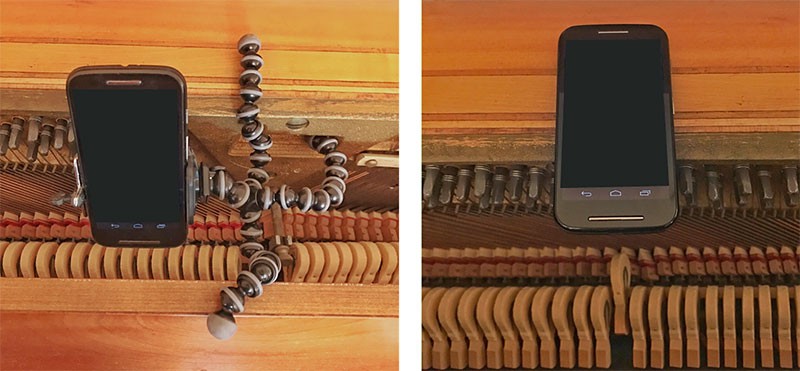
Figure 7. Possible phone placements for your experimental setup.
- In the phyphox app, start a new recording for your first test note by pressing the play button.
- Hold the C2 (two octaves below middle C) string open. Again, depress the key very slowly so that the damper is lifted up, but the hammer does not cause the string to vibrate. There should be no sound. If you do hear sound, let go of the key, wait a second or two (the damper will contact the string and silence it), and try again.
- Then firmly play and release the note you are testing, starting with C3. The app will record the sound of the singing strings.
- Once you do not hear any sound anymore, press the pause button to stop the recording. Make sure to save your data in the app.
- Your data should look something like the graph in Figure 8. You will see a sharp spike in sound intensity once you play your test note (you can ignore any occuring spikes at the very beginning and end of the graph—this occurs when you tap the phone). Then the sound intensity should gradually decrease to background levels again, sometimes showing some bumps as well.
- Measure the time between the beginning (where the peak starts) and end of the sound produced by the singing string (when the sound intensity reaches background levels again). In phyphox, you can use the 'pick data' function to select the respective data points and view their time and decibel values. For example, in Figure 8 the sound started at 8.5 seconds and ended at about 37.3 seconds.
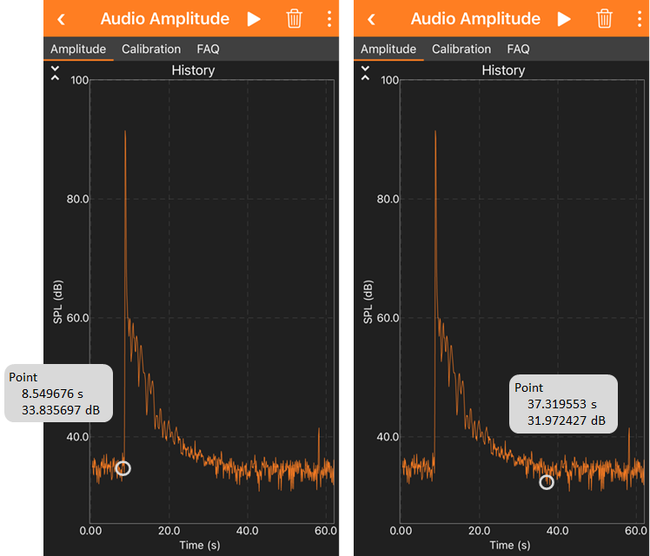
Two graphs record the sound intensity of a note played on a piano. An initial spike in decibel levels occurs at the beginning of the graph when the note is initially played and gradually decreases to background levels as time goes on. A marker is placed on the left graph right before the note is played. A marker is placed on the right graph once the sound of the note disipates.
Figure 8. This example data from the phyphox app demonstrates how to determine the sound duration of your singing string. The x-axes of the graphs are time in seconds [s] and the y-axes shows sound intensity in decibels [dB].
- Calculate the difference between these two time points. In Figure 8 this would be 37.3 s - 8.5 s, which is 28.8 s. Record your result—the duration of the sound (in seconds [s])—in the data table in your lab notebook.
- Repeat the same measurement for each test note (C3 to C4). Before each recording, make sure that your sound sensor is still calibrated or recalibrate it if necessary and save and label each of your recordings appropriately. Try to use the same motion (same amount of force, same acceleration) for each test note you play.
- After finishing each test note in between C3 and C4, repeat all measurements two more times. Depending on how consistent you are in striking the test note, you may need more trials to get consistent results.
- Option 2: Using the stopwatch
- Start by holding the C2 (two octaves below middle C) string open. Again, depress the key very slowly so that the damper is lifted up, but the hammer does not cause the string to vibrate. There should be no sound. If you do hear sound, let go of the key, wait a second or two (the damper will contact the string and silence it), and try again.
- Have your helper count down (3-2-1-go!) and start the stopwatch on "Go!" At the same moment, firmly play and release the first note you are testing (starting with C3).
- Listen carefully to the sound of the C2 string, and at the first moment you can no longer hear it, say "Stop!" Your helper should immediately stop the stopwatch. Write down the duration in your data table.
- Repeat the same measurement for each test note (C3 to C4). Try to use the same motion (same amount of force, same acceleration) for each test note you play.
- After finishing each test note in between C3 and C4, repeat all measurements two more times. Depending on how consistent you are in striking the test note, you may need more trials to get consistent results.
- Once you have finished taking all your measurements, average the duration results for each test note.
- Graph your results (a bar graph aligned with a graphic of the piano keys corresponding to the test notes would be one idea). The duration of the sound on the C2 string is a measure of the strength of the vibrational excitation from the test note. Which test notes excite C2 most strongly? Do you see any patterns in the duration data?
- Figure 9, below, shows the fundamental frequencies for each of the piano strings. Calculate harmonics 1–6 for C2. How do these compare to the fundamental frequencies of the test notes? To their harmonics? Which modes of C2 are excited by which test notes?
- Make calculations for the octave between C2 and C3 (or between C4 and C5). Predict which test notes will produce the longest-duration sympathetic vibrations. Repeat your test with the new test octave and test your hypothesis. What did you learn?
/-/https/www.sciencebuddies.org/cdn/Files/9004/10/piano-phone-setups.jpg)
/-/https/www.sciencebuddies.org/cdn/Files/9005/10/example-graph-timing-piano.png)
/-/https/www.sciencebuddies.org/cdn/Files/3455/5/Phys_img024.jpg)
Figure 9. Fundamental frequencies of the 88 notes on the piano (Irvine, 2000).

Ask an Expert
Variations
- Start with a different open string. Which notes do you predict will make the string "sing" the longest?
- If you are good with using computers and software, you can add digital recording and frequency analysis to this project. Many audio editing programs have this capability. If you do not have such a program on your computer, you can probably find a reasonably priced shareware program on the Web. Try searching for "sound frequency analysis software" or "wav file frequency analysis software." You can try shareware programs before buying them, but if you decide to use the program, do follow through and pay the registration fee. Verify the frequencies of the sympathetic vibrations are what you expect. You can also compare the relative energies of the sympathetic vibrations. Which harmonics are excited most strongly? Does it correlate with the tone duration? Try hitting a second note. Can you hear a chord on the open string? How does this affect the frequencies you record?
Careers
If you like this project, you might enjoy exploring these related careers:
/-/https/careerdiscovery.sciencebuddies.org/cdn/Files/1640/26/Fyysikot_tyossaan.jpg)

/-/https/careerdiscovery.sciencebuddies.org/cdn/Files/1801/18/pexels-photo-4988130.jpg)

/-/https/img.youtube.com/vi/NUKD9qESO58/0.jpg)
/-/https/img.youtube.com/vi/ZAsGHhWxwpM/0.jpg)
/-/https/img.youtube.com/vi/u0P40Pd9EMU/0.jpg)