/-/https/www.sciencebuddies.org/Files/21464/5/sb-logo.png)
/-/https/www.sciencebuddies.org/Files/21464/5/sb-logo.png)
Abstract
Did you know that you can measure the speed of light using a microwave oven, some egg white, and a ruler? Find out how with this cool kitchen science project thanks to Mr. Nick Hood, a science teacher in Fife, Scotland.Summary
Andrew Olson, PhD, Science Buddies
Sources
The idea for this project and the microwave oven images are from:
- Hood, N. (2007). Measuring the Speed of Light in the Kitchen.
We believe the idea behind this science project can be first traced back to this publication:
- Stauffer, R.H., Jr. (1997, April). Finding the Speed of Light with Marshmallows - A Take-Home Lab. The Physics Teacher, 35, 231.
/-/https/www.sciencebuddies.org/Files/3102/5/HumBeh_img019.gif)
Objective
The goal of this project is to measure the speed of electromagnetic waves in the microwave portion of the spectrum by measuring the spacing between hot spots in a microwave oven.
Introduction
Microwaves, like light, are an example of electromagnetic waves. Electromagnetic waves can travel through the vacuum of interstellar space. They do not depend on an external medium-unlike a mechanical wave such as a sound wave which must travel through air, water, or some solid medium. Electromagnetic waves cover a huge range of frequencies, from high-frequency gamma rays and x-rays, to ultraviolet light, visible light, and infrared light, and on into microwaves and radio waves. As the frequency decreases, so does the energy. The wavelength of an electromagnetic wave is inversely proportional to its frequency. So waves with high frequency have short wavelengths, and waves with low frequency have long wavelengths.
Electromagnetic waves interact with materials in different ways, depending on the nature of the material and the frequency of the electromagnetic wave. Microwaves work well for cooking because their energy can be efficiently absorbed by molecules commonly found in food, including water, sugars, and fats. The absorbed microwave energy heats these molecules and cooks the food. As you can see in Figure 1 below, the range of microwave wavelengths is from 0.01 cm to 10 cm.
/-/https/www.sciencebuddies.org/Files/3102/5/HumBeh_img019.gif)
The electromagnetic spectrum extends from very short wavelength gamma rays to very long wavelength radio waves. The focus of this diagram is to display the portion of the spectrum that is visible to the human eye. Wavelengths between 400 and 700 nanometer are visible as colors and make up a very small portion of the electromagnetic spectrum.
Figure 1. The electromagnetic spectrum. Electromagnetic radiation covers a huge range of wavelengths. Light (the part of the electromagnetic spectrum that we can detect with our eyes) is only a small portion of this range. X-rays, light, and microwaves are all examples of electromagnetic waves. (Illustration from Abrisa Glass & Coatings, 2005)
In this project you will take advantage of some physical properties of waves in order to estimate the speed of light. These properties are interference and the relationship between a wave's speed, its frequency, and its wavelength. Interference is what happens when multiple waves interact. For example, at the beach, the incoming waves from the ocean and the outgoing waves from the surf drawing back from the beach interfere with one another. When two wave crests coincide, they combine to make an even higher crest. When two wave troughs coincide, they combine to make an even lower trough. When a wave crest and a wave trough coincide, they tend to cancel each other out. Interference is the name physicists use for this kind of combination of waves.
In a microwave oven, interference occurs between waves that are reflected from the inside surfaces of the oven. The interference patterns can create "hot" and "cold" spots in the oven-areas where the microwave energy is higher or lower than average. This is why many microwave ovens have rotating platters to promote more even cooking of the food. In the experiment described below, you'll remove the rotating platter (if your oven has one) in order to see the effects of the interference pattern on your cooking. You'll cook an egg white just long enough for some parts of the egg to solidify, while the rest remains partially cooked. The egg white will cook fastest at the hot spots in the oven. The distance between the hot spots will be equal to half of the wavelength of the microwaves. You will be able to measure the distance between the hot spots by measuring the distance between the cooked portions of the egg.
So measurements from your cooking will give you the wavelength of the microwaves. With one more piece of information, the frequency of the waves, you will be able to calculate the speed of light. You should be able to find the frequency of the microwaves on a label on the back of the oven. The frequency (f), wavelength (λ, and wave speed (v) are related by the equation: v = f λ.
The Experimental Procedure section has all the details for doing the experiment. Do your background research and then go cook some eggs and see what they can tell you about the speed of light.
Terms and Concepts
To do this project, you should do research that enables you to understand the following terms and concepts:
- Waves
- Frequency
- Wavelength
- Speed
- Standing waves
- Interference
- Electromagnetic spectrum
- Microwaves
- Microwave oven
- Magnetron
Questions
- What is the relationship between wave speed, frequency, and wavelength?
Bibliography
- For more information on the physics of microwave ovens, see:
Baguley, R and McDonald, C. (Dec 1,2014). Appliance Science: The tasty physics of microwave ovens. Retrieved April 12, 2018. - For more background information on waves, standing waves, and interference, see the following:
The Physics Classroom. (n.d.). Waves. Retrieved May 5, 2014.
Materials and Equipment
To do this experiment you will need the following materials and equipment:
- Microwave oven
- Plate (safe for use in microwave)
- Oven mitts
- 3-6 eggs
- Ruler
- Calculator
Experimental Procedure
/-/https/www.sciencebuddies.org/Files/20483/6/icon-flask.png)
- Do your background research so that you are familiar with the terms, concepts, and questions in the Background section.
-
If your oven has a rotating platter, remove it. You won't be able to detect "hot spots" in the oven if your test plate is moving.
- Tip: you may not be able to remove the drive mechanism for the turntable in your oven. In that case, you can make a support for your egg plate by placing a flat-bottomed, microwave-safe bowl upside down over the drive mechanism. Naturally, the bowl needs to be large enough so that the drive mechanism does not touch it. It also needs to provide sturdy support for the plate used for cooking the eggs.
/-/https/www.sciencebuddies.org/Files/3103/9/Phys_img056.jpg)
Figure 2. A microwave oven with the rotating platter removed and drive mechanism removed. If the drive mechanism on your oven does not come out easily, follow the instructions above. (Hood, 2007)
- Crack an egg and separate out the egg white (allow the white to drain into a bowl, and hold the yolk back in one half of the broken shell).
-
Pour some of the egg white onto a microwave-safe plate.
- You should have puddles (or stripes) of egg white that are at least 12 cm in diameter (in length).
- To sample over the largest area possible, use a plate that is close to the inside dimensions of the microwave.
-
Put the plate in the oven, close the oven door, and cook the egg.
- You'll probably need to experiment to find the ideal cooking time for your particular oven. 30 seconds may be a good starting point. If the egg is completely cooked, start over and decrease the time. If the egg is still totally uncooked, increase the time. If you don't disturb the plate, you can simply add more time. If the plate moves, you'll need to start over with a fresh plate of uncooked egg white.
- The ideal result is to have egg white that is partially cooked in some places, and nearly completely cooked in other.
- Use oven mitts to remove the plate from the oven. Be careful not to move the egg on the plate. Allow the plate to cool.
-
Measure the spacing between the cooked portions of the egg. Notes:
- The centers of the cooked portions will not be clearly defined.
-
Your goal in making this measurement is to find:
- the average distance between the cooked portions, and
- an estimate for the error of your measurement.
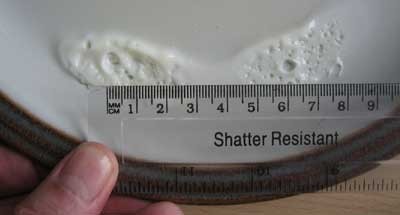
Figure 3. Using the cooked portions of the egg white to measure the distance between "hot spots" in the microwave oven. (Hood, 2007)
- Measuring the "center-to-center" distance between adjacent cooked portions will give you the average spacing of the hot spots.
- Measuring the "edge-to-edge" distances (both shortest and longest) between adjacent cooked portions will give you upper and lower bounds on the error of your measurement.
- Clean and dry the plate, and repeat the experiment at least three times.
-
Look at the label on the back of the microwave to find the frequency of the microwave radiation the oven produces (see the illustration below). Alternatively, you may find this information in the user's manual for the oven.
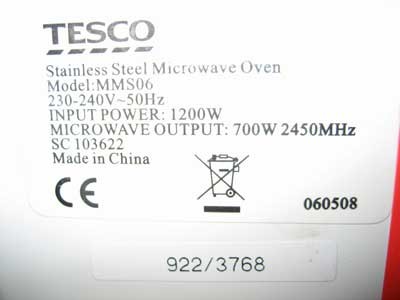
Figure 4. Example of a microwave oven label, showing the frequency of the microwave radiation: 2450 MHz. (Hood, 2007)
- The spacing of the hot spots will be equal to one-half of the wavelength of the microwaves.
- Calculate the speed of the microwaves using the wavelength (measured) and frequency (from the oven label). Remember to use your upper and lower boundary measurements to put error limits on your measurement.
- How closely does your calculation agree with published values for the speed of light?
/-/https/www.sciencebuddies.org/Files/3104/9/Phys_img057.jpg)
/-/https/www.sciencebuddies.org/Files/3105/9/Phys_img058.jpg)

Ask an Expert
Variations
- The Science Buddies project Using a Laser to Measure the Speed of Light in Gelatin has another method for measuring the speed of light in your kitchen.
- For another experiment on standing waves, see the Science Buddies project How to Make a Guitar Sing.
Careers
If you like this project, you might enjoy exploring these related careers:
/-/https/careerdiscovery.sciencebuddies.org/Files/1640/26/Fyysikot_tyossaan.jpg)

/-/https/careerdiscovery.sciencebuddies.org/Files/1649/17/pexels-photo-1181398.jpg)

/-/https/img.youtube.com/vi/lyvWd-TqqLI/0.jpg)
/-/https/img.youtube.com/vi/fuwGvZ-eOrc/0.jpg)
/-/https/img.youtube.com/vi/GFJSwrSvlN4/0.jpg)