
Abstract
How do conservation biologists know which places are important to protect? How do nature guides know which animals can be found in which places? In this experiment you can discover how maps can be used to show how different animals are distributed in a local environment.Summary
Sara Agee, Ph.D., Science Buddies
This project is based on a DragonflyTV episode.
Objective
In this science fair project, you will make and use maps to investigate the distribution of different kinds of animals in your local environment.
Introduction
Biogeography is a branch of science that studies changes in the distribution of life forms on the planet over time. A distribution is the area where you can find a plant or animal, and can be shown on maps by marking a geographical range where the organism is found. Different organisms have different distributions, some are very rare while others are nearly everywhere. Cosmopolitan species, like the common housefly, have a very broad distribution and can be found almost world-wide. Other species are endemic, like the Giant Panda, and are very rare because they are only found in a small geographical region. Often times, a rare endemic species may be at risk for extinction, and in need of protection.
Changes in the distribution of a species can be natural or due to human impact on the environment. Human activity and movement across the globe have allowed some species to move into new environments, and so are called exotic species. Sometimes, an exotic species can become an invasive species, which means it spreads rapidly in new environments and competes with native species for resources. Often, a cosmopolitan species is also an invasive species.
It can be very difficult to remove an invasive species, because usually they have no natural predators in their new environment. Sometimes an invasive species can put a native species at risk, which can be a problem for sensitive species that are already endangered. For example, the melaleucas tree is an invasive species in the Florida Everglades. Originally from Australia, the melaleucas tree spreads so rapidly that it does not give the native plants a chance to grow. Without the native plants, the entire ecosystem of the Everglades is changing, which puts endangered species, like the Florida panther, at even greater risk. To try to stop the growth of the melaleucas tree and rescue the native species, wildlife officials have imported an Australian bug, called a weevil, which eats the melaleucas tree.
You don't need to travel all the way to the Everglades to make species maps though! In this science fair project, you will do some field work to make a map to describe the distribution of species in your neighborhood. How much biodiversity exists in your local environment? Are there areas with cosmopolitan or endemic species? Are there areas with invasive or native species? Can the maps you make help you identify places around your home that can be restored to provide more native habitat?
Terms and Concepts
To do this type of experiment you should know what the following terms mean. Have an adult help you search the internet, or take you to your local library to find out more!
- Biogeography
- Biodiversity
- Species
- Distribution
- Cosmopolitan species
- Endemic species
- Endangered species
- Native species
- Exotic species
- Invasive species
- Extinction
Bibliography
- World Wildlife Fund. (n.d.). Protecting Wildlife for a Healthy Planet. Retrieved August 13, 2020.
- NOAA. (2022, April 19). NOAA showcases new mapping tool for marine species. National Oceanic and Atmospheric Administration. Retrieved May 16, 2023.
- TPT. (2006). Weevils by Elissa and Julia. DragonflyTV, Twin Cities Public Television. Retrieved November 25, 2008.
Materials and Equipment
- Plain white 8.5x11 sheets of Xerox paper
- 3-ring binder
- Drawing pencil
- Eraser
- Black marker
- Colored pencils, crayons, or markers
- Copy machine or scanner
- Digital camera
- Magnifying glass if you want to look at small creatures; available through online suppliers such as Carolina Biological Supply Company
- Binoculars for looking at birds and mammals; available through online suppliers such as Carolina Biological Supply Company
- Observation site—your home, backyard, park, marina, lake, etc.
Disclaimer: Science Buddies participates in affiliate programs with Home Science Tools, Amazon.com, Carolina Biological, and Jameco Electronics. Proceeds from the affiliate programs help support Science Buddies, a 501(c)(3) public charity, and keep our resources free for everyone. Our top priority is student learning. If you have any comments (positive or negative) related to purchases you've made for science projects from recommendations on our site, please let us know. Write to us at scibuddy@sciencebuddies.org.
Experimental Procedure
-
First choose your observation site. It should be a place you like to explore and where you think you might find a diversity of organisms. If you are not going to do the experiment at home, make sure you get a parent to accompany you on your expedition. Good places to choose are:
- a backyard,
- community garden,
- open field,
- park,
- pond,
- lake,
- wetland,
- marina,
- tidepool,
- stream,
- wooded area, or
- desert.
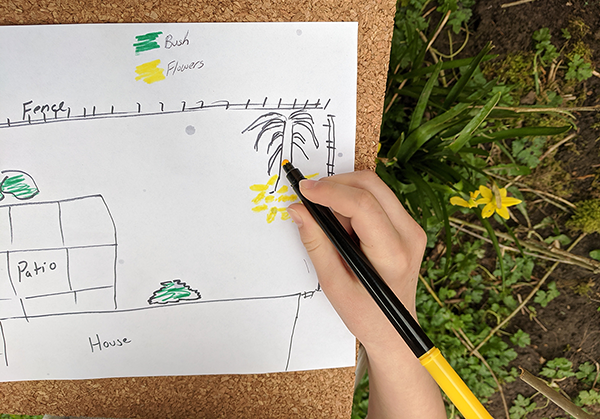
- Next, you will need to map out your location on a piece of plain white Xerox paper. Use a drawing pencil to draw in the structure of your test site as you walk around. For example, if you use your backyard you will want to draw the location of your house, the patio, a shed, etc. Try your best to draw the location to scale, but it doesn't need to be perfect.
- When you are satisfied, use a black marker to trace over the image with strong, clean lines. Then use a good quality eraser to erase all of your pencil markings.
- Use a copy machine or a scanner to make several copies of your map. You will use these to color in the distributions of different organisms as you make your observations. Put all of your copies in a 3-ring binder to bring with you to make your observations at your test site.
- For your location, choose a good time to go out and observe. Depending upon what you are observing, you may want to sit quietly or walk around and explore. If you are observing plant life, you will want to walk all around your site to see which plants grow in each of the different areas of your map. If you are observing birds, you may want to sit quietly with a pair of binoculars. If you are observing animals, be patient they will eventually come around. If you are observing bugs, you will want to explore and even dig around under rocks or with a shovel. Bring a magnifying glass to look for very small animals in the soil, leaves or under rocks.
- Use a new copy of your map for each organism that you survey for. Use colored pencils to shade in areas where each organism is found. For example, if there is grass in the middle of your yard, choose a color to represent grass and use it to shade in a region where the grass is on your map. Be sure to label each area after you draw it on your map.
- Use a digital camera to take pictures of the organisms you find to help you identify them later. Pictures will also be a nice addition to your poster. You may also want to consult a nature guide for your area to help you identify the plants and animals.
- Write down some notes about each organism, what it looks like, where you saw it, and what you think it is. Don't worry if you can't identify something right away, if you write it down and take a picture, you can figure out what it is later. Use a field or nature guide to help you, there is one available on the web at eNature.com. One time digging in my garden I found a kind of long, skinny newt. After looking on the internet I found out it was a California Slender Salamander, and now I see them in my garden every year.
- When you are done, you will have a notebook full of different organisms, some pictures, their locations and distributions, and some notes and information about them. You may want to assemble the information into a large map that includes all of your data. Use a different color for each organism and remember to include a color key, or legend.
- How many different species were in your location? Which areas had the most different kinds of species? Are there areas with invasive species on your map? Are there any interesting native species on your map? Can you think of a project to invite more native species in your project area?

Ask an Expert
Global Connections
The United Nations Sustainable Development Goals (UNSDGs) are a blueprint to achieve a better and more sustainable future for all.

Variations
- In this experiment you have surveyed the distribution of species at one location. For a slightly more difficult project, you could survey two or more locations and compare. How do your local parks compare to each other? Try comparing your yard to the yards of your friends and neighbors. Try comparing business areas to residential areas. If you live near the coast, you could compare the shoreline along a park to a more industrial zone. How do the species compositions change? How can these types of experiments tell you about the composition and health of your local environment?
- Do you have a pen-pal or relative who lives in a very different environment than you? Perhaps you live in the Arizona desert and she/he lives near the beach in Florida? This is a perfect way to share data and compare two very different environments for species diversity. Have your friend do the same survey, and trade data with each other. Are there some differences in the kinds of plant and animal species you each find? Are there some cosmopolitan species that you both saw?
- Sampling for biodiversity is one way that scientists identify important regions for conservation. Is there an area near you that is protected for conservation? Research the area and find out what unique animals are there, and why the area is being protected. Conduct your own biodiversity survey there to show which types of animals live there. Remember to think about migratory or seasonal animals too.
Careers
If you like this project, you might enjoy exploring these related careers: