/-/https/www.sciencebuddies.org/cdn/Files/21464/5/sb-logo.png)
/-/https/www.sciencebuddies.org/cdn/Files/21464/5/sb-logo.png)
Abstract
Have you ever stopped to watch a trail of ants moving back and forth between a food source and their nest? Have you ever wondered how they establish their trail? You've probably read that ants use chemical signals to communicate with one another. This is a relatively simple experiment that you can do to determine whether ants use attractant signals (positive cues) or repellant signals (negative cues) or both.Summary
Andrew Olson, Ph.D., Science Buddies
Sources
This project is based on a paper by Elva Robinson and colleagues at the University of Sheffield. The research was also described in a Science News article.
- Robinson, E.J., et al., 2005a. "Insect Communication: 'No Entry' Signal in Ant Foraging," Nature 438(24 November):442. Available online at: http://www.lasi.group.shef.ac.uk/pdf/RobinsonNegPhero.pdf.
- Robinson, E.J., et al., 2005b. "Supplementary Information," (companion to above-cited article) Nature. Retrieved May 24, 2006.
- Milius, S., 2005. "Unway Sign: Ant Pheromone Stops Traffic," Science News 168 (26 November):340-341.
/-/https/www.sciencebuddies.org/cdn/Files/2490/5/Zoo_img004.jpg)
Objective
The goal of this project is to study ant pheromones, the chemical signals that ants use to mark trails. Ants produce attractant pheromones to mark trails that lead to food sources. Do they also produce a "do not enter" signal to mark paths that do not lead to food?
Introduction
Ants use chemical signals called pheromones to communicate with one another. Among other functions, pheromones serve to identify nestmates, to mark foraging trails, and to alert the colony when members are injured. The queen also produces a special pheromone that prevents other females in the colony from laying eggs (Wikipedia contributors, 2006).
The flow chart below describes how foraging Pharaoh's ants communicate to the colony that they have found a food source (Hutchinson, date unknown). It is a fascinating system: with just a few simple rules, the ants self-organize their behavior to benefit the colony.
/-/https/www.sciencebuddies.org/cdn/Files/2490/5/Zoo_img004.jpg)
A positive feedback loop occurs in a foraging ant's communication. First scouts locate a food source. Then they return to the nest laying a pheromone trail. Worker ants follow the pheromone trail to the food source. If no food is found then the pheromone trail will slowly evaporate. However, if the initial trail leads to a food source the worker ants will reinforce the pheromone trail. The stronger pheromones will increase the number of worker ants who follow the trail and then more ants are able to reinforce the pheromone trail. The cycle continues until no more food is found at the end of the trail, ants stop reinforcing the pheromone trail and then the trail slowly evaporates.
The Bibliography includes a webpage where you can run a computer simulation that shows how simple rules mimicking ants and pheromones will self-organize into an efficient trail between a food source and the nest (Kan, date unknown). If you are interested in computer programming and want to explore this simulation further, see the Variations section, below, for more information.
You can do a hands-on investigation of ant trail-making and pheromones with a simple experimental apparatus that you can build yourself. The idea is to use small Y-shaped platforms, raised up a short distance from the ground (see Figure 1, below).
/-/https/www.sciencebuddies.org/cdn/Files/2491/3/Zoo_img005.jpg)
One platform is used as a test platform. The other platform is used as a "production platform" for trail pheromones. Both platforms are covered with paper so that you can cut out and move sections of the pheromone trails in order to perform a test. You provide the ants with a path to the base of the Y. When the ants reach the fork of the Y, they will have to make a choice between the two paths. You can use this choice point to investigate whether the pheromones on paper from a "food" branch will cause different behavior from the pheromones on paper from a "non-food" branch. Details are given in the Experimental Procedure section, below.
Negative trail pheromones, which discourage ants from following unproductive foraging paths, are a recent discovery in ant communication by Elva J.H. Robinson and colleagues at the University of Sheffield in England (see Robinson, 2005a; Milius, 2005, in Sources section, below). This signal was discovered in a species of tiny ants called Pharaoh's ants, which often make their nests in the walls of buildings. So if you do this experiment with another species of ant, you may end up discovering a signal that was not known before! On the other hand, you might also find that your species does not use negative signals. But that's what science is all about: finding out. So why not try it and find out?
Terms and Concepts
To do this project, you should do research that enables you to understand the following terms and concepts:
- pheromones,
- ant communication,
- social insects.
Bibliography
- Wikipedia contributors, 2006. Ant, Wikipedia, The Free Encyclopedia. Retrieved May 22, 2006.
- For information on Pharaoh's ants, the species used in the original study that identified a "do not enter" pheromone, see:
Hutchinson, S., date unknown. "Pharaoh's Ants, Monomorium pharaonis," Department of Animal and Plant Sciences, University of Sheffield. Retrieved May 22, 2006. - Here are two great websites with information on ants:
- AntWeb.org, 2006. AntWeb,. Retrieved June 9, 2006.
- JADG, 2003. Ant Image Database 2003, Japanese Ant Database Group. Retrieved June 9, 2006.
- This book is by two world-renowned ant experts (myrmecologists), but is written for the general reader.
Hölldobler, B. and E.O. Wilson, 1994. Journey to the Ants, Cambridge, MA: The Belknap Press of Harvard University Press.
Materials and Equipment
To do this experiment you will need the following materials and equipment:
- a sweet-eating ant colony,
- stiff cardboard for making Y platforms and feeder disks,
- ruler,
- scissors,
- utility knife,
- tweezers or stamp tongs for handling paper with pheromone trails,
- pencil,
- paper for covering platforms,
- food source (strong sugar solution),
- small, soft paint brush for sweeping ants off path during testing,
- blocks of wood (for raising platform off ground),
- removeable glue stick (e.g., Post-It type).
- Optional: video camera and tripod for recording experiment.
Experimental Procedure
/-/https/www.sciencebuddies.org/cdn/Files/20483/6/icon-flask.png)
-
Make two (or more) Y-shaped platforms similar to the ones shown in Figure 2. The material used should be stiff enough to support its own weight when only the base of the "Y" is anchored. (Dimensions shown are for Pharaoh's ants, worker size about 2 mm long. Adjust accordingly for larger ants.)
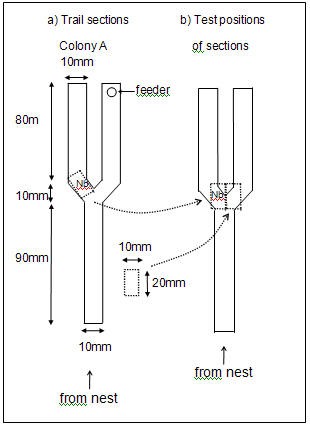
Two Y-shaped platforms are identical in size. Both are 10 millimeters wide at the base and travel up 90 millimeters before splitting into two arms. The platform measures 180 millimeters from the top of both arms to the bottom of the base. A feeder is placed at the end of one arm on the production platform and a rectangular piece of paper measuring 10 millimeters by 20 millimeters is placed near the split of the second arm that does not have a feeder. On the test platform two rectangles of paper are placed directly over the split.
Figure 2. Diagram of Y-shaped experimental platform, with dimensions. The base of the Y is raised from the ground on the block, so there is only one path leading to the fork. Provide a short ramp up to the block, if needed. For the negative trail pheromone experiment described, the "production platform" is on the left, and the "test platform" is on the right.
- Trace the platforms on paper. Cut out paper Y's to use as platform covers.
- Cut out some 10 mm x 20 mm test sections (marked "NB" in Figure 2) to use as control paper (see step 8).
- Make small feeder disks from glossy cardboard (e.g., cereal box).
- For food, make a concentrated sugar solution by dissolving about 1/3 cup of sugar in 1 cup (final volume) of water. Use a drop of this solution on the feeder disk.
- As mentioned in the Introduction, you will use a pair of platforms. One will be the test platform and the other will be the production platform. The production platform will be used as the source of the paper with the pheromone trail you want to test. The test platform provides a source of ants and a choice point. The steps that follow show how you would test for a negative ("do not enter") trail pheromone.
- Both platforms should be covered with paper, so that the trail pheromones can be removed. To keep them from blowing away, you can tack them down with removeable glue stick (e.g., Post-It type). The test sections (marked "NB" in Figure 2, above) should be pre-cut so that you can easily peel them off.
- Put pieces of test paper (step 3) somewhere near the nest, but not on a regular trail. These will be your control papers. You want the ants to find them and mark them as part of their territory. Using fresh paper instead might cause the ants to recognize it as new territory, and stimulate a recruitment response.
-
When you are testing for a "do not enter" trail pheromone, your test platform should have a food source on each branch of the Y, and your production platform should have a food source on only one branch of the Y, as shown in Figure 3.
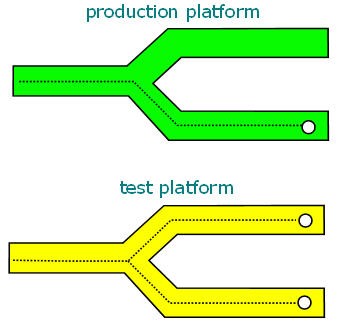 Figure 3. Diagram of production and test platforms used for the negative trail pheromone experiment.
 - Place the platforms near a nest entrance. Be patient, and wait for the ants to establish a trail pattern as shown by the dotted lines in Figure 3. Note the start time in your lab notebook. Take notes on how long it takes the ants to explore the platforms, locate the food sources, and establish trails. Optional: record experiment with video camera.
-
Once the trails are well-established, you can perform the test.
- Mark the choice point on the trail with a pencil. This is the place where the ants turn to the fork with food.
- Gently remove the ants from the production platform, using the soft brush. You don't want to squash the ants, which would release alarm pheromones.
- Remove the production platform, taking care not to touch the trail surfaces.
- Peel out a piece of paper from the non-food branch of the Y. If necessary trim it so that what you have left starts just past the choice point (see Figure 2). Take care not to touch the trail surface. Wear gloves, and handle the paper with tweezers or (better yet) stamp tongs, which are tweezers made for holding paper.
- This is your test paper. You are going to see if it contains a negative pheromone by placing it at the choice point on the test platform. Before you do this, you'll need to brush the ants away from the choice point, and brush off all the ants on the branches of the test platform (disturb the main trail as little as possible, you want the ants to keep coming). Peel off the pre-cut sections at the choice point, and replace one of them with your test paper, and the other with a piece of control paper.
- Now you need to observe the ants that approach the choice point to see what they do. Since pheromones dissipate with time, you want to test over a limited time window. In the original paper, the scientists recorded the response of the first 25 ants to reach the choice point. Then they switched the positions of the control paper and the test paper, and recorded the responses of the next 25 ants. This was to prove that the signal was coming from the paper, and not visual or other external cues.
- If there is a negative trail hormone, you would expect that more ants would choose the control paper branch. Another behavior you might see is the U-turn, where the ants turn around and head back the way they came. A negative trail pheromone would be expected to cause more U-turns than the control paper.
- To test for a positive trail hormone, simply reverse the roles of the test platform and production platform. The production platform should have food sources on both branches, and the test platform should have a food source on only one branch. Test to see if replacing the paper at the choice point causes the ants to choose the previously unused branch.
/-/https/www.sciencebuddies.org/cdn/Files/2492/5/Zoo_img006.jpg)
/-/https/www.sciencebuddies.org/cdn/Files/2493/3/Zoo_img007.jpg)

Ask an Expert
Global Goals
The United Nations Sustainable Development Goals (UNSDGs) are a blueprint to achieve a better and more sustainable future for all.
/-/https/www.sciencebuddies.org/cdn/Files/19758/6/E-WEB-Goal-15.png)
Variations
- What is the spatial extent of the pheromone trail? Is the length different for positive and negative cues? Try taking test sections from different points along the production platform Y to answer these questions.
- Advanced. Did you think that the simulation in the Bibliography was pretty cool? If you're interested in computer programming, you could make an excellent project by extending the model used in the simulation. The simulation was written using the NetLogo programming environment, which you can find out about here: http://ccl.northwestern.edu/netlogo/docs/. To simulate this experiment, you'd need to make two changes to the model:
- Modify the environment so that the simulated ants have to navigate a Y-shaped path. One branch would have a food source and the other branch would not.
- Add a "do not enter" pheromone, including rules for when ants should deposit it, and how ants should respond when they encounter it.
There are many other interesting experiments you could try with the simulation. For example, you could vary the amount of time that a trail pheromone lasts and see what effects this has when the food source is depleted.
Careers
If you like this project, you might enjoy exploring these related careers:
/-/https/careerdiscovery.sciencebuddies.org/cdn/Files/1900/17/iStock-1191167137.jpg)

/-/https/careerdiscovery.sciencebuddies.org/cdn/Files/947/17/pexels-photo-3825412.jpg)

/-/https/img.youtube.com/vi/jhRyistosQk/0.jpg)
/-/https/img.youtube.com/vi/P6PGedCKrUM/0.jpg)
/-/https/img.youtube.com/vi/nGo3A980PtE/0.jpg)