/-/https/www.sciencebuddies.org/Files/21464/5/sb-logo.png)
/-/https/www.sciencebuddies.org/Files/21464/5/sb-logo.png)
Abstract
Has your house ever suffered an ant invasion? This project is an interesting way to investigate what substances are effective as ant repellents. The goal is to find substances that keep ants away, yet are safe for humans and the environment.Summary
Andrew Olson, Ph.D., Science Buddies
Sources
This project is based on the following 2007 California State Science fair project, a winner of the Science Buddies Clever Scientist Award:
- Shu, C.V., 2007. The Defense Against Ants II: Why Are Ants Afraid of Baby Powder? California State Science Fair abstracts. Retrieved May 25, 2007.
/-/https/www.sciencebuddies.org/Files/3040/3/Zoo_img023.jpg)
Objective
The goal of this project is to find an effective method for repelling ants that is safe for humans and the environment.
Introduction
Has your house ever been invaded by ants? Ant colonies are everywhere, and their scouts are always out looking for food sources. Once they find a food source, the scouts carry food back to the nest, leaving behind a chemical trail of pheromones that other ants can follow to find the food. The pheromones are volatile chemicals that evaporate over time. However, as more ants travel to and from the food source, the pheromone trail becomes more and more concentrated. Soon there is a heavy trail of workers passing back and forth between the nest and the food.
Once this happens, it can be hard to get rid of the ants. You can kill the ants and clean up the trail, but soon more scouts come exploring, starting the process all over again. Is there a way to discourage the scouts without using toxic pesticides that may be harmful to human health and the environment?
In this project-based on an entry to the 2007 California State Science Fair (Shu, 2007)-you'll build a simple apparatus that you can use to test various substances as ant repellents. The apparatus consists of two wide-mouth, transparent bottles capped with quilt batting material. (The batting material is held in place with a rubber band. It allows air exchange but keeps ants in.) The two bottles are connected by clear tubing, which passes through the batting material. (The tubing can be secured with another rubber band, if needed.) Ants are placed in one bottle, and a food source is placed in the other bottle. The repellent substance to be tested in placed in the tubing connecting the bottles. To measure the effectiveness of the repellent, count the number of ants in the food source bottle at the end of 30 minutes. Obviously, the fewer the ants, the more effective the repellent.
Terms and Concepts
To do this project, you should do research that enables you to understand the following terms and concepts:
- Ants
- Social insects
- Ant behavior
- Ant scouts
- Ant foraging
- Ant repellents
Questions
- What material qualities make a good ant repellent?
Bibliography
- Here are two great websites with information on ants:
- AntWeb.org, 2006. AntWeb,. Retrieved May 25, 2007.
- JADG, 2003. Ant Image Database 2003, Japanese Ant Database Group. Retrieved May 25, 2007.
-
This book is by two world-renowned ant experts (myrmecologists), but is written for the general reader.
Hölldobler, B. and E.O. Wilson, 1994. Journey to the Ants, Cambridge, MA: The Belknap Press of Harvard University Press. - For ideas on different substances to test as ant repellents, try this webpage:
Berkeley Parents Network, 2006. Getting Rid of Ants, Berkeley Parents Network. Retrieved May 25, 2007. - This project idea is from the 2007 California State Science Fair:
Shu, C.V., 2007. The Defense Against Ants II: Why Are Ants Afraid of Baby Powder? California State Science Fair abstracts. Retrieved May 25, 2007.
Materials and Equipment
To do this experiment you will need the following materials and equipment:
- Ants, available from Carolina Biological, item #: 144526. You will need 20 anys for each test condition.
- 6 (or more) small, wide-mouth, clear glass or plastic bottles:
- Available from local craft store
- Also available online: part number 60406228891 from save-on-crafts.com
- Clear plastic or vinyl tubing, (length: 15 cm, inner diameter: 1.2 cm, outer diameter: 1.6 cm; exact dimensions not critical)
- Quilt batting material (allows air exchange from bottle, but keeps ants in)
- Rubber bands
- Dust mask, available from Carolina Biological, item #: 972333
- Disposable gloves. Can be purchased at a local drug store or pharmacy, or through an online supplier like Carolina Biological. If you are allergic to latex, use vinyl or polyethylene gloves.
- Sugary food source (e.g., sugar cubes or crushed candy)
- Clock or timer
- Bottle brush or old toothbrush
- Choose three or more of the following potential repellents to test:
- Talc
- Baby powder
- Finely ground nutmeg
- Finely ground cinnamon
- Salt
- Sandpaper
Disclaimer: Science Buddies participates in affiliate programs with Home Science Tools®, Amazon.com, Carolina Biological, and Jameco Electronics. Proceeds from the affiliate programs help support Science Buddies, a 501(c)(3) public charity, and keep our resources free for everyone. Our top priority is student learning. If you have any comments (positive or negative) related to purchases you've made for science projects from recommendations on our site, please let us know. Write to us at [email protected].
Experimental Procedure
/-/https/www.sciencebuddies.org/Files/20483/6/icon-flask.png)
- Do your background research so that you are knowledgeable about the terms, concepts, and questions, above.
- Select at least three potential ant repellents to test.
-
The test apparatus is quite simple to make:
-
The test apparatus is made from two wide-mouth transparent bottles (glass or plastic).
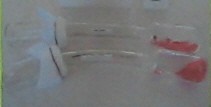
Figure 1. Ant repellent test apparatus (illustration from photo of project display board, Shu, 2007). - Place the sugary food source in one of each pair of bottles.
- Cover the opening of each bottle with quilt batting, or similar material (as shown for the bottles on the left in the illustration above).
- Put the repellent to be tested into the tubing (wear gloves and dust mask for this step). Cover both ends of the tubing tightly and shake to disperse the material evenly. Tip: from this point on, keep the tube horizontal to avoid spilling the test substance.
- Insert the tubing through the quilt batting material. Use a rubber band to attach the batting to the tube, if needed.
-
The test apparatus is made from two wide-mouth transparent bottles (glass or plastic).
-
For testing the effectiveness of each repellent, use the following steps:
- Take off the rubber band to remove the quilt batting over the empty bottle.
- For each test, place the same number of ants (20-30) in the empty (non-food-containing) bottle.
- Re-cover the bottle, keeping the connecting tube in place.
- Wait for 30 minutes, then count how many ants are in the bottle containing the food, and record this number in your lab notebook.
- After each trial, the tube should be cleaned with soapy water and a brush (bottle brush or old toothbrush), then rinsed and dried (you can speed up drying by using a hair dryer on the cool setting).
- Complete at least three separate trials for each repellent that you test.
- Which substance(s) were ineffective repellents?
- Which substance(s) were effective repellents?
- Was any repellent 100% effective?
- If there were multiple effective repellents, did they have qualities in common?
/-/https/www.sciencebuddies.org/Files/3040/3/Zoo_img023.jpg)

Ask an Expert
Variations
- Extend the project by trying to figure out what material properties make an ant repellent effective. Is it the particle size, the smell of the material, or some other quality that repels the ant? To test if odor is the key component, enclose the material in an open-ended, smaller-diameter tube and place it in the tube that connects the two bottles. The odor of the material will be present, but the ants won't be forced to touch the material. To test particle size, you will need to prepare samples of the material with different particle sizes. For example, with cinnamon you could crush or grind cinnamon sticks to different degrees of fineness.
- For a more basic experiment on ant repellents, see the Science Buddies project Drawing Circles Around Ants.
Careers
If you like this project, you might enjoy exploring these related careers:
/-/https/careerdiscovery.sciencebuddies.org/Files/1900/17/iStock-1191167137.jpg)

/-/https/careerdiscovery.sciencebuddies.org/Files/1107/19/pexels-photo-3938023.jpg)
/-/https/careerdiscovery.sciencebuddies.org/Files/1100/18/unsplash-NP6JLl_2C-c.jpg)
/-/https/careerdiscovery.sciencebuddies.org/Files/20209/5/chemical-engineer-citgo.jpg)

/-/https/img.youtube.com/vi/qFefTN5vyMM/0.jpg)
/-/https/img.youtube.com/vi/dxC_GuLNiAs/0.jpg)
/-/https/img.youtube.com/vi/a9Nn3ppWhK0/0.jpg)