/-/https/www.sciencebuddies.org/Files/21464/5/sb-logo.png)
/-/https/www.sciencebuddies.org/Files/21464/5/sb-logo.png)
Abstract
Are you curious about the birds that live in your neighborhood? Would you like to find out more about them: what they look like close up, what they eat, how they sing? In this project you'll build a bird feeding platform with four separate feeding areas. You'll be able to observe birds at close range, find out what birds inhabit your area, and learn about their seed-eating preferences. So get out your woodworking tools and binoculars, and get ready to see some birds.
Summary
None
Readily available
Adult supervision required for using power drill and staple gun
This project is based on the following 2007 California State Science fair project, a winner of the Science Buddies Clever Scientist Award:
- Fukumitsu, K.S., 2007. Dining with the Birds: What Type of Seeds Do Birds Prefer to Eat? California State Science Fair Abstract. Retrieved May 31, 2007.
/-/https/www.sciencebuddies.org/Files/3046/8/Zoo_img027.jpg)
Objective
The goal of this project is to investigate the seed-eating preferences of local birds.
Introduction
If you'd like to learn more about the birds in your area, then building a bird feeder is a great way to do that. A well-placed feeder will attract birds, allowing you to get a close-up look without disturbing the birds from behind a nearby window.
This project shows you how to design and build a four-part feeder that will make it easy to figure out what types of seeds your local birds like best. The project is based on an entry to the 2007 California State Science Fair (Fukumitsu, 2007). With this design, you can easily measure the rate at which different types of seeds are consumed. You can also observe which species of birds prefer which part of the feeder. This will give you insight into species-specific seed preferences for your local bird population.
You should do background research on the types of birds in your area. Find out about each bird's preferred habitat and diet. With the right food, you may be able to attract some birds that you don't normally see otherwise. So spend some time in your wood shop, then get out your binoculars and start watching birds!
Terms and Concepts
To do this project, you should do research that enables you to understand the following terms and concepts:
- Birds
- Bird watching
- Bird feeders
- Bird migration
- Ornithology
Questions
- What bird species are native to your area?
- What bird species pass through your area during migration, and when?
- What are the bird species that visit your feeder?
Bibliography
- For identifying birds, the Peterson field guides are a valuable resource (various publication dates and titles, typical examples follow):
- Peterson, R.T., 2002. A Field Guide to the Birds of Eastern and Central North America Boston, MA: Houghton Mifflin Co.
- Peterson, R.T., 1990. A Field Guide to Western Birds: A Completely New Guide to Field Marks of All Species Found in North America West of the 100th Meridian and North of Mexico. Boston, MA: Houghton Mifflin Co.
- Here's an online guide to identifying birds:
eNature.com, 2005. FieldGuides: Birds, eNature.com. Retrieved October 1, 2007. - For information on bird seed preferences, and tips on feeder design, placement, viewing, and bird safety for your feeder, see:
- Project FeederWatch (n.d.). Feeding Birds. Cornell Lab of Ornithology and Bird Studies Canada. Retrieved July 15, 2025
- This project is based on the following 2007 California State Science fair project, a winner of the Science Buddies Clever Scientist Award:
Fukumitsu, K.S., 2007. Dining with the Birds: What Type of Seeds Do Birds Prefer to Eat? California State Science Fair Abstract. Retrieved May 31, 2007.
Materials and Equipment
- A square of plywood, 16 in (about 40 cm) on each side (exact dimensions not critical) and at least 1/2 in (1.3 cm) thick
- 6 16 in (about 40 cm) lengths of stripwood (approximately 3/4-in (2.0 cm) wide by 1/4 in (0.6 cm) thick) to create four separate quadrants for seeds
- White glue or staple gun for attaching stripwood
- 4 6 in (about 15 cm) lengths of 3/8 in (0.95 cm) dowel material (for mounting seed bottles to feeding platform)
- Rubber bands for attaching seed bottles to dowels
- 4 wide mouth plastic bottles of the same size (e.g. 20 oz. Gatorade® bottles)
- Power drill
- Drill bits:
- 3/8 in (0.95 cm) for drilling holes in caps and mounting dowels
- Appropriate size for drilling pilot holes for mounting screws
- Sturdy pole or post for mounting feeder
- Screws and mounting hardware to attach feeder to post
- You may also need sheet metal to make an upside-down "funnel" on the post to prevent squirrels from raiding the bird seed (see Figure 3 in the Experimental Procedure section, below)
- You may also want to build a cover for your feeding platform if your area gets regular precipitation during your experiment
- 4 bags of bird seed of various separate types, for example:
- Black oil sunflower
- Striped sunflower
- Safflower
- Millet
- Nyjer (thistle)
- Corn
- Milo
- Mixed seed
- Metric ruler for measuring seed levels
- Lab notebook
- Bird field guide for identifying visiting birds, available from Carolina Biological for Eastern North America (item #: 455096) or Western North America (item #: 455096A)
- Optional equipment:
- Camera with telephoto lens and tripod for photographing visiting birds
- Binoculars for close-up viewing to aid in identification of birds, available from Carolina Biological, item #: 602576
- Kitchen scale for weighing seed containers to track seed consumption by weight; available through online suppliers such as Carolina Biological Supply Company
Disclaimer: Science Buddies participates in affiliate programs with Home Science Tools®, Amazon.com, Carolina Biological, and Jameco Electronics. Proceeds from the affiliate programs help support Science Buddies, a 501(c)(3) public charity, and keep our resources free for everyone. Our top priority is student learning. If you have any comments (positive or negative) related to purchases you've made for science projects from recommendations on our site, please let us know. Write to us at [email protected].
Experimental Procedure
/-/https/www.sciencebuddies.org/Files/20483/6/icon-flask.png)
- Do background research on the birds in your area and their feeding preferences. Then decide which types of seed you want to test.
- Build your bird feeding platform.
- The platform is a simple square of plywood material, with strips of wood glued or stapled on top to divide the platform into four equal quadrants (see Figure 1, below).
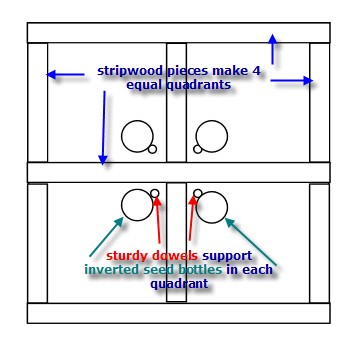
Figure 1. Top view of bird feeding platform. The surface of the square piece of plywood is divided into four equal quadrants using 3/4" wide by 1/4" thick strips of wood (exact dimensions not critical). In each quadrant, a bottle of seed (see below) is mounted on a 3/8"-diameter dowel.
- In the central corner of each quadrant, drill a hole and glue a 6 in (about 15 cm) length of 3/8 in (0.95 cm) dowel in place. The four seed bottles will be mounted to these dowels.
- You'll need to drill holes in the seed bottle caps so that the seed can come out. Make a '+' pattern with four separate holes, as shown in Figure 2, below. The holes are shown in gray. Knock out the central area if any plastic remains.
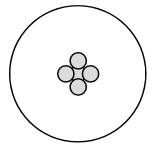
Figure 2. Hole pattern for seed bottle caps.
- Optional: if there are squirrels in your area (often the case), you may find that your bird feeding platform becomes a squirrel-feeding platform instead. To prevent squirrels from raiding the bird seed, attach a piece of sheet metal to your feeder's mounting post, either in an upside-down funnel or cylinder shape as shown in Figure 3, below.
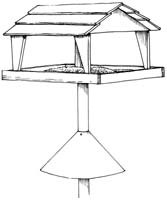
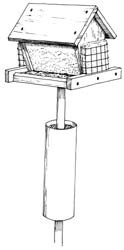
Figure 3. Two different methods for keeping squirrels away from your bird feeder. Attach a piece of sheet metal to your feeder's mounting post in the shape of an upside-down funnel (left) or cylinder (right). (Feeder images ©Project FeederWatch, 2007, used by permission.)
- Optional: depending on how much precipitation you get in your area, you may want to consider making a cover for your feeder. Think carefully about the dimensions of your design. You want to make sure that your feeder can accommodate all of the birds that are likely to visit in your area.
- The platform is a simple square of plywood material, with strips of wood glued or stapled on top to divide the platform into four equal quadrants (see Figure 1, below).
- Load up the containers with seed. The bottles can be mounted to the dowels with a rubber band or cable tie. Mount the bottles upside down, so that the caps are slightly above the surface of the platform, allowing some seeds to fall out. The seeds on the platform should then block the hole. As seeds on the platform are eaten by birds, more will fall out of the corresponding bottle so that the platform has a constant supply. Test to see that each seed bottle dispenses seed as expected, and make any necessary adjustments (e.g., change mounting height, enlarge dispensing hole) before starting your experiment.
- Measure and record the height of seed in each bottle, and the time that you made the feeder available for birds.
- Mount the platform on a sturdy pole or post in a convenient location both for bird access and for viewing/monitoring. It is ideal if you can view the platform from a window in your house.
- Monitor the feeder at regular intervals to see what birds visit.
- Use your field guide to identify visiting birds.
- In your lab notebook, record the number and type(s) of birds that you see, and the time that you see them.
- If you have a camera, take pictures of the birds, using a telephoto lens, if possible. The pictures will aid in confirming your identifications of the birds, and will add interest to your project display board.
- Keep an eye out for squirrels, and take measures to keep them from raiding the seed, if necessary.
- To get an estimate of the amount of seed consumed for each quadrant, measure the height of the seed remaining in each seed bottle. Subtract this from the previous height measurement to see how much seed was consumed in the preceding time period. (Alternatively, remove each bottle and weigh it.)
- Re-fill bottles as necessary to assure a constant supply of seed. Be sure to record the new seed height (or weight) and time when bottles are refilled.
/-/https/www.sciencebuddies.org/Files/3046/8/Zoo_img027.jpg)
/-/https/www.sciencebuddies.org/Files/3045/8/Zoo_img026.jpg)
/-/https/www.sciencebuddies.org/Files/3043/8/Zoo_img024.jpg)
/-/https/www.sciencebuddies.org/Files/3044/8/Zoo_img025.jpg)
Ideas for Analyzing Your Data
- At what time(s) of day is your feeder most frequently visited?
- Do times vary for different species?
- Do different species prefer different seeds (and thus different quadrants of the feeder)?
- Which seed(s) are most popular?
- How much of each seed type, on average, is consumed per day? Make a bar graph to compare the different rates of consumption.
- Which types of birds are the most frequent visitors? Can you think of a way to estimate the number of birds that visit your feeder each day? Can you estimate how much seed is consumed per bird per day?

Ask an Expert
Global Goals
The United Nations Sustainable Development Goals (UNSDGs) are a blueprint to achieve a better and more sustainable future for all.
/-/https/www.sciencebuddies.org/Files/19758/6/E-WEB-Goal-15.png)
Variations
- Increase your data collection with video recording and playback. See which birds visit your feeder and which quadrant(s) they prefer to feed from.
- Include other food types, e.g. suet, nectar (sugar water).
- You may also be interested in participating in Project Feeder Watch or in using data from their site. For more information, see:
Project FeederWatch 2007c. "Project FeederWatch Home Page," Cornell Lab of Ornithology and Bird Studies Canada [accessed May 31, 2007] http://www.birds.cornell.edu/pfw/index.html. - Extend your research over a year to see if your local bird population changes with the seasons.
Careers
If you like this project, you might enjoy exploring these related careers:
/-/https/careerdiscovery.sciencebuddies.org/Files/1900/17/iStock-1191167137.jpg)


/-/https/img.youtube.com/vi/v0oaTHb2u0Y/0.jpg)
/-/https/img.youtube.com/vi/u3LdI00902o/0.jpg)
/-/https/img.youtube.com/vi/U7XYzPfutBs/0.jpg)