Page 4 of 4
Re: Soil-Based Microbial Fuel Cells
Posted: Sun Dec 04, 2016 7:56 pm
by deleted-380572
Hi Donna,
I just sent out the endorsement request to ScienceBuddies! Thank you so much!
My school has some electrolysis supplies, so I can ask to run a few trials with varied concentrations of acetic acid. Thank you for the idea!
Sincerely,
CMS
Re: Soil-Based Microbial Fuel Cells
Posted: Sun Dec 04, 2016 8:18 pm
by donnahardy2
Hi CMS,
Thanks for letting me know. I have never received a response to my inquiry about how I can post an endorsement without violating our confidentiality policy, so I will send another inquiry. Hopefully we can make some progress this time.
It's great that you have electrolysis equipment. You can try a small experiment and verify that it works first.
Let me know how it goes.
Donna
Re: Soil-Based Microbial Fuel Cells
Posted: Fri Dec 09, 2016 7:07 pm
by deleted-380572
Hi Donna,
Good news! My proposal finally got approved! Have you recieved the email for the endorsement from sciencebuddies?
Thank you!
CMS
Re: Soil-Based Microbial Fuel Cells
Posted: Fri Dec 09, 2016 7:51 pm
by donnahardy2
Hi CMS,
Congratulations! This is great news.
Yes, I got the link, but I can't open it. I sent a message back asking for help in opening it, but I haven't gotten a response yet. . The link requires the application Outlook, which I don't have and can't seem to get installed on my computer.
Let me know if you have any ideas.
Donna
Re: Soil-Based Microbial Fuel Cells
Posted: Fri Dec 09, 2016 11:00 pm
by deleted-380572
Hi Donna,
Hmm, I tried sending myself an endorsement request to see the problem. I think that Experiment may have updated the endorsement link, so it should not require Outlook anymore. I will try resending the link to sciencebuddies. After clicking on the link, it should take you directly to the proposal page with the endorsement link on top.
If that doesn't work, I have the link here:
https://experiment.com/projects/8340/endorse/7AOLrDs. It should take you to the endorsement page.

Thank you!
CMS
Re: Soil-Based Microbial Fuel Cells
Posted: Sat Dec 10, 2016 7:27 pm
by donnahardy2
Hi CMS,
I'm making progress and got into the page to submit the endorsement, but it requires a photo, which I don't have on my computer at the moment. I'll try to finish tomorrow or Monday. I'm so sorry for the delay.
Donna
Re: Soil-Based Microbial Fuel Cells
Posted: Tue Dec 13, 2016 5:03 pm
by deleted-380572
That's alright.
CMS
Re: Soil-Based Microbial Fuel Cells
Posted: Thu Dec 15, 2016 9:04 am
by deleted-380572
Hi Donna,
If it is possible, can you post the endorsement by tonight? Tomorrow is supposed to be the launch date, but I need at least one endorsement to lauch

.
Thank you so much!
CMS
Re: Soil-Based Microbial Fuel Cells
Posted: Thu Dec 15, 2016 10:58 pm
by deleted-380572
Hi Donna,
I've been looking at an acetic acid-based electrolyte for electroplating. I found quite a lot of sources (although not research papers) on possible electrolyte solution for copper (not lead unfortunately).
Here is one forum which used vinegar (4% acetic acid in water), some hydrogen peroxide (3%), and a pinch of table salt:
http://www.finishing.com/500/90.shtml
This one is a bit more specific, and requires more materials:
https://www.google.com/patents/US2466660
I will probably not dilute my vinegar. For the hydrogen peroxide, will it be applicable to lead? It was added to oxidize copper, which would apparently spead up dissolution. I'm not quite sure if I should do this.
By the way I found this very useful research paper on mfc based recovery of four metals, including Pb2+. They used 2 mole HCl for the cathode electrolyte, and about 0.4 g of Pb/Litre:
http://publications.lib.chalmers.se/rec ... 163014.pdf
To quantify the lead plated onto the cathode electrode, I will soak the electrode in vinegar for a few hours (around 5), and use the kit to determine lead concentration.
Thank you!
CMS
Re: Soil-Based Microbial Fuel Cells
Posted: Mon Dec 26, 2016 5:18 pm
by deleted-380572
Hi Donna,
Is it possible to post the endorsment tonight? I need it to launch the project
.
Thank you so much!
CMS
Re: Soil-Based Microbial Fuel Cells
Posted: Thu Dec 29, 2016 1:47 pm
by deleted-380572
Hi Donna,
I ordered all of my arduino incubator supplies and the carbon cloth about a week ago!
They should arrive soon. I have also finished programming and compiling the arduino code in preparation for the actual hardware design. I will be constructing my MFC later on the afternoon (However without the soil sample yet since it is raining.) I just want to let you know some of the research I've been doing on electrolytes in electrolysis.
The purpose of an electrolyte is to provide the ions (in this case Pb2+) and a conductive medium; the more conductive the better. Many studies simply used acids like HCL:
http://publications.lib.chalmers.se/rec ... 163014.pdf.
I would use HCL if I wasn't using plastic containers to hold it...

(Here are the containers I am using:
https://ziploc.com/en/products/containe ... loc-medium).

I do not want to risk drilling through a glass jar. Doing some further research I think I understand why vinegar and citric acid are not particularly used for electrolysis. Their conductivities are fairly low because of the lack of free ions in the solution. I did consider using table salt, but I realized that this would create chlorine gas, which is apparently dangerous. This sciencebuddies idea suggests magnesium sulfate (epsom salts) for the electrolyte solution since it is considerably conductive:
https://www.sciencebuddies.org/science- ... background
This science fair project also used magnesium sulfate and explained some of the reactions if the magnesium were to be electrolysed (not something I would want). Surprisingly the voltages used were extremely high, so I may just get a tiny bit of the mangesium sulfate plated along with the reduced Pb2+. The tiny amount from the magnesium sulfate would mostly be magnesium hydroxide (which should not be poisonous):
http://www.odec.ca/projects/2013/beso13 ... sults.html
IMPORTANT:
I do however have a problem with the MFC electrodes. I need to use conductive nickel epoxy or other conductive glues to attach my copper wire to the carbon cloth (I am still waiting for the cloth to be shipped though). I cannot find conductive glue anywhere, and purchasing them is quite expensive ($25.00 for 0.2 mL not including shipping). I also don't want to wait for the shipping, which should take around 4-5 weeks from Hong Kong or China. I have been looking at some diy conductive glue recipe using contact cement and graphite powder. Should I try this? The results are apparently pretty good.
BY THE WAY PLEASE READ ALL THE POSTS BEFORE THIS! IF YOU HAVE NOT READ THIS PAPER :
http://publications.lib.chalmers.se/rec ... 163014.pdf, PLEASE DO. IT IS ALMOST 99% RELEVANT TO MY TOPIC.
Thank you!
CMS
Re: Soil-Based Microbial Fuel Cells
Posted: Sun Jan 01, 2017 12:51 pm
by deleted-380572
Hi Donna,
I am still having trouble with my cathode electrolyte... Is it possible for you to explain this chemical reaction:
http://www.odec.ca/projects/2013/beso13 ... sults.html
The equations are on the top of the page. I just want to make sure any bi-products of electrolysing magnesium sulfate will not be poisonous.
Thank you!
CMS
Re: Soil-Based Microbial Fuel Cells
Posted: Sun Jan 01, 2017 8:03 pm
by donnahardy2
Hi CMS,
I apologize for the delay; I had to switch to a new computer and I missed a couple of notifications from you. I should be able to keep up now.
I will answer your last post and go back and review the post from earlier this week and reply again tomorrow.
The equation you posted is for the reaction of the element magnesium in water. Magnesium is a very reactive element and will react with water to produce hydrogen gas. The end products are not hazardous; the elements are magnesium, sulfur, oxygen and hydrogen and magnesium sulfate is not particularly hazardous. However, the reaction of the element magnesium with air or water is quick and exothermic, so hopefully you are not planning to do this at home.
The reaction in the cathode electrode is different. It involves transferring the electrons generated in the anode chamber to an electrode acceptor and the reaction is not exothermic. The cathode reaction is required to complete the circuit of the MFC and generate electricity.
Have you set up the MFC yet?
Donna
Re: Soil-Based Microbial Fuel Cells
Posted: Mon Jan 02, 2017 8:55 pm
by donnahardy2
Hi CMS,
You are really good at background research. The research paper on metal recovery is completely relevant to your project. It specifies the voltage that will work for recovery of Pb from the cathode electrode, so if your MFC will generate the voltage, you should be able to plate the Pb on the cathode electrode. The authors used 2 M HCl and I think it would be much safer for you to the the acetic acid mixture. At this point, you are not optimizing the system for maximum recovery; you just need to show that it will work.
The cost of the conductive glue is prohibitive, so you should definitely try the graphite alternative. Make sure you get the wire in contact with the carbon cloth
Donna
Re: Soil-Based Microbial Fuel Cells
Posted: Mon Jan 02, 2017 9:37 pm
by deleted-380572
Hi Donna,
I bought my aquarium pump, some epoxies and tubing. I will still need to find a pipe to finish building the mfc, however.
For the electrolyte solution, I will probably be using this solution:
http://forums.sohc4.net/index.php?topic=119931.0.
I don't want to use table salt because it will create chlorine gas. The magnesium sulfate will not be plated on the cathode (hopefully, since it requires a high Voltage?). It will set a good conductivity in the solution.
Here's a quick question: Since oxygen will not be the electron acceptor, will hydrogen gas accumulate in the cathode? Should I attach a tube to get rid of the excess gas?
Thank you so much!
CMS
Re: Soil-Based Microbial Fuel Cells
Posted: Tue Jan 03, 2017 9:26 am
by donnahardy2
Hi CMS,
The anode electrode should be accepting most of the electrons, however just in case there is a side fermentation, it would not hurt to connect tubing that will allow gas to escape from your MFC.
Donna
Re: Soil-Based Microbial Fuel Cells
Posted: Tue Jan 03, 2017 10:52 pm
by deleted-380572
Hi Donna,
I was looking at this MFC diagram to better understand some of the chemical reactions occuring in the cell. I don't quite understand what the H+ is. I used to always think that they were hydrogen ions, which would just leave the anode as hydrogen gas in the cathode (since Pb2+ would not combine with it to form water). However doing some further research makes me think that the H+ would combine with Pb2+. What would really happen when H+ combines with Pb2+? Here is the picture for reference.
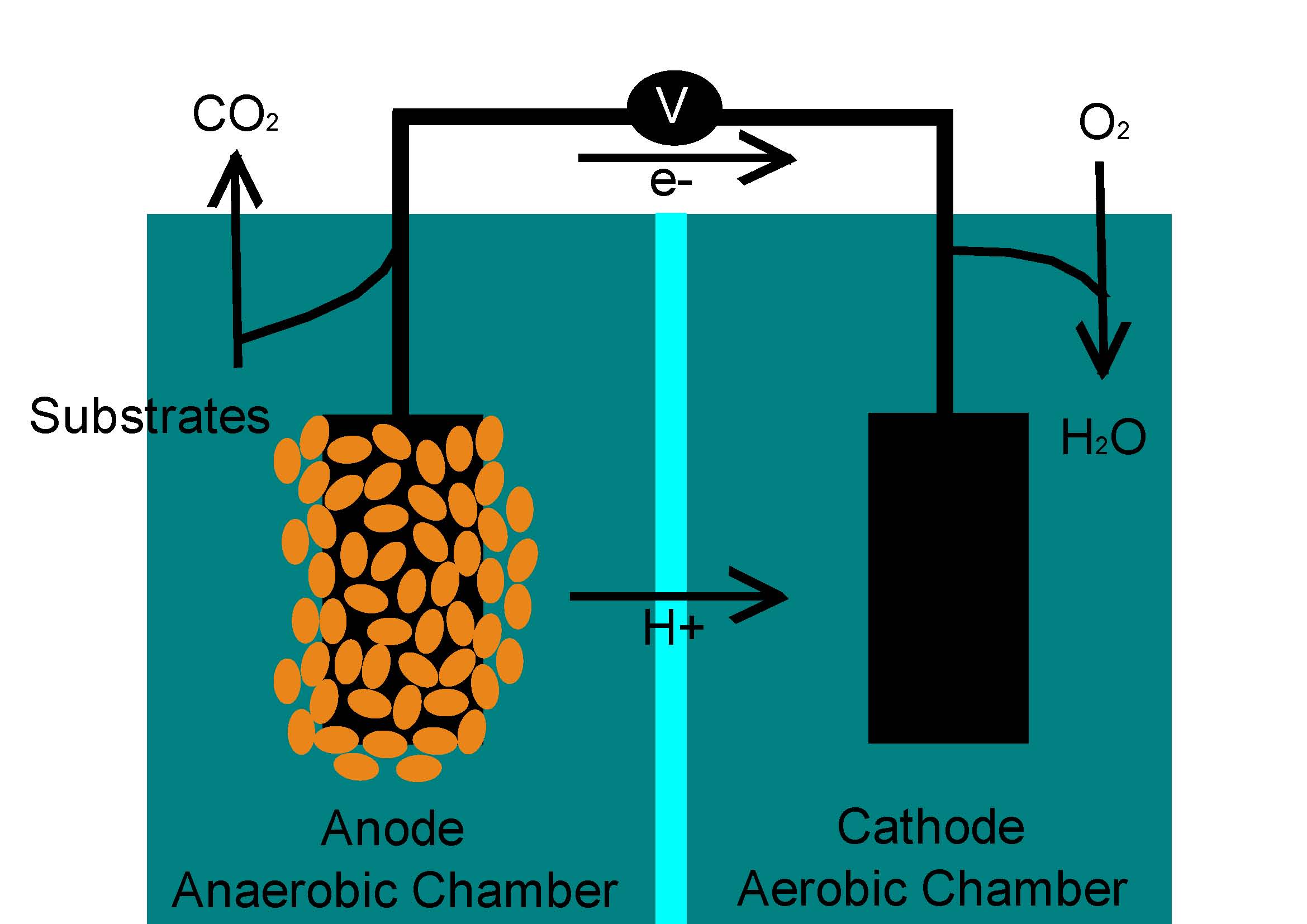
I think I confused the microbial electrolysis cell (MEC) with the MFC. Apparently an additional voltage is supplied to reduce the protons into hydrogen gas. If this is true I will probably attach a tube in the anode chamber to get rid of the excess methane gas? I think that this can be applicable to commercial MFCs in the future (to harness the methane gas produced from MFCs to be used in internal combustion engines in order to replace fossil fuels?)
Thank you!
CMS
Re: Soil-Based Microbial Fuel Cells
Posted: Wed Jan 04, 2017 8:16 pm
by deleted-380572
By the way, is it possible to post the endorsement for Experiment? Thank you so much!
Re: Soil-Based Microbial Fuel Cells
Posted: Sun Jan 08, 2017 7:52 am
by donnahardy2
Hi CMS,
I'm so sorry for the delay. I have been having trouble logging on to my new computer; hopefully the issues are resolved now.
You are correct; the magnesium sulfate is a non-toxic electrolyte that is completely ionized when in solution, so it is highly conductive. The acetic acid is a weakly ionized molecule, so is not as conductive. Chloride is corrosive and it is possible for the chloride ions to be oxidized to chlorine, which is a toxic gas. The science buddies project guide information is correct.
Have you set up your MFC yet? Please let me know if you are making progress.
I will try again to complete the endorsement.
Donna
Re: Soil-Based Microbial Fuel Cells
Posted: Thu Jan 26, 2017 9:09 am
by deleted-380572
Hi Donna,
I set up my MFC yesterday, and the voltage spiked up to 480 mV. However in the morning when I checked the cell, the voltage was around 120 mV. In addition the cathode chamber turned quite yellow. Do you know what could have caused this problem? I searched everywhere but I can't find a solution.
Thank you!
CMS
Re: Soil-Based Microbial Fuel Cells
Posted: Wed Feb 15, 2017 9:56 pm
by deleted-380572
Hi Donna,
I'm not sure if you will read this reply, but I just wanted to update you on what has happenned in my experiment
.
So first of all, I did not end up using Pb2+ as the electron acceptors, as I was just too concerned about toxicity issues (I'm doing the experiment at home). Instead, I used Copper sulfate pentahydrate (Cu2+) for the test run. I am currently using several metal ions (zinc, nickel and copper) to precipitate several metals using different potential differences.
I am extremely happy with the Voltages I was able to generate! I ended up using some garden soil for the test run, but was still able to consistently generate aroun 612 mV! The resistance reduce from 1300 to about 780. Thus the Cu2+ was precipitated onto the electrode in less than a day. (I used freezing point and density measurements to screen for the precipitation of copper). The cool thing was that the specific gravity decreased below the original electrolyte solution, showing that not only copper was precipitated onto the cathode. This could mean that the magnesium sulfate or sugar in the solution was also removed from the solution. In the future I will probably create a copper hydroxide solution to determine the presence and amount of copper in the solution. I'll just weigh the dried precipitate.
Currently, I am developing this topic by using yeast in the anode and waste paper as the feed stock. (I will apply a pretreatment onto the cellulose and further add sulfuric acid to hydrolze the paper into glucose. This will allow me to create bioethanol as well.
This project is really turning into an innovation, because I am combining several known and well researched fields together. (Generating electricity from waste paper, reducing metals, and producing bioethanol). I decided to work on this topic since MFCs actually have so much more potential than just generating electricity. I'm also pretty sure that waste paper was never considered for use in MFCs before.
For waste paper, I will:
a) Apply oxdiative delignification pretreatment onto some paper to allow access to the cellulose (I chose this method because I can just use some hydrogen peroxide). I will also create a 1% NaOH solution.
b) Hydrolyse the paper for several hours in an incubator using either 1 M sulfuric acid or HCl depending on what's available in school.
c) Measure glucose content using glucose test strips or convert specific gravity measurements.
For metal reduction, I will:
a) Create a 1 g/L dilution of Cu2+, Ni2+, Zn2+, and maybe some other metals in the cathode.
b) Vary the Voltage potential by adding different concentrations of nutrients (explained later) to recover the different metals.
c) Take measurements of metal contents using sodium hydroxide and weighing the precipitate.
For bioethanol, I will:
a) Create a mixed culture of bakers yeast and probiotic yeast strain; add beef stock, vitamin powder, and nutrients
b) Add glucose from waste paper, and feed the MFC using an aquarium tube.
c) Take hydrometer readings to calculate ethanol produced; take conductivity measurements and additional measurements (freezing point, etc).
Thank you so much for helping with my project! Your feedback on my new project would be highly appreciated! I'll definately keep you updated on any questions I have on my project.
CMS