Determining catalysts for electrolysis/electrodialysis
Posted: Mon Jan 06, 2014 6:27 pm
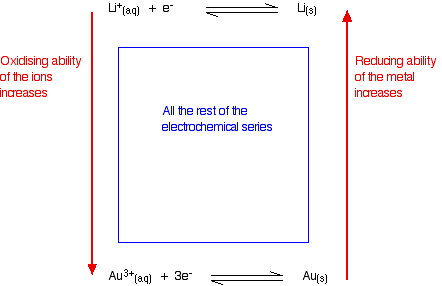
Hello, I'm a high school student doing a continuation project on electrodialysis, and starting the investigation phase for finding suitable electrocatalysts (narrowed it down) for the project. My problem though, in doing this is that I'm not entirely clear on how can you determine an element/compound is viable for a catalyst. Probably, I'm even more confused based on the tens of pages I've looked at. Currently, I'm investigating whether the electrode potential of the element (check this page-> http://www.chemguide.co.uk/physical/redoxeqia/ecs.html) has an effect on its conductivity, in more certain terms, whether the oxidizing ability or reduction ability has an apparent and direct effect to the conductivity.
Right now, this is my train of thought, which I believe has a contradiction in it:
Higher E* -> higher oxidizing ability -> better oxidizing agent -> more prone to reduction (which is loss of electrons.)
But according to my definitions within my notes, an oxidizing agent takes electrons from something else. So it would help if this could be clarified.
Also, cobalt nitrate, iron nitrate (ferric nitrate), and magnesium nitrate are oxidizers, is there a connection? (Might be random chance, though, b/c I haven't tested if any of those are good at conducting or not.
Also, I've looked at previous threads, namely, the "Alternate Catalysts for "Water to Fuel to Water" Project (https://www.sciencebuddies.org/science- ... php?t=8475), and the student, mjd, asked whether the catalyst had to be a nitrate compound, and it was recommended. He also suggested cobalt chloride as an alternative to cobalt nitrate. I've checked the electron valence electron count from a periodic table of both chlorine and nitrogen, and I wondered why are they the other side of the compound if they don't match (realized now that nitrate was a polyatomic atom, but question still stands, what makes them similar to be used as part of a compound as a catalyst?).
These probably aren't my last questions, but to start off with, are there any cheap supplier that sell iron nitrate, magnesium nitrate, silver nitrate (Possibly?) etc within the U.S., preferably under 40 dollars each? I already have obtained the cobalt nitrate, and have bought it from United Nuclear.
And not sure if this might affect anything in the experiment, but my electrodes are graphite rods. Not as good as copper or steel, but is non-corrosive.
I am not able to afford platinum or graphene with my budget. (hehe, graphene.)
If there are any alloys that may also work as a catalyst that can be applied by electroplating (I might need to know how to get those equipment as well), please feel free to mention it.
~Thanks, Matt1500.
Right now, this is my train of thought, which I believe has a contradiction in it:
Higher E* -> higher oxidizing ability -> better oxidizing agent -> more prone to reduction (which is loss of electrons.)
But according to my definitions within my notes, an oxidizing agent takes electrons from something else. So it would help if this could be clarified.
Also, cobalt nitrate, iron nitrate (ferric nitrate), and magnesium nitrate are oxidizers, is there a connection? (Might be random chance, though, b/c I haven't tested if any of those are good at conducting or not.
Also, I've looked at previous threads, namely, the "Alternate Catalysts for "Water to Fuel to Water" Project (https://www.sciencebuddies.org/science- ... php?t=8475), and the student, mjd, asked whether the catalyst had to be a nitrate compound, and it was recommended. He also suggested cobalt chloride as an alternative to cobalt nitrate. I've checked the electron valence electron count from a periodic table of both chlorine and nitrogen, and I wondered why are they the other side of the compound if they don't match (realized now that nitrate was a polyatomic atom, but question still stands, what makes them similar to be used as part of a compound as a catalyst?).
These probably aren't my last questions, but to start off with, are there any cheap supplier that sell iron nitrate, magnesium nitrate, silver nitrate (Possibly?) etc within the U.S., preferably under 40 dollars each? I already have obtained the cobalt nitrate, and have bought it from United Nuclear.
And not sure if this might affect anything in the experiment, but my electrodes are graphite rods. Not as good as copper or steel, but is non-corrosive.
I am not able to afford platinum or graphene with my budget. (hehe, graphene.)
If there are any alloys that may also work as a catalyst that can be applied by electroplating (I might need to know how to get those equipment as well), please feel free to mention it.
~Thanks, Matt1500.
 . Bear with me as I try to help you the best way I can.
 ) I have been mulling over the past few weeks is: should I be able to use two types of electrocatalysts separately onto my anode and cathode?