Hello emreisenauer,
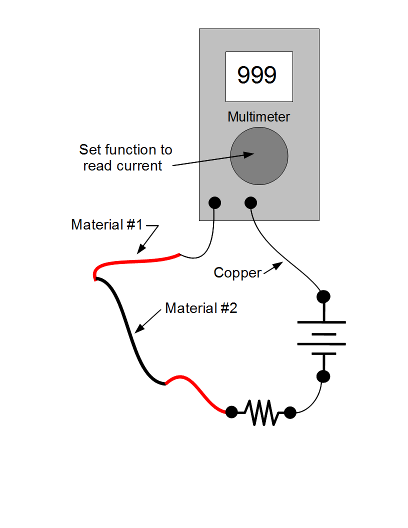
After my last reply to you I continued to think about the problems you have had with observing the Peltier effect. I had not done the experiment as described in the Cool Junctions project description, and I just assumed, as I'm sure you did, that the effect was easy to observe if set up correctly. Last night I did it and confirmed my suspicions that the effect produced by the suggested setup is
very small.
The effect is not large enough for nearly any inexperienced person to observe. Using a chromel-alumel junction with the 9 milliamp current that is recommended, I was able to measure at most a temperature change when the current started flowing of 0.2 degrees Fahrenheit. This was achieved only by wrapping the junction in insulating foam, waiting three minutes for it to equilibrate, using a sensitive thermocouple meter to measure the temperature, making multiple measurements, and taking the largest result (not a reliable technique).
Tests with currents of 38 milliamps and 80 milliamps gave about the same temperature reduction when the current was flowing to produce cooling but higher temperature rises when the current was reversed as resistive heating began to overcome the Peltier effect.
I think this result is consistent with what one would expect. The electrical power applied to the junction is no more than a few milliwatts. The cooling power has to be much less than the supplied power since metal-metal contacts are not efficient thermoelectric coolers.
The procedure described for observing the Seebeck effect has a better chance of producing observable results, but you should be advised about the very small magnitude of the likely result. Experimenters are advised to try common metals available at hardware stores. Thus, a copper-iron (or steel) junction is a very likely one to be tried. That junction has a Seebeck coefficient of about 13 microvolts per degree Kelvin. If one tries boiling water versus ice water (as suggested) he will encounter a voltage of only 1.3 millivolts. If you have a modern multimeter with a most-sensitive range of 200 mV, you will be just able to see this reading. If you heat one junction with a flame, you'll see a bigger effect.
I apologize for your unnecessary troubles with this experiment. Science Buddies has a policy of testing the suggested projects, but I am told that this one has been around for a long time and likely missed the reviews now in place because of its age.
You can very easily observe the Peltier effect if you get a thermoelectric module such as at
http://www.parts-express.com/pe/showdet ... er=320-253 or at
http://www.amazon.com/Peltier-Junction- ... -1-catcorr. Such a module is built using semiconductor materials that create a much larger Peltier effect than do metals, and the module combines a large number of junctions to get a significant power rating. You can read more about thermoelectric cooling at
http://en.wikipedia.org/wiki/Thermoelectric.
Again I apologize for the unhelpful advice given earlier and thank you for posing the questions that led to discovering this problem with one of the project descriptions.
Best regards, WW
 .
.