/-/https/www.sciencebuddies.org/cdn/Files/21464/5/sb-logo.png)
/-/https/www.sciencebuddies.org/cdn/Files/21464/5/sb-logo.png)
Abstract
Why do different types of fruits come packaged in different ways? In this project, you will experiment with different ways of packaging fruit to see if it has an effect on the freshness of the fruit. Will a different kind of packaging allow the fruit to stay fresh longer?Summary
Sara Agee, Ph.D., Science Buddies
/-/https/www.sciencebuddies.org/cdn/Files/2981/5/MatlSci_img055.jpg)
Objective
In this experiment, you will test different types of fruit packaging, to see if you can find the best one for keeping fruit fresh.
Introduction
I bet you thought the hardest part of farming was growing crops. Actually, picking and packaging crops is a very challenging aspect of farming. It is also a branch of Food Science called Packaging Science. Think I am kidding? Here is part of an abstract of a study on strawberry fruit packaging from a technical journal of food science:
"The effect of film perforation on gas content during modified atmosphere packaging of strawberry fruit was studied. Camarosa strawberries were refrigerated at 2 °C, and wrapped with polypropylene (PP) film with perforations of 1 and 2 mm diameter. Fruits were held at 2 °C during three days, simulating refrigerated transport, and then at 20°C for four days to simulate retail display temperatures. Perforation degree affected final gas contents inside the packages, ranging from 5.68-25.96% CO2 and from 4.84-15.69% O2 on day 7. " (Sanz et. al., 2000)
Sound like another language to you? This abstract, in very technical scientific language, states that strawberries that were packaged with plastic wrap that had holes poked in it did better that those with fewer or smaller holes, and that this effect was studied by measuring what gases were trapped inside the package.
Why would putting holes in the package make a difference? As fruit ripens, it produces a gas called ethylene that can become trapped in the packaging. Ethylene is a gas that naturally ripens fruit, but it can also over ripen fruit and cause spoilage. If the fruit is not packaged properly, then the ethylene gas can build up in the package leading to rotten fruit. Who wants to buy that?
/-/https/www.sciencebuddies.org/cdn/Files/2980/5/MatlSci_img054.jpg)
USDA food technologist Yaguang Luo studies test packages of lettuce for permeability and shelf life (Bliss, 2006, image from the USDA).
A lot of thought goes into that package that you buy at the store. An agricultural scientist, food scientist, packaging scientist, and material scientist all worked together to be sure the food you get is perfectly fresh and ripe at the table. In this experiment, you will do your own experiment with fruit packaging. By wrapping fruit with different packaging designs and observing the differences, you will pick the best design. How will different packaging materials compare?
Terms and Concepts
To do this type of experiment you should know what the following terms mean. Have an adult help you search the Internet, or take you to your local library to find out more!
- Material science
- Food and packaging science
- Packaging materials
- Fruit ripening
- Ethylene gas
Questions
- Which type of packaging keeps fruit fresh and prevents spoilage?
- Do all types of fruit do best in the same kind of packaging?
- Is it better to have a closed package or a ventilated package?
Bibliography
- This site has information about the fruit ripening process:
Koning, R.E. (1994). Fruit Growth and Ripening. Retrieved January 21, 2014. - Here is an interesting article from the U.S. Department of Agriculture (USDA) about the challenges of packaging fresh fruits, vegetables, and produce:
Bliss, R., 2006. Fresh-Cuts Are Popular, Any Way You Slice Them, Agricultural Research Magazine, Agricultural Research Service (ARS), U.S. Department of Agriculture (USDA). Retrieved June 6, 2007. - Here is the original research article quoted above, but be aware of the technical reading level:
Sanz, C., Perez, A.G., Olias, R., Olias, J.M., 2000. Modified atmosphere packaging of strawberry fruit: Effect of package perforation on oxygen and carbon dioxide, Food Science and Technology International, Vol. 6, No. 1, pages 33-38.
Materials and Equipment
- Fresh fruit for testing (green bananas work very well)
- Different types of packaging material
- Brown paper bags
- Plastic bags
- Cardboard boxes
- Strawberry baskets
- Plastic netting
- Notebook for keeping a log
- Digital camera
Experimental Procedure
/-/https/www.sciencebuddies.org/cdn/Files/20483/6/icon-flask.png)
-
The first step is to go to a local farmer's market or to the grocery store produce aisle. Walk around and examine the different fruits, paying attention to how they are packaged to get ideas. Here are some ideas I got from my local grocery store:
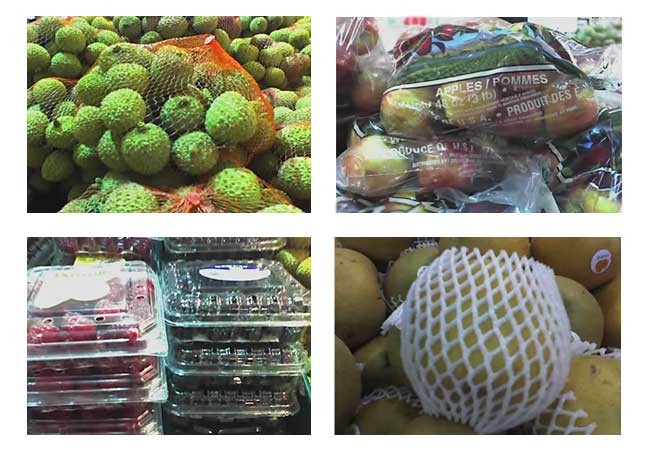
Here are some fruit packing ideas I got from a quick visit to the grocery store.
- While you are there, buy some fruit to test in your experiment. I suggest green bananas because they are easy to see as they ripen and change colors from green to yellow to brown.
-
When you get home, set up your experiment. Place one fruit (green banana) in each different packaging material. Set all of the packages in the same place, choosing a place that is cool and not in direct sunlight. Here are some packaging material ideas:
- Plain paper bag without holes
- Plain paper bag with holes
- Plastic bag without holes
- Plastic bag with holes (sometimes used for grapes)
- Plastic netting (often used for avocados)
- styrofoam netting (sometimes used to protect pears)
- strawberry containers
- cardboard boxes
- anything else you can think of!
-
Check on your fruit once a day, noting the color and smell of the fruit. Keep a daily log of your experimental results in a notebook. Write down all necessary data in your daily log, here is an example:
Swipe left to see more
Date: Time: Package Type Coloring - (green, yellow, brown speckles, brown)
Smell - (no smell, light smell, fragrant, smelly, stinky) Other Notes - (firm, hard, spots, wrinkly, mushy, moldy) Brown Paper Bag
Plastic Baggie
Cardboard Box - After about a week, start looking for a day when you see some variation in results between your different packaging materials. This is a good time to conclude your experiment.
- Remove the fruit from the packaging and take pictures using the digital camera for your poster.
- Develop a rating scale for your fruit and use it to rate the different materials. Which packaging worked the best?
/-/https/www.sciencebuddies.org/cdn/Files/2981/5/MatlSci_img055.jpg)

Ask an Expert
Global Goals
The United Nations Sustainable Development Goals (UNSDGs) are a blueprint to achieve a better and more sustainable future for all.
/-/https/www.sciencebuddies.org/cdn/Files/19745/5/E-WEB-Goal-02.png)
/-/https/www.sciencebuddies.org/cdn/Files/19755/5/E-WEB-Goal-12.png)
Variations
- You can make this experiment unique by changing the fruit you use. Try using your favorite fruits for this experiment. If you live on a farm or have a family garden, try using your own fruit for the experiment. You can also try comparing different fruits to see if they have the same packaging needs.
- Did you find that holes made a difference? How much ventilation is best? Try to improve the ventilation of packaging by adding ventilation holes in bags and boxes. Compare the packaging with and without holes. Also compare different numbers of holes. How can increasing the number of ventilation holes improve the package design?
- An interesting thing about plastic bags, is that they are not all the same. Try comparing different kinds of plastic bags to see how well they keep fruit fresh. Do all plastic bags give the same results?
- How does light affect fruit ripening? The brown paper bags block light, but clear plastic bags let light in. Could this have something to do with the results? Design an experiment to test the difference between dark and light packaging.
- What about the plant biology of fruit ripening? Try the Science Buddies experiment One Bad Apple Spoils the Whole Bunch: An Experiment on the Plant Hormone Ethylene to find out.
Careers
If you like this project, you might enjoy exploring these related careers:
/-/https/careerdiscovery.sciencebuddies.org/cdn/Files/860/17/pexels-photo-5230966.jpg)

/-/https/careerdiscovery.sciencebuddies.org/cdn/Files/1429/17/unsplash-4pM4nhHyo9M.jpg)
/-/https/careerdiscovery.sciencebuddies.org/cdn/Files/852/17/iStock-678248510.jpg)
/-/https/careerdiscovery.sciencebuddies.org/cdn/Files/20156/6/quality-control-inspector-worker.jpg)

/-/https/img.youtube.com/vi/8h7UZ8pE_Q0/0.jpg)
/-/https/img.youtube.com/vi/ZWJfIdZOpP4/0.jpg)
/-/https/img.youtube.com/vi/pK-iPwtW4W8/0.jpg)