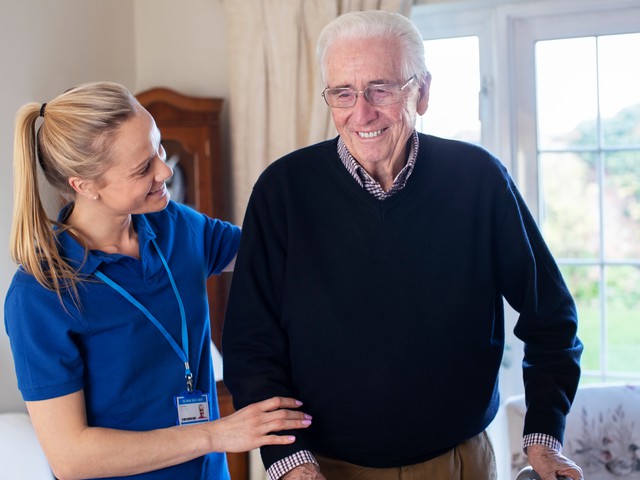
No one likes to go to the hospital, or get a bad diagnosis, but medical social workers can help patients manage their condition, emotionally and practically. For example, they assist in communication between patients and health care providers, so that patient questions get answered and patient concerns are heard. They advise and educate the patient and family members about the patient’s condition; refer the patient to social services that can help with finances, housing, and legal aid; and arrange home care, meal delivery, and special equipment when the patient is discharged. Medical social workers are a vital part of a patient’s health care team. Read more...
Key Requirements
Patience, empathy, emotional strength, and outstanding communication skills Read more...
Read this article to learn about medical social worker and HIV counselor Tina Levin, who uses her own life experiences to develop compassion for, and make a connection with her patients.
In this video, you'll meet Tammy, a medical social worker who works as a provider of hospice (end-of-life) care.
In these videos, you'll meet Martha Harper and Chuck Miceli, who work as oncology social workers, a new type of social work that helps people who are newly diagnosed with cancer.
Watch this video to find out about the daily work routine of clinical social worker Barbara Passman, who helps answer questions, eases fears, and facilitates communication between patients and their caregivers.
Medical and public health social workers provide persons, families, or vulnerable populations with the psychosocial support needed to cope with chronic, acute, or terminal illnesses, such as Alzheimer's disease, cancer, or AIDS. They also advise family caregivers, counsel patients, and help plan for patients’ needs after discharge by arranging for at-home services, from meals-on-wheels to oxygen equipment. Some work on interdisciplinary teams that evaluate certain kinds of patients—geriatric or organ transplant patients, for example. Medical and public health social workers might work for hospitals, nursing and personal care facilities, individual and family services agencies, or local governments.
In this video, you'll meet Jennifer Perez, a social worker for a shock trauma unit, who likes helping people at a time when they feel like they cannot find help, on a day that may feel like the worst day ever.
Full-time social workers usually work a standard 40-hour week; however, some occasionally work evenings and weekends to meet with clients, attend community meetings, and handle emergencies. Some, particularly in voluntary nonprofit agencies, work part-time.
Social workers usually spend most of their time in an office or residential facility, but also may travel locally to visit clients, meet with service providers, or attend meetings. Some may use one of several offices within a local area in which to meet with clients. The work, while satisfying, can be emotionally draining. Understaffing and large caseloads add to the pressure in some agencies. To tend to patient care or client needs, many hospitals and long-term care facilities are employing social workers on teams with a broad mix of occupations, including clinical specialists, registered nurses, and health aides.
Education and Training
A bachelor's degree in social work (BSW) degree with a minimum of 400 hours of supervised field experience is the most common minimum requirement to qualify for a job as a social worker; however, majors in psychology, sociology, and related fields may be sufficient to qualify for some entry-level jobs, especially in small community agencies. Although a bachelor's degree is required for entry into the field, an advanced degree has become the standard for many positions. A master's degree in social work (MSW) is necessary for positions in health and mental health settings and typically is required for certification for clinical work. Jobs in public agencies also may require an advanced degree, such as a master's degree in social service policy or administration. Supervisory, administrative, and staff training positions usually require an advanced degree. College and university teaching positions and most research appointments normally require a doctorate in social work (DSW or PhD).
Medical social workers must be honest, ethical, and reliable, and very sensitive to the needs and feelings of others. They must be able to handle high-stress situations and negative emotions calmly and professionally.
Advocate for clients or patients to resolve crises.
Collaborate with other professionals to evaluate patients' medical or physical condition and to assess client needs.
Refer patient, client, or family to community resources to assist in recovery from mental or physical illness and to provide access to services such as financial assistance, legal aid, housing, job placement or education.
Counsel clients and patients in individual and group sessions to help them overcome dependencies, recover from illness, and adjust to life.
Utilize consultation data and social work experience to plan and coordinate client or patient care and rehabilitation, following through to ensure service efficacy.
Plan discharge from care facility to home or other care facility.
Organize support groups or counsel family members to assist them in understanding, dealing with, and supporting the client or patient.
Modify treatment plans to comply with changes in clients' status.
Monitor, evaluate, and record client progress according to measurable goals described in treatment and care plan.
Identify environmental impediments to client or patient progress through interviews and review of patient records.
Do you have a specific question about a career in Human Biology & Health that isn't answered on this page? Post your question on Science Buddies Ask an Expert Forum.
University of Chicago Medical Center. (2009, October 23). Support for Breast Cancer Patients: Barbara Passman, Medical Social Worker. Retrieved November 27, 2009, from http://www.youtube.com/watch?v=xBlL0bql3Jk
If this website has helped you, won't you consider a small gift so we may continue developing resources to help teachers and students?
It's free! As a member you will be the first to receive our new and innovative project ideas, news about upcoming science competitions, science fair tips, and information on other science related initiatives.