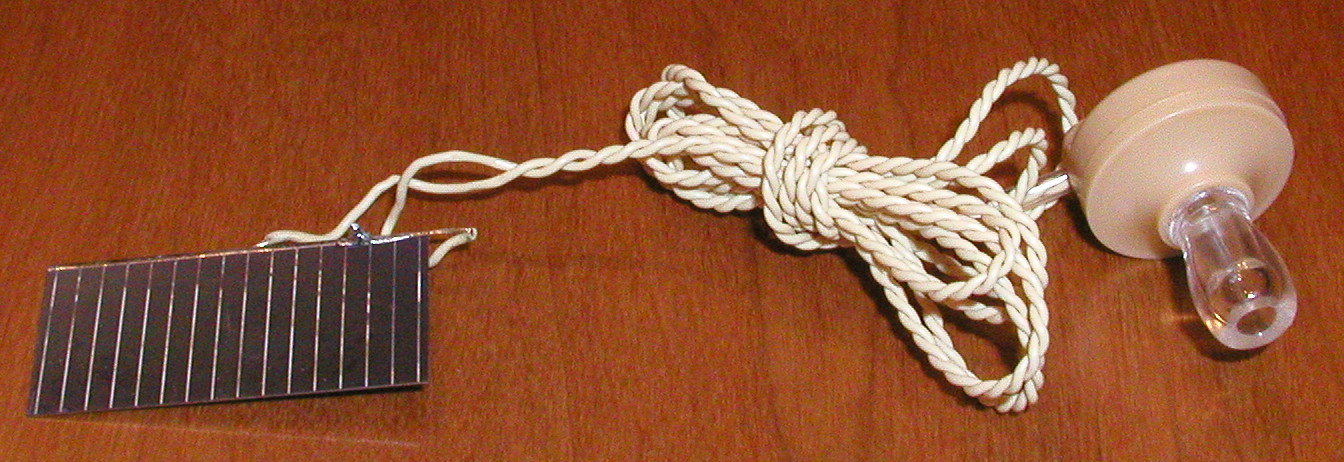
Hi Rocket Man,
I gather from your post that you're referring to this science fair project suggestion. (I'm including it here to make it easy for other people who browse the forum to find.)
https://www.sciencebuddies.org/mentorin ... p004.shtml
I didn't have anything to do with writing the project suggestion, but I have some experience with electronics and would be happy to help talk you through the experiment.
As far as the type of wire goes, it probably isn't an issue. You'll only be drawing a tiny amount of current (the number of electrons flowing through the wire per second, times some constants to make the units work out). Almost any wire will work, although if it's really thin it might be hard to handle. Also, some of the really, really tiny wire that people use for winding coils looks like it's just metal wire, but it's actually got insulation painted on it which has to be removed to make electrical contact.
If you're going to buy new wire, something like 22 gauge wire is a fine choice. Somewhat bigger or smaller would be fine too. Stranded wire, which is made up of a bunch of little wires all twisted together, would be easier to use if you're going to use screws or solder to connect wires together. Solid wire will be easier to use if you're going to use crimp-on connectors. (See discussion below.) Either can be made to work, though.
How to connect things together may be a little bit tricky. The easiest way is to use wires that have little clips on the ends of them, usually called "alligator clips." Radio Shack sells them in packages of 8 for five dollars. You may also be able to borrow some from a science teacher at school if you can't buy them.
If that isn't an option, then I'm sure we can make something work. We'll need to think a little harder about what tools you have available at home. Some options:
If your family has a soldering iron, that would work. But most people don't have one.
If you have a set of crimp-on wire connectors and a crimper, then that will work. They're used to put connectors on the ends of wire for automotive wiring or repairing household appliances.
If you have some wire-nuts - cone shaped plastic things, about half an inch long, with a threaded screw hole in the end - those would work too. They're often used in household electrical wiring.
If you don't have access to any of those, then you can make the connections using metal screws and nuts. (Any size will work, but if you are going to buy new ones something like a 1/2 inch long 8-32 screw with a matching nut is probably a good choice.)
Remove about 1/2 inch of insulation from the end of the two wires you want to connect, using a wire stripper if you have one or a sharp knife or razor blade if you don't. Hold them together so the ends face the same direction, and twist the ends together. Then wrap the twisted ends around a screw, and tighten a nut on it to hold the wires in place. Don't let the screws touch anything metal or each-other. (It's not dangerous, but you'll short out the circuit and it won't work.)
I'll throw together a quick diagram of what I think the author of the project suggestion intended and post it here soon.
One question: what does your volt meter look like? Is it just a meter with two connectors or wires on it that looks like it should be mounted on a piece of equipment, or is it a stand alone box with probes connected to it and an on/off switch and other knobs?
take care,
Erik