/-/https/www.sciencebuddies.org/Files/21464/5/sb-logo.png)
/-/https/www.sciencebuddies.org/Files/21464/5/sb-logo.png)
veggie power problems
Moderators: AmyCowen, kgudger, bfinio, MadelineB, Moderators
-
lisaph310
- Posts: 3
- Joined: Mon Mar 19, 2007 7:34 pm
veggie power problems
I'm having trouble increasing the voltage of my potato batteries. I hooked a few together (in series--I'm pretty sure) but the voltage only goes up a little and then the needle on my meter starts to drop until the voltage is even less than it is with one potato. What's going on?
-
deleted-71588
- Former Expert
- Posts: 1297
- Joined: Mon Oct 16, 2006 11:47 am
What grade are you in? Knowing that will help us choose our words appropriately to explain things.
Since I don't know what grade you are in, the following may use words you aren't familiar with.
What is the impedance (or resistance) of the meter on the DC volt scale you are using? If you don't know, then tell us about the brand and model and scale so we can look it up. The impedance of the meter determines how much current the meter draws from the batteries. In any case, the higher the voltage, the more current the meter will draw.
Ever think about "dead" batteries? It is just a guess.
Try measuring each individual battery cell and cleaning and moving the electrodes to new places on ones that have a lower reading. You might experiment with how close you place the electrodes. If the fruit / vegtable dries out, the "electrolyte" dries out as well. The wider the separation, the more sensitive the "battery" is to "electrolyte" losses.
With batteries in series, the ability to supply current is limited by the weakest battery.
Since I don't know what grade you are in, the following may use words you aren't familiar with.
What is the impedance (or resistance) of the meter on the DC volt scale you are using? If you don't know, then tell us about the brand and model and scale so we can look it up. The impedance of the meter determines how much current the meter draws from the batteries. In any case, the higher the voltage, the more current the meter will draw.
Ever think about "dead" batteries? It is just a guess.
Try measuring each individual battery cell and cleaning and moving the electrodes to new places on ones that have a lower reading. You might experiment with how close you place the electrodes. If the fruit / vegtable dries out, the "electrolyte" dries out as well. The wider the separation, the more sensitive the "battery" is to "electrolyte" losses.
With batteries in series, the ability to supply current is limited by the weakest battery.
-Craig
-
deleted-71588
- Former Expert
- Posts: 1297
- Joined: Mon Oct 16, 2006 11:47 am
I tried searching online for the technical specifications of the HSP10 and mostly found auction sites. Given that this is an inexpensive analog meter, and the trouble you are having, I'm going to guess that it is 1000 ohms per volt meter. It might show this somewhere on the face of the meter or on the instruction sheet.
1000 ohms per volt meters requires 1 milliamp of current to read 1 volt, 2 milliamps to read 2 volts, .... That is quite a bit of current to get from potatoe batteries.
If your Mom wants to spend money on another meter, she should consider an inexpensive digital volt meter that takes a 9 volt battery. These meters typically have impedance of 100,000 ohms per volt or greater which means they would draw only 0.01 milliamp which is more appropriate for potatoe batteries.
Oranges, grapefruit, or lemons might provide more current and be more appropriate for your HSP10 meter. In any case, you don't want to leave the meter hooked up too long at one time because the "electrolyte", in this case the acid in the fruit juices between the electrodes get used up.
Cleaning electrodes:
How does your mom clean pots and pans after cooking potatoes? The dishwasher? Not a good idea. Well what did we do before dishwashers?
That is only part of it. If the metal is oxidized, just using dishwashing detergent on it won't make it bright and shiney. Time for the SOS pad, CLR, or 400 grit sand paper.
1000 ohms per volt meters requires 1 milliamp of current to read 1 volt, 2 milliamps to read 2 volts, .... That is quite a bit of current to get from potatoe batteries.
If your Mom wants to spend money on another meter, she should consider an inexpensive digital volt meter that takes a 9 volt battery. These meters typically have impedance of 100,000 ohms per volt or greater which means they would draw only 0.01 milliamp which is more appropriate for potatoe batteries.
Oranges, grapefruit, or lemons might provide more current and be more appropriate for your HSP10 meter. In any case, you don't want to leave the meter hooked up too long at one time because the "electrolyte", in this case the acid in the fruit juices between the electrodes get used up.
Cleaning electrodes:
How does your mom clean pots and pans after cooking potatoes? The dishwasher? Not a good idea. Well what did we do before dishwashers?
That is only part of it. If the metal is oxidized, just using dishwashing detergent on it won't make it bright and shiney. Time for the SOS pad, CLR, or 400 grit sand paper.
-Craig
-
deleted-71576
- Former Expert
- Posts: 238
- Joined: Thu Jan 05, 2006 6:28 pm
I looked on Radio Shack's website, and the cheapest digital multimeter I could find was $49.99!!! Wow, things have changed.
If your mom wants to find a cheaper alternative, I found ones by Googling for "Digital Multimeter" for as little as $9.95
http://www.electronickits.com/gold/dt83c.htm
I'm sure there are a multitude of other sites out there with similar deals.
Or, you can try buying a new batch of potatoes.
If your mom wants to find a cheaper alternative, I found ones by Googling for "Digital Multimeter" for as little as $9.95
http://www.electronickits.com/gold/dt83c.htm
I'm sure there are a multitude of other sites out there with similar deals.
Or, you can try buying a new batch of potatoes.
Alan Lichtenstein, MD
Anesthesiologist
Mens et manus
Veritas
He who laughs last...Thinks slowest.
Anesthesiologist
Mens et manus
Veritas
He who laughs last...Thinks slowest.
-
deleted-71588
- Former Expert
- Posts: 1297
- Joined: Mon Oct 16, 2006 11:47 am
Silly me, I've been thinking about this as a measurement problem: "What does it take to measure very small amounts of current from a potatoe battery?".
If we turn it around and ask a different question "What does it take to get a measurable current from a potatoe battery?", out comes ideas that probably don't involve spending money.
The amount of elecrical current is dependent on the amount of chemical reaction that can occur at the same time. This is dependent on:
Electrode surface area - larger electrodes should produce more current!
Higher ion mobility in the electrolye - higher current density and lower internal battery resistance - should produce more current.
When the old style unsealed car batteries ran low on fluid, they didn't produce enough current to start your car, what did you do, add water!
Try soaking your potatoes in water for a few hours.
If we turn it around and ask a different question "What does it take to get a measurable current from a potatoe battery?", out comes ideas that probably don't involve spending money.
The amount of elecrical current is dependent on the amount of chemical reaction that can occur at the same time. This is dependent on:
Electrode surface area - larger electrodes should produce more current!
Higher ion mobility in the electrolye - higher current density and lower internal battery resistance - should produce more current.
When the old style unsealed car batteries ran low on fluid, they didn't produce enough current to start your car, what did you do, add water!
Try soaking your potatoes in water for a few hours.
-Craig
-
deleted-71576
- Former Expert
- Posts: 238
- Joined: Thu Jan 05, 2006 6:28 pm
Good points. Doh!!!
In that similar vein, I'm not sure what you are using as an electrode for the copper, but a penny has pretty large surface area for the copper electrode.
And a very large zinc nail would have a reasonably large surface area for the zinc electrode.
Of course, you could also take this approach:
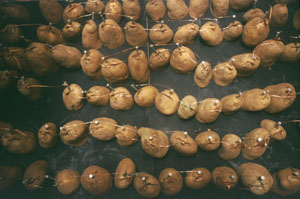
Personally, I think 500lbs of potatoes is overkill.
The penny should cost, well, a penny.
And good large 16 penny nail should run - well, you get the point.
In that similar vein, I'm not sure what you are using as an electrode for the copper, but a penny has pretty large surface area for the copper electrode.
And a very large zinc nail would have a reasonably large surface area for the zinc electrode.
Of course, you could also take this approach:
Personally, I think 500lbs of potatoes is overkill.
The penny should cost, well, a penny.
And good large 16 penny nail should run - well, you get the point.
Alan Lichtenstein, MD
Anesthesiologist
Mens et manus
Veritas
He who laughs last...Thinks slowest.
Anesthesiologist
Mens et manus
Veritas
He who laughs last...Thinks slowest.
-
Louise
- Former Expert
- Posts: 921
- Joined: Mon Jan 16, 2006 2:17 pm
zzzzdoc wrote:Good points. Doh!!!
In that similar vein, I'm not sure what you are using as an electrode for the copper, but a penny has pretty large surface area for the copper electrode.
And a very large zinc nail would have a reasonably large surface area for the zinc electrode.
Of course, you could also take this approach:
Personally, I think 500lbs of potatoes is overkill.
The penny should cost, well, a penny.
And good large 16 penny nail should run - well, you get the point.
I am very impressed with the 500 lb of potato battery!
Louise
-
99help
- Posts: 18
- Joined: Fri Mar 30, 2007 4:22 pm
- Occupation: student
- Project Question: Chemistry of hair highlights
- Project Due Date: 5/4/09
- Project Status: I am finished with my experiment and analyzing the data
Physical Science
Hi zzzzdoc,
My name is Sabrina. The experiment your is simmilar to mines. I did the project and I can help you.Rememmber the picture you put on your post?
That picture leads to a clue. What I mean was that an potatto has little electricity. So theirfore it might take a million potattos to make the calculator to work. You should know that a calculater needs about 1.5 volts.

My name is Sabrina. The experiment your is simmilar to mines. I did the project and I can help you.Rememmber the picture you put on your post?
That picture leads to a clue. What I mean was that an potatto has little electricity. So theirfore it might take a million potattos to make the calculator to work. You should know that a calculater needs about 1.5 volts.
Thank you so much for you help!!!
-Sabrina
-Sabrina
-
lisaph310
- Posts: 3
- Joined: Mon Mar 19, 2007 7:34 pm
veggie power problems
Thank you for helping me on my science project . I switched to a L.E.D. bulb, and it worked.It stayed on for two and a half weeks.
I got first place at my school.
THANKS SCIENCE BUDDIES!
I got first place at my school.
THANKS SCIENCE BUDDIES!
-
deleted-71576
- Former Expert
- Posts: 238
- Joined: Thu Jan 05, 2006 6:28 pm
Congratulations. And you are very welcome. It is truly our pleasure to help.
You obviously did a great job, plus learned about electricity which is a pretty interesting subject.
Be proud. Nothing like winning a science fair.
You obviously did a great job, plus learned about electricity which is a pretty interesting subject.
Be proud. Nothing like winning a science fair.
Alan Lichtenstein, MD
Anesthesiologist
Mens et manus
Veritas
He who laughs last...Thinks slowest.
Anesthesiologist
Mens et manus
Veritas
He who laughs last...Thinks slowest.