/-/https/www.sciencebuddies.org/cdn/Files/21464/5/sb-logo.png)
/-/https/www.sciencebuddies.org/cdn/Files/21464/5/sb-logo.png)
Chicken and Cow DNA: Looking at the differences
Moderators: AmyCowen, kgudger, MadelineB, Moderators
-
jluke45
- Posts: 8
- Joined: Sat Aug 31, 2013 5:43 pm
- Occupation: Student 9th Grade
- Project Question: I need to have a science fair project about mice. I would like to have bleep related to seeing the effects of different drugs or bleep on the mouse's bodily functions (blood pressure , heart rate,ect.)Please no maze ideas or childish things. I would like bleep medically related along the lines of what i said earlier.
- Project Due Date: Few Months
- Project Status: Not applicable
Chicken and Cow DNA: Looking at the differences
SO for my project I will be extracting DNA from a chicken's liver and a cow's liver to see the difference in DNA between two organisms. My plan was for this project be a stepping stone for more advanced projects, but my science teacher refuses to approve it until I add more to it. I was going to examine the DNA under a microscope, but i realized that microscopes can only see the exterior of DNA which would really provide no help to see the differences. What i am asking is for different ways in which you can compare DNA. I am aware of the fact that there are microscopes that CAN go into the components of the DNA but those are exceptionally expensive + I do not think I would have the knowledge to be able to understand all the differences. Is there any other way that I could compare the DNA? Thank you so much.
-
SciB
- Expert
- Posts: 2071
- Joined: Fri Feb 01, 2013 7:00 am
- Occupation: Retired molecular biologist, university researcher and teacher
- Project Question: I wish to join Scibuddies to be able to help students achieve the best science project possible and to understand the science behind it.
- Project Due Date: n/a
- Project Status: Not applicable
Re: Chicken and Cow DNA: Looking at the differences
Hi and welcome to Scibuddies,
Comparing DNAs is bleep biological scientists frequently do, but think about what is being compared--the information in the DNA molecule that is contained in the sequence of base pairs. DNA sequencing is commonplace nowadays, but it still requires complex and expensive equipment.
What exactly are you interested in? Why do you want to compare cow DNA to chicken DNA? Of course, the sequences of the DNAs will be different, but that is what makes one animal different from another. The types of bases and the sugar-phosphate backbone of virtually every DNA are the same, so if you just compare the gross molecular structure of cow DNA and chicken DNA, they would look the same. Only the base sequence differs.
Check out Scibuddies' projects with DNA and see if you can find bleep that interests you that is doable https://www.sciencebuddies.org/science- ... l?v=&s=dna .
The sequence of the cow genome and the chicken genome may already have been determined, so you could do an online comparison of selected parts of the DNA. This is a type of scientific study that does not require lab experiments but can still provide useful data. Check out the Basic Local Alignment Search Tool (BLAST) which allows you to put in two sequence and align them to see how much they differ: http://en.wikipedia.org/wiki/BLAST
There's also a video you can watch that shows you how to do a database search for specific sequences and the BLAST comparison: http://www.youtube.com/watch?v=OSKwuOccAak&noredirect=1
Let us know what you decide about your project so we can help you get started.
Best wishes,
Scibee
Comparing DNAs is bleep biological scientists frequently do, but think about what is being compared--the information in the DNA molecule that is contained in the sequence of base pairs. DNA sequencing is commonplace nowadays, but it still requires complex and expensive equipment.
What exactly are you interested in? Why do you want to compare cow DNA to chicken DNA? Of course, the sequences of the DNAs will be different, but that is what makes one animal different from another. The types of bases and the sugar-phosphate backbone of virtually every DNA are the same, so if you just compare the gross molecular structure of cow DNA and chicken DNA, they would look the same. Only the base sequence differs.
Check out Scibuddies' projects with DNA and see if you can find bleep that interests you that is doable https://www.sciencebuddies.org/science- ... l?v=&s=dna .
The sequence of the cow genome and the chicken genome may already have been determined, so you could do an online comparison of selected parts of the DNA. This is a type of scientific study that does not require lab experiments but can still provide useful data. Check out the Basic Local Alignment Search Tool (BLAST) which allows you to put in two sequence and align them to see how much they differ: http://en.wikipedia.org/wiki/BLAST
There's also a video you can watch that shows you how to do a database search for specific sequences and the BLAST comparison: http://www.youtube.com/watch?v=OSKwuOccAak&noredirect=1
Let us know what you decide about your project so we can help you get started.
Best wishes,
Scibee
-
deleted-143565
- Former Expert
- Posts: 19
- Joined: Wed Aug 28, 2013 9:28 am
- Occupation: Cytogenetic Technologist
- Project Question: really interested in helping students as I remember doing my science fair project in high school and having no idea how to approach it and where to start.
- Project Due Date: n/a
- Project Status: Not applicable
Re: Chicken and Cow DNA: Looking at the differences
Very good advice by your expert. This is I agree, a complex experiment. Also remember you are comparing mammalian DNA to bird DNA , and this may also be bleep to research. On the DNA level you may want to research the difference in chromosomes , the condensed form of DNA. The number of chromosomes vary from species to species and especially between ,mammals and non mammals.
You may want to look into this as a research topic.
Good luck.
T.choate
You may want to look into this as a research topic.
Good luck.
T.choate
-
jluke45
- Posts: 8
- Joined: Sat Aug 31, 2013 5:43 pm
- Occupation: Student 9th Grade
- Project Question: I need to have a science fair project about mice. I would like to have bleep related to seeing the effects of different drugs or bleep on the mouse's bodily functions (blood pressure , heart rate,ect.)Please no maze ideas or childish things. I would like bleep medically related along the lines of what i said earlier.
- Project Due Date: Few Months
- Project Status: Not applicable
Re: Chicken and Cow DNA: Looking at the differences
Hello all,
Thank you for your wonderful replies. Determining the number of chromosomes seems to be the most practical approach for looking at differences. What are the ways that I could count the number of chromosomes? (Note: I am kind of a beginner to DNA ) I would REALLY like to be able to do this in a experiment as opposed to a database search, as I think my science teacher would disapprove of internet research.
-jluke45
Thank you for your wonderful replies. Determining the number of chromosomes seems to be the most practical approach for looking at differences. What are the ways that I could count the number of chromosomes? (Note: I am kind of a beginner to DNA
) I would REALLY like to be able to do this in a experiment as opposed to a database search, as I think my science teacher would disapprove of internet research.-jluke45
-
deleted-143565
- Former Expert
- Posts: 19
- Joined: Wed Aug 28, 2013 9:28 am
- Occupation: Cytogenetic Technologist
- Project Question: really interested in helping students as I remember doing my science fair project in high school and having no idea how to approach it and where to start.
- Project Due Date: n/a
- Project Status: Not applicable
Re: Chicken and Cow DNA: Looking at the differences
Well you are lucky in this aspect because you CAN see chromosomes under the microscope!.. I do this as my job and the procedure is not to difficult. Given that you are already extracting DNA from livers I don't know what your lab capabilities are at this point ...you don't need liver only the blood to get the chromosomes but I would need some more background on your capabilities .
You can basically grow some cells in culture for about three days then do a fairly simple harvest procedure then put the cells on a slide and stain them purple and look at them under 100 x on a microscope. You will first need to understand the cell cycle as chromosomes appear in metaphase. This procedure may be too advanced if you do not have all the resources but if you can research the cell cycles of mammals vs. birds ( one lays an egg) then you could draw out the cell division of each animal.
Then you may be able to find images of Cow chromosomes and bird ( chicken) chromosomes and compare these. You may even want to include other animals such as mice, flies etc as there is a lot of information on this. Not only the number of chromosomes but the way they look.
I can get a comparison to human link for you I will just have to attach it in another post.
Let me know your thoughts
T.choate
You can basically grow some cells in culture for about three days then do a fairly simple harvest procedure then put the cells on a slide and stain them purple and look at them under 100 x on a microscope. You will first need to understand the cell cycle as chromosomes appear in metaphase. This procedure may be too advanced if you do not have all the resources but if you can research the cell cycles of mammals vs. birds ( one lays an egg) then you could draw out the cell division of each animal.
Then you may be able to find images of Cow chromosomes and bird ( chicken) chromosomes and compare these. You may even want to include other animals such as mice, flies etc as there is a lot of information on this. Not only the number of chromosomes but the way they look.
I can get a comparison to human link for you I will just have to attach it in another post.
Let me know your thoughts
T.choate
-
deleted-132180
- Former Expert
- Posts: 302
- Joined: Thu Apr 04, 2013 12:27 pm
- Occupation: Graduate Student
- Project Question: I am volunteering for the "Ask an Expert" program.
- Project Due Date: I am volunteering for the "Ask an Expert" program.
- Project Status: Not applicable
Re: Chicken and Cow DNA: Looking at the differences
Hello there,
The experts have given you very good advice so far. If you want to count the number of chromosomes and look at the differences between the differences in the chromosomes between chicken and cows, the best thing to do is probably generate a karyotype. A karyotype is basically the complete set of chromosomes in an individual organism, and it describes the number of chromosomes that are present and what the chromosomes look like structurally under a microscope. In particular, much attention is paid to the lengths of the chromosomes and the position of the centromeres (which is basically the part of the chromosome where the sister chromatids are linked together) and differences between the sex chromosomes. Usually, the chromosomes will be stained with a dye like Giemsa, and you can see that different chromosomes have very unique banding patterns as well. Karyotypes can usually be used to diagnose genetic disorders where people have gained an additional chromosome, have lost a chromosome, have truncated chromosomes, or chromosomes that have switched parts with each other. An example of a karyotype of a human male, in which the chromosomes have been stained with Giemsa, can be found here: http://upload.wikimedia.org/wikipedia/c ... yotype.png. The Wikipedia page for “karyotype” also gives a pretty good description of what it’s all about, so you should definitely check it out.
Remember that many species are diploid organisms (including humans, chickens, and cows), and hence, we have two copies of each of our chromosomes. For example, we have 23 different chromosomes, but because we have two copies each, we have a total of 46 chromosomes. The numbers of chromosomes present in cows and chickens are known, so you can definitely look it up to make sure that when you’ve generated your karyotypes that you’ve included all of the chromosomes!
Generating karyotypes, however, may require a bit of expertise. For example, you would need to be able to tell how many different chromosomes there are in the cells of these animals by comparing their lengths, the position of their centromeres, and the banding patterns that show up when you stain them with Giemsa in order to sort out all the chromosomes. This often requires years of training in order to do that. Are there any science labs near the vicinity of where you live whom you could contact and perhaps have someone help you with generating karyotypes?
Here are some general links for how to generate karyotypes:
http://www.nature.com/scitable/topicpag ... lities-298
http://downsyndrome.about.com/od/diagno ... ype_ro.htm
I am by no means an expert on this subject, so if any other expert has anything to add to this or catches any errors with my replies, please pitch in your own thoughts!
Best of luck,
Connie
The experts have given you very good advice so far. If you want to count the number of chromosomes and look at the differences between the differences in the chromosomes between chicken and cows, the best thing to do is probably generate a karyotype. A karyotype is basically the complete set of chromosomes in an individual organism, and it describes the number of chromosomes that are present and what the chromosomes look like structurally under a microscope. In particular, much attention is paid to the lengths of the chromosomes and the position of the centromeres (which is basically the part of the chromosome where the sister chromatids are linked together) and differences between the sex chromosomes. Usually, the chromosomes will be stained with a dye like Giemsa, and you can see that different chromosomes have very unique banding patterns as well. Karyotypes can usually be used to diagnose genetic disorders where people have gained an additional chromosome, have lost a chromosome, have truncated chromosomes, or chromosomes that have switched parts with each other. An example of a karyotype of a human male, in which the chromosomes have been stained with Giemsa, can be found here: http://upload.wikimedia.org/wikipedia/c ... yotype.png. The Wikipedia page for “karyotype” also gives a pretty good description of what it’s all about, so you should definitely check it out.
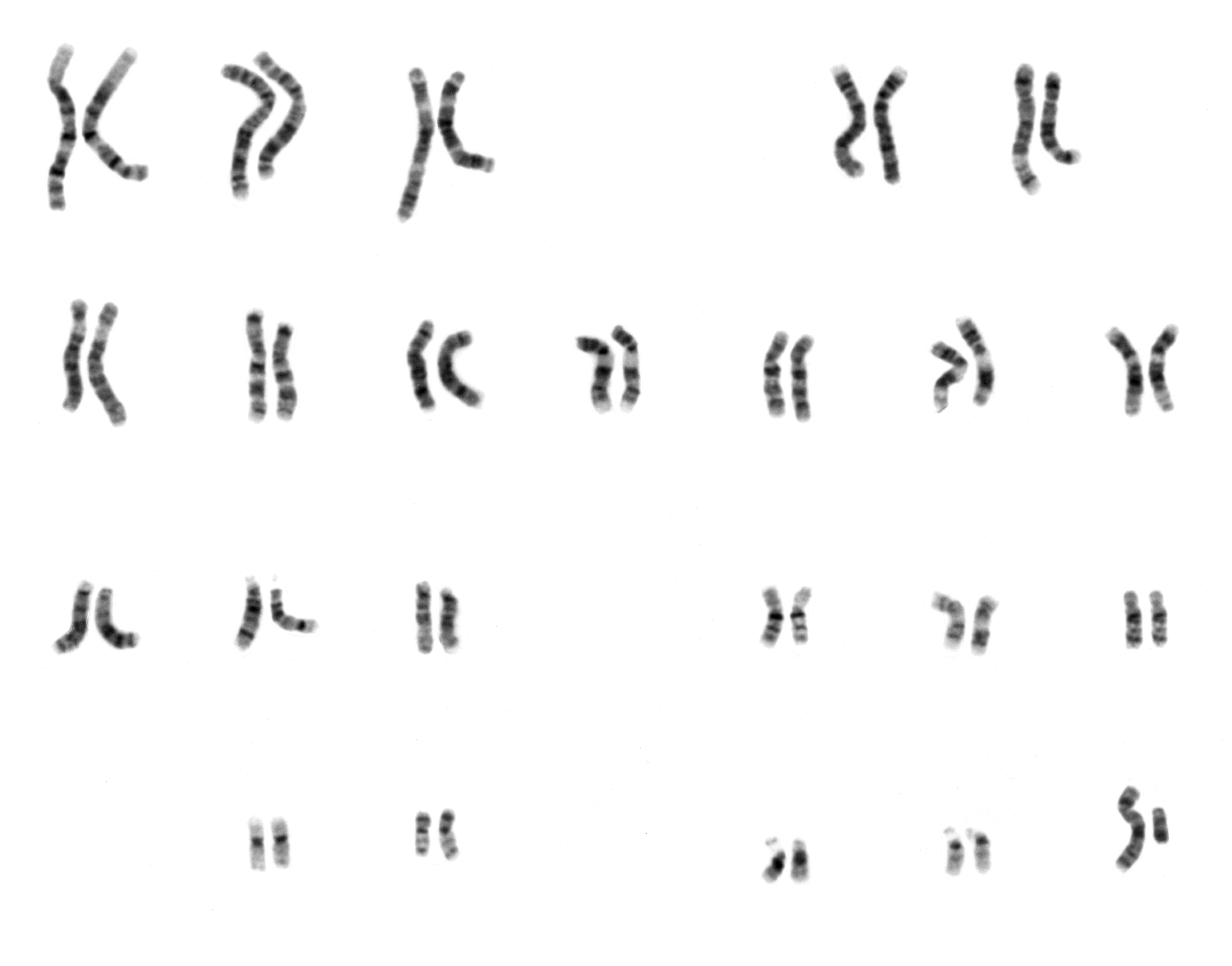
Remember that many species are diploid organisms (including humans, chickens, and cows), and hence, we have two copies of each of our chromosomes. For example, we have 23 different chromosomes, but because we have two copies each, we have a total of 46 chromosomes. The numbers of chromosomes present in cows and chickens are known, so you can definitely look it up to make sure that when you’ve generated your karyotypes that you’ve included all of the chromosomes!
Generating karyotypes, however, may require a bit of expertise. For example, you would need to be able to tell how many different chromosomes there are in the cells of these animals by comparing their lengths, the position of their centromeres, and the banding patterns that show up when you stain them with Giemsa in order to sort out all the chromosomes. This often requires years of training in order to do that. Are there any science labs near the vicinity of where you live whom you could contact and perhaps have someone help you with generating karyotypes?
Here are some general links for how to generate karyotypes:
http://www.nature.com/scitable/topicpag ... lities-298
http://downsyndrome.about.com/od/diagno ... ype_ro.htm
I am by no means an expert on this subject, so if any other expert has anything to add to this or catches any errors with my replies, please pitch in your own thoughts!
Best of luck,
Connie
-
jluke45
- Posts: 8
- Joined: Sat Aug 31, 2013 5:43 pm
- Occupation: Student 9th Grade
- Project Question: I need to have a science fair project about mice. I would like to have bleep related to seeing the effects of different drugs or bleep on the mouse's bodily functions (blood pressure , heart rate,ect.)Please no maze ideas or childish things. I would like bleep medically related along the lines of what i said earlier.
- Project Due Date: Few Months
- Project Status: Not applicable
Re: Chicken and Cow DNA: Looking at the differences
Thank you for the great replies, I would like to clarify bleep though. When I mean beginner to DNA, I mean little lab experience and limited knowledge. SO taking that into consideration, I don't want to get too deep into DNA (maybe next year after I take Biology). I like the idea of the chromosomes under microscope, bleep (i think) I can do at home. If you could please send detailed instructions, but at a 9th grade level, I would immensely appreciate it. It doesn't sound too complex, but would that alter my project from DNA to chromosomes? I am fine with the change, I am just wondering however. Thank you all soooo much
-
deleted-143565
- Former Expert
- Posts: 19
- Joined: Wed Aug 28, 2013 9:28 am
- Occupation: Cytogenetic Technologist
- Project Question: really interested in helping students as I remember doing my science fair project in high school and having no idea how to approach it and where to start.
- Project Due Date: n/a
- Project Status: Not applicable
Re: Chicken and Cow DNA: Looking at the differences
Hi there,
Well you may need to explore a different aspect of your project. First off since Chromosomes are DNA just in a condensed form you would still essentially be looking at DNA. As far as doing this project at home, unless you had ready prepared karyotypes that you could try to compare, there is not much to this project that you could do at home. As previous posts have mentioned preparing karyotypes, which is the way to truly compare chromosomes , is highly technical and takes a lot of training to do. As a beginner to DNA and having little lab experience , if you want to try to do this project you may need to stick to what is already out there and research chromosomes and try and find karyotypes of your chosen animals. Then read up on the structure of chromosomes, the centromeres, how they are classified in a karyotype by size, banding pattern, and sex chromosomes.
Wikipedia has a lot of information on chromosomes.
This may be a place to start as you may have to alter your project.
Let me know what you find and how you may think you want to proceed. Speak with your teacher also as she may have some guidance.
Good Luck,
T.choate
Well you may need to explore a different aspect of your project. First off since Chromosomes are DNA just in a condensed form you would still essentially be looking at DNA. As far as doing this project at home, unless you had ready prepared karyotypes that you could try to compare, there is not much to this project that you could do at home. As previous posts have mentioned preparing karyotypes, which is the way to truly compare chromosomes , is highly technical and takes a lot of training to do. As a beginner to DNA and having little lab experience , if you want to try to do this project you may need to stick to what is already out there and research chromosomes and try and find karyotypes of your chosen animals. Then read up on the structure of chromosomes, the centromeres, how they are classified in a karyotype by size, banding pattern, and sex chromosomes.
Wikipedia has a lot of information on chromosomes.
This may be a place to start as you may have to alter your project.
Let me know what you find and how you may think you want to proceed. Speak with your teacher also as she may have some guidance.
Good Luck,
T.choate