/-/https/www.sciencebuddies.org/Files/21464/5/sb-logo.png)
/-/https/www.sciencebuddies.org/Files/21464/5/sb-logo.png)
Biomimicry
Moderators: AmyCowen, kgudger, bfinio, MadelineB, Moderators
-
deleted-89863
- Posts: 36
- Joined: Fri Dec 30, 2011 9:41 am
- Occupation: Student: 7th Grade Gifted
- Project Question: Engineering/Biomimicry
- Project Due Date: October 2014
- Project Status: I am just starting
Biomimicry
Can beta keratin bond to unmodified chitin? If so, how?
-
deleted-2131
- Former Expert
- Posts: 1415
- Joined: Sat Nov 08, 2003 11:27 pm
- Occupation: Planetary Scientist
- Project Question: N/A
- Project Due Date: N/A
- Project Status: Not applicable
Re: Biomimicry
Hi Proscience,
A bit more information about your project will help us address your question more effectively. What is your scientific question and hypothesis? Also, when you say "bond" are you referring to bonding of molecules of beta keratin to chitin? Or are you talking about connecting larger pieces of beta keratin to chitin?
A bit more information about your project will help us address your question more effectively. What is your scientific question and hypothesis? Also, when you say "bond" are you referring to bonding of molecules of beta keratin to chitin? Or are you talking about connecting larger pieces of beta keratin to chitin?
All the best,
Terik
Terik
-
deleted-89863
- Posts: 36
- Joined: Fri Dec 30, 2011 9:41 am
- Occupation: Student: 7th Grade Gifted
- Project Question: Engineering/Biomimicry
- Project Due Date: October 2014
- Project Status: I am just starting
Re: Biomimicry
I'm not really sure. I'm working on an Invention Convention project for school. I'm really interested in nanotechnology and biomimicry but I have to make a crude model to explain my invention. I wanted to know if its possible to attach keratin fibers to a chitin scaffold. I read that catapillars bodies are made of unmodified chitin so they are flexible. The exoskeletons of insects are chitin too, but they are hard. I need something flexible from nature.
Keratin is made of strong protein fibers like in hair or feathers. I was thinking about soccer goal nets and basketball nets that are attached to a frame but the nets are strong and flexible and they absorb energy. So is it possible to get the molecules of keratin to bond to a scaffold of chitin that would be flexible like a soccer goal or a basketball net?
I was hoping I could make a model and in my paper explain how it might work at a nano level. I don't know enough about chemistry to know if it will work. I read about hydrogen bonding. I guess sometimes it's strong and sometimes it's weak. I'm stuck and so if you could guide me in any way, that would be great. Thanks.
Keratin is made of strong protein fibers like in hair or feathers. I was thinking about soccer goal nets and basketball nets that are attached to a frame but the nets are strong and flexible and they absorb energy. So is it possible to get the molecules of keratin to bond to a scaffold of chitin that would be flexible like a soccer goal or a basketball net?
I was hoping I could make a model and in my paper explain how it might work at a nano level. I don't know enough about chemistry to know if it will work. I read about hydrogen bonding. I guess sometimes it's strong and sometimes it's weak. I'm stuck and so if you could guide me in any way, that would be great. Thanks.
-
deleted-2131
- Former Expert
- Posts: 1415
- Joined: Sat Nov 08, 2003 11:27 pm
- Occupation: Planetary Scientist
- Project Question: N/A
- Project Due Date: N/A
- Project Status: Not applicable
Re: Biomimicry
Hi Proscience,
Thank you for posting these additional details - they are very helpful!
I think your idea is clever. A coworker of mine studies nano-structure of iridescent beetle shells as a pattern for photonic crystals; very cool stuff. Based on your project description, I suggest reading up on the Engineering Design Process (https://www.sciencebuddies.org/science- ... uide.shtml). Since you are working on designing something to meet a specific need, following the engineering design process will help clarify what you are doing and why you are doing it. Write everything down in a notebook--all of your thoughts and ideas, what you do as you work on your invention, etc.
With regards to your specific question about bonding keratin to chitin, I'm afraid that I don't have enough of a organic chemistry background to know if (and how) they bond at the molecular level. I will ask another Expert to address that question. So - expect another response within the next day or so with more specifics!
Thank you for posting these additional details - they are very helpful!
I think your idea is clever. A coworker of mine studies nano-structure of iridescent beetle shells as a pattern for photonic crystals; very cool stuff. Based on your project description, I suggest reading up on the Engineering Design Process (https://www.sciencebuddies.org/science- ... uide.shtml). Since you are working on designing something to meet a specific need, following the engineering design process will help clarify what you are doing and why you are doing it. Write everything down in a notebook--all of your thoughts and ideas, what you do as you work on your invention, etc.
With regards to your specific question about bonding keratin to chitin, I'm afraid that I don't have enough of a organic chemistry background to know if (and how) they bond at the molecular level. I will ask another Expert to address that question. So - expect another response within the next day or so with more specifics!
All the best,
Terik
Terik
-
deleted-89863
- Posts: 36
- Joined: Fri Dec 30, 2011 9:41 am
- Occupation: Student: 7th Grade Gifted
- Project Question: Engineering/Biomimicry
- Project Due Date: October 2014
- Project Status: I am just starting
Re: Biomimicry
The engineering process flow chart is really helpful. I started building my model. I was going to use human hair extensions but switched to feathers. Hair was hard to work with.
Do you know how I can measure shearing of a feather? I also wanted to see if the feather was super hydrophobic like the lotus. I read that you can measure the contact angle but the formula is very complicated and there's a special instrument that does that. My grandfather says there's an app where you can take lots of pictures of dripping water. If I do that can I use a protractor and the picture to measure the contact angle?
I really want to use my idea. My teacher wanted me to come up with a different idea but I don't know what to do. I want to do something different, not some gadget.
Oh, I don't have any lab equipment to use. I have to do this at home.
Thanks for helping.
Do you know how I can measure shearing of a feather? I also wanted to see if the feather was super hydrophobic like the lotus. I read that you can measure the contact angle but the formula is very complicated and there's a special instrument that does that. My grandfather says there's an app where you can take lots of pictures of dripping water. If I do that can I use a protractor and the picture to measure the contact angle?
I really want to use my idea. My teacher wanted me to come up with a different idea but I don't know what to do. I want to do something different, not some gadget.
Oh, I don't have any lab equipment to use. I have to do this at home.
Thanks for helping.
-
deleted-2131
- Former Expert
- Posts: 1415
- Joined: Sat Nov 08, 2003 11:27 pm
- Occupation: Planetary Scientist
- Project Question: N/A
- Project Due Date: N/A
- Project Status: Not applicable
Re: Biomimicry
Hi Proscience,
I'm glad the engineering process link was helpful, and it's exciting that you've started your model! I think your idea is an excellent one. If you are passionate about it, then I suggest sticking with it. But, your teacher should approve the project, too! Perhaps it would be helpful to explain to your engineering goal to you teacher. When people invent a gadget of some sort, they do so to fill a need. For example, someone might say "I don't like having a cord connecting my ear buds to my music. I will invent wireless ear buds so people don't have to be tether to their music device." In your case, it sounds like you are trying to invent a whole new material, a material that combines the characteristics of keratin and chitin. Some people's whole job is based on inventing new materials; it's an important branch of science and engineering. Then, other people come along and invent new gadgets, tools, etc. using the new materials. What types of things do you think could be built or improved using <i>your</i> material?
Doing things at home is a great option. You can do quite a bit without having too much expensive lab equipment! Speaking of which, let's get to your question about shearing a feather. Am I correct in thinking that you want to measure how strong a feather is when you shear it? Do you want to measure how hard you have to push or pull on a feather to make it shear? Or do you want to measure how much the feather deforms when you push or pull on it? Also, are you thinking of measuring a single feather? Or a group of feathers all together? I think it will probably be easier for you to measure how much the feather deforms in response to a specified stress than to measure how much stress it takes to create a certain amount of deformation. Let me know the answers to these questions, and I will help you think of a way to test it.
Regarding contact angle - your Grandpa's idea of taking pictures of a drop of water on the feather is a good one. With the feather on a flat surface, you could put a drop or two of water on the feather (with an eyedropper or even with a dripping water faucet), take a close-up picture of the droplet, and then use a protractor to measure the contact angle. Sure, the measurement won't be as precise as if you did it in a fancy lab with special instruments. But, you'll get a decent estimate. Creative problem solving is a really important part of a science or engineering project. If your project will be judged when it's done, I know that the judges will be impressed by your thinking about how you could measure the contact angle without special instruments.
I'm glad the engineering process link was helpful, and it's exciting that you've started your model! I think your idea is an excellent one. If you are passionate about it, then I suggest sticking with it. But, your teacher should approve the project, too! Perhaps it would be helpful to explain to your engineering goal to you teacher. When people invent a gadget of some sort, they do so to fill a need. For example, someone might say "I don't like having a cord connecting my ear buds to my music. I will invent wireless ear buds so people don't have to be tether to their music device." In your case, it sounds like you are trying to invent a whole new material, a material that combines the characteristics of keratin and chitin. Some people's whole job is based on inventing new materials; it's an important branch of science and engineering. Then, other people come along and invent new gadgets, tools, etc. using the new materials. What types of things do you think could be built or improved using <i>your</i> material?
Doing things at home is a great option. You can do quite a bit without having too much expensive lab equipment! Speaking of which, let's get to your question about shearing a feather. Am I correct in thinking that you want to measure how strong a feather is when you shear it? Do you want to measure how hard you have to push or pull on a feather to make it shear? Or do you want to measure how much the feather deforms when you push or pull on it? Also, are you thinking of measuring a single feather? Or a group of feathers all together? I think it will probably be easier for you to measure how much the feather deforms in response to a specified stress than to measure how much stress it takes to create a certain amount of deformation. Let me know the answers to these questions, and I will help you think of a way to test it.
Regarding contact angle - your Grandpa's idea of taking pictures of a drop of water on the feather is a good one. With the feather on a flat surface, you could put a drop or two of water on the feather (with an eyedropper or even with a dripping water faucet), take a close-up picture of the droplet, and then use a protractor to measure the contact angle. Sure, the measurement won't be as precise as if you did it in a fancy lab with special instruments. But, you'll get a decent estimate. Creative problem solving is a really important part of a science or engineering project. If your project will be judged when it's done, I know that the judges will be impressed by your thinking about how you could measure the contact angle without special instruments.
All the best,
Terik
Terik
-
deleted-89863
- Posts: 36
- Joined: Fri Dec 30, 2011 9:41 am
- Occupation: Student: 7th Grade Gifted
- Project Question: Engineering/Biomimicry
- Project Due Date: October 2014
- Project Status: I am just starting
Re: Biomimicry
Well I noticed that flight feathers can stretch in a diagonal direction when I pull on it. My dad says that when the feather separates that's shearing. I'm guessing that a group of feathers can take more stress than a single feather because of surface area. So I wanted the measure how much stretching the group of feathers can take. My research says that flight feathers are very strong. I want to find out how strong. I'm glad that I can measure the contact angle using a protracter  . The variables I want to measure are hydrophobicity and shearing. Maybe temperature and uv since feathers protect birds from the sun and keeps them warm.
. The variables I want to measure are hydrophobicity and shearing. Maybe temperature and uv since feathers protect birds from the sun and keeps them warm.-
deleted-89863
- Posts: 36
- Joined: Fri Dec 30, 2011 9:41 am
- Occupation: Student: 7th Grade Gifted
- Project Question: Engineering/Biomimicry
- Project Due Date: October 2014
- Project Status: I am just starting
Re: Biomimicry
Actually, measuring how much the feather deforms would work too since you mentioned that might be easier to measure.
Thanks!
Thanks!
-
deleted-2131
- Former Expert
- Posts: 1415
- Joined: Sat Nov 08, 2003 11:27 pm
- Occupation: Planetary Scientist
- Project Question: N/A
- Project Due Date: N/A
- Project Status: Not applicable
Re: Biomimicry
Hi Proscience,
I can think of a few different ways to measure how strong a feather is. Something shears in response to an applied stress, which is a force per area. But, measuring the force required to deform the feather will give you some idea of how strong the feather is, even if it isn't totally rigorous. So, you'll need some way of measuring force (which is measured in newtons, if you are using SI units, or pounds, if you are using US units). I think a spring scale might work; there are different styles of spring scales out there, but many of them look something like this: http://www.arborsci.com/media/catalog/p ... 1-6970.png. Talk to your teacher and see if your school has one. A friend or neighbor might have one, especially if they like to fish. Different spring scales cover different weight ranges. I suspect you will need a pretty strong one. As a brief note, if you use a SI spring scale, it will probably measure mass in kilograms. To get to newtons, multiple the number of kilograms by the acceleration due to gravity, 9.8 m/(s^2). A newton has units of kg*m/(s^2).
Although I don't have feathers that I can try this with, I think the following procedure will work to get a rough idea for how strong the feathers are under shear. Take a feather and attach two binder clips diagonally across from each other at the two ends of the feather. Then attach one of the binder clips to something very strong and steady. This will be the "anchor" point. Then, loop the hook of the spring scale through the loops on the handle of the other binder clip, and pull on the spring scale until the feather breaks. You'll probably need a helper to watch the spring scale to see what it reads right before the feather breaks. Or, you could video the test and then use the footage to read the spring scale right before the feather breaks. Another option would be hanging the whole setup vertically and then putting a bucket on the other loop of the spring scale and slowing adding weight to the bucket. Then you can weigh the bucket once the test is done to figure out how much load the feather held. The hard part will be making sure that the feather breaks, instead of the binder clip just pulling off the feather. So, depending on how strong the feather is, you may need to glue the binder clips to the feather. If the clips come off, then what you are measuring is the strength of the contact between the feathers and the binder clip (or the strength of the glue, if you glue the clips to the feather). That number will be a lower limit to the strength of the feather--the feather is at least that strong, but it may be stronger.
Always keep in mind your engineering goal. Hydrophobicity and shear strength are two things you can measure, but think about how you can test your material to see if it meets your design criteria. You'll want to make sure you have a specific "test plan". Take a look at https://www.sciencebuddies.org/engineer ... ents.shtml to help you define design requirements, if you haven't done so already. Also check out https://www.sciencebuddies.org/engineer ... ment.shtml for info about testing different versions of your material. I suggest that you brainstorm two or three different versions of your material. Be sure to write down why you chose each design--explain your thought process. Then do the same tests on all those materials to see which one best meets your design criteria. You can then iterate, or repeat the process. Use what you learned by doing your tests to design an improved version of your material, and then test that one. Repeat this process until you have a material that meets your design criteria.
I can think of a few different ways to measure how strong a feather is. Something shears in response to an applied stress, which is a force per area. But, measuring the force required to deform the feather will give you some idea of how strong the feather is, even if it isn't totally rigorous. So, you'll need some way of measuring force (which is measured in newtons, if you are using SI units, or pounds, if you are using US units). I think a spring scale might work; there are different styles of spring scales out there, but many of them look something like this: http://www.arborsci.com/media/catalog/p ... 1-6970.png. Talk to your teacher and see if your school has one. A friend or neighbor might have one, especially if they like to fish. Different spring scales cover different weight ranges. I suspect you will need a pretty strong one. As a brief note, if you use a SI spring scale, it will probably measure mass in kilograms. To get to newtons, multiple the number of kilograms by the acceleration due to gravity, 9.8 m/(s^2). A newton has units of kg*m/(s^2).

Although I don't have feathers that I can try this with, I think the following procedure will work to get a rough idea for how strong the feathers are under shear. Take a feather and attach two binder clips diagonally across from each other at the two ends of the feather. Then attach one of the binder clips to something very strong and steady. This will be the "anchor" point. Then, loop the hook of the spring scale through the loops on the handle of the other binder clip, and pull on the spring scale until the feather breaks. You'll probably need a helper to watch the spring scale to see what it reads right before the feather breaks. Or, you could video the test and then use the footage to read the spring scale right before the feather breaks. Another option would be hanging the whole setup vertically and then putting a bucket on the other loop of the spring scale and slowing adding weight to the bucket. Then you can weigh the bucket once the test is done to figure out how much load the feather held. The hard part will be making sure that the feather breaks, instead of the binder clip just pulling off the feather. So, depending on how strong the feather is, you may need to glue the binder clips to the feather. If the clips come off, then what you are measuring is the strength of the contact between the feathers and the binder clip (or the strength of the glue, if you glue the clips to the feather). That number will be a lower limit to the strength of the feather--the feather is at least that strong, but it may be stronger.
Always keep in mind your engineering goal. Hydrophobicity and shear strength are two things you can measure, but think about how you can test your material to see if it meets your design criteria. You'll want to make sure you have a specific "test plan". Take a look at https://www.sciencebuddies.org/engineer ... ents.shtml to help you define design requirements, if you haven't done so already. Also check out https://www.sciencebuddies.org/engineer ... ment.shtml for info about testing different versions of your material. I suggest that you brainstorm two or three different versions of your material. Be sure to write down why you chose each design--explain your thought process. Then do the same tests on all those materials to see which one best meets your design criteria. You can then iterate, or repeat the process. Use what you learned by doing your tests to design an improved version of your material, and then test that one. Repeat this process until you have a material that meets your design criteria.
All the best,
Terik
Terik
-
deleted-89863
- Posts: 36
- Joined: Fri Dec 30, 2011 9:41 am
- Occupation: Student: 7th Grade Gifted
- Project Question: Engineering/Biomimicry
- Project Due Date: October 2014
- Project Status: I am just starting
Re: Biomimicry
Thanks, I will try it this week and I will let you know what happens.
-
deleted-2131
- Former Expert
- Posts: 1415
- Joined: Sat Nov 08, 2003 11:27 pm
- Occupation: Planetary Scientist
- Project Question: N/A
- Project Due Date: N/A
- Project Status: Not applicable
Re: Biomimicry
Great! I look forward to hearing how things go. I also realized that I wasn't clear about something - testing the feather like this way tells you about their shear strength under tension.
All the best,
Terik
Terik
-
deleted-89863
- Posts: 36
- Joined: Fri Dec 30, 2011 9:41 am
- Occupation: Student: 7th Grade Gifted
- Project Question: Engineering/Biomimicry
- Project Due Date: October 2014
- Project Status: I am just starting
Re: Biomimicry
I did the stress test using a spring scale and small binder clips. Using a group of three flight feathers my result was 0.049 N.
That's pretty weak. I forgot to tell you that I removed the feather from the quill. I need to remove the quill for my invention.
The biggest problem I have is shearing in the vertical direction. How do birds keep their flight feathers together when they fly? Surely there are stronger forces acting on the feathers when they fly. I need to keep the barbules together. Is polyacrylate breathable? Can air pass through a layer of polyacrylate?
Do you think I can use a UV index card to measure how much UV radiation the feather filters out? My project is due at the end of October.
Thanks
That's pretty weak. I forgot to tell you that I removed the feather from the quill. I need to remove the quill for my invention.
The biggest problem I have is shearing in the vertical direction. How do birds keep their flight feathers together when they fly? Surely there are stronger forces acting on the feathers when they fly. I need to keep the barbules together. Is polyacrylate breathable? Can air pass through a layer of polyacrylate?
Do you think I can use a UV index card to measure how much UV radiation the feather filters out? My project is due at the end of October.
Thanks
-
deleted-2131
- Former Expert
- Posts: 1415
- Joined: Sat Nov 08, 2003 11:27 pm
- Occupation: Planetary Scientist
- Project Question: N/A
- Project Due Date: N/A
- Project Status: Not applicable
Re: Biomimicry
Hi Proscience,
I'm glad you were able to do the stress tests. I'm a bit surprised by your results; I thought the feather would be stronger. But, I haven't done the test and you have! Your comment about "removing the feather from the quill" makes me think that maybe you didn't measure what I thought you were measuring, which may explain the low value. Do you mean that you took the vane off the rachis and shaft and measured the strength of the vane alone, detached from the rachis? (see this page for feather anatomy: http://askabiologist.asu.edu/explore/feather-biology) When the feathers failed, did they break in the middle? Or did they break where they connected to the binder clips? I definitely agree that birds have forces on their feathers greater than 0.049N when they fly. That's part of why I want to know what, precisely, you measured and how the feather broke.
Birds feathers have little interlocking barbules and hooklets that lock together, helping the feathers stay connected and in place. It's a bit like Velcro. They also match the bird's aerodynamic profile, so the way that air passes around the feathers helps them stay together, to some extent. There are also oils and waxes in feathers that might help bind them together. In addition, different types of feathers fill different roles, so flight feathers are quite different from downy feathers.
Can you please describe the vertical shear problem in more detail? One thing to keep in mind is that the strength of materials is often anisotropic, which is a big word that just means they are stronger in one direction than in others. So, you might be able to address the problem by changing the orientation of the feather. Polyacrylate might help the feathers stay together, but I'm not certain of that. You can always test it and see if it works. You can then also test to see if you can blow air through the polyacrylate-coated feathers. That's what the engineering design process is all about. You're showing it in action right here--you built something; you tested it and it didn't work like you had planned. So, you brainstormed possible solutions. Now is the time to test those solutions. It's an iterative process, and it sounds like you are doing it well. Keep track of all your iterations and work; that's what will show your teacher and judges that you didn't just tinker with something. Instead, you applied the engineering design process to invent a material that meets specified design criteria.
Are you referring to a UV indicator card, such as this: http://www.healthedco.com/index.php/uv- ... -card.html? If so, I think that is a neat idea for getting a qualitative sense for how effective your invention is at filtering out UV light. I like how you are thinking. Without knowing more about your invention (its size, shape, opacity, etc.) or seeing a picture of it, I'm not sure how well the card will work, but I think it's a great idea to try. Essentially, if your invention is small compared to the size of the card, then the card won't really be shielded from UV by your invention; light will just go around the invention and hit the card. And, if your invention blocks the light completely then the card won't tell you much about UV filtering specifically. But, these are based on specifics about your invention. From a theoretical point of view, I don't see any reason why the card wouldn't give you qualitative information. From a practical point of view, the card's usefulness will depend on the details of your invention. I suggest trying the card and seeing if it works with your particular invention.
Best of luck as you continue your project. I'm sure the end of October due date feels like it's coming up quickly. But, keep working on your project, step by step, and you'll get there. I'm excited to see how your project turns out! Let me know if I can help in any other way.
All the best,
Terik
I'm glad you were able to do the stress tests. I'm a bit surprised by your results; I thought the feather would be stronger. But, I haven't done the test and you have! Your comment about "removing the feather from the quill" makes me think that maybe you didn't measure what I thought you were measuring, which may explain the low value. Do you mean that you took the vane off the rachis and shaft and measured the strength of the vane alone, detached from the rachis? (see this page for feather anatomy: http://askabiologist.asu.edu/explore/feather-biology) When the feathers failed, did they break in the middle? Or did they break where they connected to the binder clips? I definitely agree that birds have forces on their feathers greater than 0.049N when they fly. That's part of why I want to know what, precisely, you measured and how the feather broke.
Birds feathers have little interlocking barbules and hooklets that lock together, helping the feathers stay connected and in place. It's a bit like Velcro. They also match the bird's aerodynamic profile, so the way that air passes around the feathers helps them stay together, to some extent. There are also oils and waxes in feathers that might help bind them together. In addition, different types of feathers fill different roles, so flight feathers are quite different from downy feathers.
Can you please describe the vertical shear problem in more detail? One thing to keep in mind is that the strength of materials is often anisotropic, which is a big word that just means they are stronger in one direction than in others. So, you might be able to address the problem by changing the orientation of the feather. Polyacrylate might help the feathers stay together, but I'm not certain of that. You can always test it and see if it works. You can then also test to see if you can blow air through the polyacrylate-coated feathers. That's what the engineering design process is all about. You're showing it in action right here--you built something; you tested it and it didn't work like you had planned. So, you brainstormed possible solutions. Now is the time to test those solutions. It's an iterative process, and it sounds like you are doing it well. Keep track of all your iterations and work; that's what will show your teacher and judges that you didn't just tinker with something. Instead, you applied the engineering design process to invent a material that meets specified design criteria.
Are you referring to a UV indicator card, such as this: http://www.healthedco.com/index.php/uv- ... -card.html? If so, I think that is a neat idea for getting a qualitative sense for how effective your invention is at filtering out UV light. I like how you are thinking. Without knowing more about your invention (its size, shape, opacity, etc.) or seeing a picture of it, I'm not sure how well the card will work, but I think it's a great idea to try. Essentially, if your invention is small compared to the size of the card, then the card won't really be shielded from UV by your invention; light will just go around the invention and hit the card. And, if your invention blocks the light completely then the card won't tell you much about UV filtering specifically. But, these are based on specifics about your invention. From a theoretical point of view, I don't see any reason why the card wouldn't give you qualitative information. From a practical point of view, the card's usefulness will depend on the details of your invention. I suggest trying the card and seeing if it works with your particular invention.
Best of luck as you continue your project. I'm sure the end of October due date feels like it's coming up quickly. But, keep working on your project, step by step, and you'll get there. I'm excited to see how your project turns out! Let me know if I can help in any other way.
All the best,
Terik
All the best,
Terik
Terik
-
deleted-89863
- Posts: 36
- Joined: Fri Dec 30, 2011 9:41 am
- Occupation: Student: 7th Grade Gifted
- Project Question: Engineering/Biomimicry
- Project Due Date: October 2014
- Project Status: I am just starting
Re: Biomimicry
Hi Terik,
Yes, I cut the vane off the rachis because I wanted the feather to be flexible and fabric-like. I put some cut vanes together using a glue that wouldn't make the feather stiff. When I tested the group of vanes they separated at the hooklets. The vanes started to separate in the middle and with more force the rest of the vane would fall apart. I was hoping to find something that would keep the vane flexible but would also make the hooklets stronger so they could take more stress. That's why I asked the question about poly acylates. Yesterday I tried spraying the vanes with hairspray and then a group with liquid bandage because they both have acrylates in them. That's what the label said, but maybe that wasn't the right acrylate. Both products have alcohol in them so all they did was dry out the vane and make it brittle. So that didn't work.
I thought hairsrpay might work because hair is keratin. And I tried liquid bandage because it is flexible. So I guess my idea of spraying the vanes with polyacrylate won't work. I wiah I could tell you my idea, but I don't want someone stealing it.
My challenge is exactly the velcro analogy you mentioned. How do I get the "velcro" on the barb to hang on, but keeping the feather flexible?
To answer your question about the shear problem: If you hold the vane straight up and down with the quill end down and pull perpendicular to the barb, the vane beginns to shear from the center. That's what was 0.049 N, but id you pull the vane in the same direction as the barb it doesn't shear.
UV index card: Yes, I meant the indicator card. I couldn't think of the name. My invention is meant to be temporary. Birds molt their feathers because they can't repair themselves. My invention follows thw same idea, using it for a particular purpose, for a certain length of time, and can be disposed of anywhere without hurting the environment.
Yes, I cut the vane off the rachis because I wanted the feather to be flexible and fabric-like. I put some cut vanes together using a glue that wouldn't make the feather stiff. When I tested the group of vanes they separated at the hooklets. The vanes started to separate in the middle and with more force the rest of the vane would fall apart. I was hoping to find something that would keep the vane flexible but would also make the hooklets stronger so they could take more stress. That's why I asked the question about poly acylates. Yesterday I tried spraying the vanes with hairspray and then a group with liquid bandage because they both have acrylates in them. That's what the label said, but maybe that wasn't the right acrylate. Both products have alcohol in them so all they did was dry out the vane and make it brittle. So that didn't work.
I thought hairsrpay might work because hair is keratin. And I tried liquid bandage because it is flexible. So I guess my idea of spraying the vanes with polyacrylate won't work. I wiah I could tell you my idea, but I don't want someone stealing it.
My challenge is exactly the velcro analogy you mentioned. How do I get the "velcro" on the barb to hang on, but keeping the feather flexible?
To answer your question about the shear problem: If you hold the vane straight up and down with the quill end down and pull perpendicular to the barb, the vane beginns to shear from the center. That's what was 0.049 N, but id you pull the vane in the same direction as the barb it doesn't shear.
UV index card: Yes, I meant the indicator card. I couldn't think of the name. My invention is meant to be temporary. Birds molt their feathers because they can't repair themselves. My invention follows thw same idea, using it for a particular purpose, for a certain length of time, and can be disposed of anywhere without hurting the environment.
-
deleted-2131
- Former Expert
- Posts: 1415
- Joined: Sat Nov 08, 2003 11:27 pm
- Occupation: Planetary Scientist
- Project Question: N/A
- Project Due Date: N/A
- Project Status: Not applicable
Re: Biomimicry
Hi Proscience,
Thank you for posting those details! They are extremely helpful. Your idea for cutting the vane off the rachis was a good one, and I especially like that you explained why you thought that was a good idea. That's just the kind of thinking you'll want to make clear in your report or presentation.
Your stress test results make sense given what you measured. The Velcro analogy is a really good one for understanding your results. When you put two pieces of Velcro together, it's pretty easy to pull them apart if you pull on them like this:
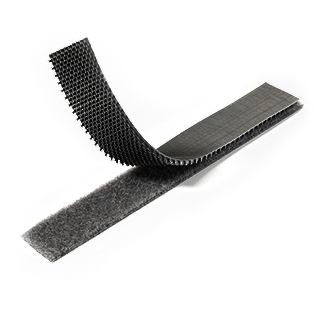
But, if instead of pulling the two sides of the Velcro strip apart (like in the picture) you pulled parallel to the strips, it would be much, much, much harder to pull them apart. To use a word from my last post, the strength of Velcro could be considered anisotropic--it's much easier to break the "grip" between the strips by applying a force in one direction compared to another. The Velcro works the same way no matter which way you pull on it. But, it can be easier or harder to pull it apart depending on how you pull the strips. In this case, the Velcro is weaker when the applied stress is perpendicular to the “seam” between the two strips. It is much stronger when the applied stress is parallel to the “seam”.
The hooklet bonds between bards in the vane are also anisotropic. The data from your stress tests show this (as with Velcro, it was much easier to pull the barbs apart when they were aligned perpendicular to the applied stress). So, your material may be much stronger in one direction (where the applied stress is parallel to barb) than in the other (where the barbs are perpendicular to the applied stress). The anisotropy of your material might give it interesting (and perhaps useful!) properties, depending on the details of your invention.
That being said, you asked about ways to strengthen the barbs when the applied stress is perpendicular to them. The hairspray and liquid bandage were good ideas, and, as a side note, it's just as important to make note of things that don't work as the things that do. It's all part and parcel of the engineering design process. One idea would be to bond two layers of vanes together, oriented so that they are perpendicular to one another. In that orientation, the "strong" and "weak" directions would add up, giving you a strength that is something in between. You could even try weaving the vanes together, like the lattice top of a pie. The question is what to use to bond the two layers together. One option is cyanoacrylate (Super Glue or a similar brand). You will need to be very careful if you decide to try cyanoacrylate--be sure to read the warning labels, follow the directions carefully, and have an adult supervise you. Use cyanoacrylate in a well-ventilated area and don’t let it get on your fingers.
Let me know how it goes. This sounds like cooler project every time you post how things are going. As always, post back if I can help in any other way.
All the best,
Terik
Thank you for posting those details! They are extremely helpful. Your idea for cutting the vane off the rachis was a good one, and I especially like that you explained why you thought that was a good idea. That's just the kind of thinking you'll want to make clear in your report or presentation.
Your stress test results make sense given what you measured. The Velcro analogy is a really good one for understanding your results. When you put two pieces of Velcro together, it's pretty easy to pull them apart if you pull on them like this:
But, if instead of pulling the two sides of the Velcro strip apart (like in the picture) you pulled parallel to the strips, it would be much, much, much harder to pull them apart. To use a word from my last post, the strength of Velcro could be considered anisotropic--it's much easier to break the "grip" between the strips by applying a force in one direction compared to another. The Velcro works the same way no matter which way you pull on it. But, it can be easier or harder to pull it apart depending on how you pull the strips. In this case, the Velcro is weaker when the applied stress is perpendicular to the “seam” between the two strips. It is much stronger when the applied stress is parallel to the “seam”.
The hooklet bonds between bards in the vane are also anisotropic. The data from your stress tests show this (as with Velcro, it was much easier to pull the barbs apart when they were aligned perpendicular to the applied stress). So, your material may be much stronger in one direction (where the applied stress is parallel to barb) than in the other (where the barbs are perpendicular to the applied stress). The anisotropy of your material might give it interesting (and perhaps useful!) properties, depending on the details of your invention.
That being said, you asked about ways to strengthen the barbs when the applied stress is perpendicular to them. The hairspray and liquid bandage were good ideas, and, as a side note, it's just as important to make note of things that don't work as the things that do. It's all part and parcel of the engineering design process. One idea would be to bond two layers of vanes together, oriented so that they are perpendicular to one another. In that orientation, the "strong" and "weak" directions would add up, giving you a strength that is something in between. You could even try weaving the vanes together, like the lattice top of a pie. The question is what to use to bond the two layers together. One option is cyanoacrylate (Super Glue or a similar brand). You will need to be very careful if you decide to try cyanoacrylate--be sure to read the warning labels, follow the directions carefully, and have an adult supervise you. Use cyanoacrylate in a well-ventilated area and don’t let it get on your fingers.
Let me know how it goes. This sounds like cooler project every time you post how things are going. As always, post back if I can help in any other way.
All the best,
Terik
All the best,
Terik
Terik
-
deleted-89863
- Posts: 36
- Joined: Fri Dec 30, 2011 9:41 am
- Occupation: Student: 7th Grade Gifted
- Project Question: Engineering/Biomimicry
- Project Due Date: October 2014
- Project Status: I am just starting
Re: Biomimicry
Hi Terik,
I finished my prototype. I will have to make another one to show with my board. I'm guessing that my testing will cause some significant damage to the prototype, especially the stress/shearing test. I used a glue that contains sodium polyacrylate as one of its ingredients. It's more flexible than Superglue (cyanoacrylate) and seems to be holding up so far. Flexibility is a keep component of my product. I will test the product the way you suggested in your posts. I can't find a UV indicator card in our local stores, but my mom has an Speedo UV meter. Maybe that will work to measure how well my product filters UV radiation.
So with an engineering product, do you still have to do three trials for data like you would for a science fair? I hope not because I would have to build three prototypes. That would hours and it would be expensive because all the prototypes might get destroyed in the testing. Besides none of the feathers are the same, so the results of three trials may not mean anything because none of my variables are constant. If I show drawings, photos (before and after testing), and one set of data for results would that be enough? I wonder how many Teslas Elon Musk destroyed when testing his prototype!
Oh! If my prototype measures 11 cm X 11 cm, is there some mathematical way I can extrapolate my shearing test results to predicate how strong my product would be if it were larger like 33 cm X 33 cm ? Is it possible that my product could take more stress if it were larger because the forces are distributed over a larger surface area? I'm doing 6th grade math. We haven't started pre-algebra yet.
Anyway, I have to do homework now. I'll look forward to your response.
Thanks!
I finished my prototype. I will have to make another one to show with my board. I'm guessing that my testing will cause some significant damage to the prototype, especially the stress/shearing test. I used a glue that contains sodium polyacrylate as one of its ingredients. It's more flexible than Superglue (cyanoacrylate) and seems to be holding up so far. Flexibility is a keep component of my product. I will test the product the way you suggested in your posts. I can't find a UV indicator card in our local stores, but my mom has an Speedo UV meter. Maybe that will work to measure how well my product filters UV radiation.
So with an engineering product, do you still have to do three trials for data like you would for a science fair? I hope not because I would have to build three prototypes. That would hours and it would be expensive because all the prototypes might get destroyed in the testing. Besides none of the feathers are the same, so the results of three trials may not mean anything because none of my variables are constant. If I show drawings, photos (before and after testing), and one set of data for results would that be enough? I wonder how many Teslas Elon Musk destroyed when testing his prototype!
Oh! If my prototype measures 11 cm X 11 cm, is there some mathematical way I can extrapolate my shearing test results to predicate how strong my product would be if it were larger like 33 cm X 33 cm ? Is it possible that my product could take more stress if it were larger because the forces are distributed over a larger surface area? I'm doing 6th grade math. We haven't started pre-algebra yet.
Anyway, I have to do homework now. I'll look forward to your response.
Thanks!
-
deleted-2131
- Former Expert
- Posts: 1415
- Joined: Sat Nov 08, 2003 11:27 pm
- Occupation: Planetary Scientist
- Project Question: N/A
- Project Due Date: N/A
- Project Status: Not applicable
Re: Biomimicry
Hi Proscience,
I'm glad you've built your prototype! I'm also glad you found a suitable adhesive for your feathers. I don't know much about the Speedo UV meter, but as long as it has some way of telling you the relative amounts of UV hitting the meter, it will probably work OK. It's definitely worth trying.
In regards to multiple "trials": as with science experiments, engineering benefits from as much information as possible. But, you have to evaluate time and cost. It doesn't make sense to build and test three copies of the exact same "prototype" spacecraft, for example. Instead, the folks who build spacecraft prototype and test components of the spacecraft. They use what they learn through testing to improve the components and then assemble the final, improved components onto the spacecraft. The spacecraft is then put through some final tests.
This process of building, testing, redesigning, and retesting is an important part of the engineering design process. So, you don't need to make three copies of the same prototype. Instead, I suggest building one prototype, testing it, and then building another, new prototype based on what you learn from testing the first. Time and cost will limit how many iterations you go through. Those limitations might mean that you can only build and test one version of your prototype. If that's the case, then make an improved version to show with your board, explaining why you made the changes you did. You should definitely show the drawings, photos, etc. Your board and presentation should highlight the process you used to engineer your product, as well as the final product itself.
Now, you raised a point about how none of the feathers are the same. That's an important point, and I suggest that you think about how it might affect your invention. I suspect you may get asked questions about that issue when you present your work. For example, could you limit the variability by only using one specific type of feather from one type of bird (e.g., a flight feather from a specific species)? How you account for feather variation will depend on your invention and engineering goals.
You also asked whether there is a way to mathematically scale how your invention will work at larger scales. A lot of experimental and theoretical research goes into figuring out how things like material strength scale with size. For some materials it is possible (within reason) to calculate how material properties change with scale, but the math is a bit above 6th grade, unfortunately. That being said, you can think about some things conceptually. Bigger isn't always stronger. For example, things like rocks are often full of fractures, so big pieces of rock can be much weaker than the small samples (mm- to cm-sized) tested in the lab. But, you are right that if the same force were distributed over a larger surface, the material would be under less stress. Whether going "bigger" makes something stronger or weaker will depend on a lot of factors, including the presence of imperfections and failure points in the material, along with how and where stresses are applied.
I look forward to hearing about your progress!
All the best,
Terik
I'm glad you've built your prototype! I'm also glad you found a suitable adhesive for your feathers. I don't know much about the Speedo UV meter, but as long as it has some way of telling you the relative amounts of UV hitting the meter, it will probably work OK. It's definitely worth trying.
In regards to multiple "trials": as with science experiments, engineering benefits from as much information as possible. But, you have to evaluate time and cost. It doesn't make sense to build and test three copies of the exact same "prototype" spacecraft, for example. Instead, the folks who build spacecraft prototype and test components of the spacecraft. They use what they learn through testing to improve the components and then assemble the final, improved components onto the spacecraft. The spacecraft is then put through some final tests.
This process of building, testing, redesigning, and retesting is an important part of the engineering design process. So, you don't need to make three copies of the same prototype. Instead, I suggest building one prototype, testing it, and then building another, new prototype based on what you learn from testing the first. Time and cost will limit how many iterations you go through. Those limitations might mean that you can only build and test one version of your prototype. If that's the case, then make an improved version to show with your board, explaining why you made the changes you did. You should definitely show the drawings, photos, etc. Your board and presentation should highlight the process you used to engineer your product, as well as the final product itself.
Now, you raised a point about how none of the feathers are the same. That's an important point, and I suggest that you think about how it might affect your invention. I suspect you may get asked questions about that issue when you present your work. For example, could you limit the variability by only using one specific type of feather from one type of bird (e.g., a flight feather from a specific species)? How you account for feather variation will depend on your invention and engineering goals.
You also asked whether there is a way to mathematically scale how your invention will work at larger scales. A lot of experimental and theoretical research goes into figuring out how things like material strength scale with size. For some materials it is possible (within reason) to calculate how material properties change with scale, but the math is a bit above 6th grade, unfortunately. That being said, you can think about some things conceptually. Bigger isn't always stronger. For example, things like rocks are often full of fractures, so big pieces of rock can be much weaker than the small samples (mm- to cm-sized) tested in the lab. But, you are right that if the same force were distributed over a larger surface, the material would be under less stress. Whether going "bigger" makes something stronger or weaker will depend on a lot of factors, including the presence of imperfections and failure points in the material, along with how and where stresses are applied.
I look forward to hearing about your progress!
All the best,
Terik
All the best,
Terik
Terik
-
deleted-89863
- Posts: 36
- Joined: Fri Dec 30, 2011 9:41 am
- Occupation: Student: 7th Grade Gifted
- Project Question: Engineering/Biomimicry
- Project Due Date: October 2014
- Project Status: I am just starting
Re: Biomimicry
Hi Terik,
Well, my project is due next Tuesday and I'm having trouble collecting data. I wanted tried using my mother's Speedo UV meter. Like you said, it only provides a qualitative result. The problem is the meter isn't sensitive enough. I get a "low" UV rating when I am outside and when I cover the meter with my invention my result is no UV rating. I tried this same process with a t- shirt and then again with a paper napkin, all with the same result. I know that the feathers protect a bird from UV radiation so I can deduce that the same would apply even if the feather is not on the bird. But I'm pretty sure that UV radiation would pass through a paper napkin. How do I record my results? Do I create a table comparing the feathers to the t-shirt and the paper napkin? Actually, isn't UV radiation reflected off the feather? So is it possible that I wouldn't get a UV rating because of it?
Also, my temperature readings were inconclusive. I used these stick on fever indicators to determine my skin's temperature. I wanted to see if my skin got warmer because I wanted to test if the feathers were good insulators. Unfortunately, the fever test indicators showed "N" which is normal temperature before and after applying the feathers to my skin for 20 minutes. So the fever indicators didn't help because my body temperature would have to be 99 degrees or higher to get a difference in temperature.
My contact angle was good. I got a range of 140 to 145 degrees, so that's definitely in the hydrophobic range. I was hoping that the feather was superhydrophobic.
I haven't applied any force to my invention using the spring scale yet. I want to see if you had anymore suggestion for the UV and temp variables before I destroy my prototype. If not, do you think I can use what I have? Or should I just provide data for the contact angle and the shearing?
Thanks!
Well, my project is due next Tuesday and I'm having trouble collecting data. I wanted tried using my mother's Speedo UV meter. Like you said, it only provides a qualitative result. The problem is the meter isn't sensitive enough. I get a "low" UV rating when I am outside and when I cover the meter with my invention my result is no UV rating. I tried this same process with a t- shirt and then again with a paper napkin, all with the same result. I know that the feathers protect a bird from UV radiation so I can deduce that the same would apply even if the feather is not on the bird. But I'm pretty sure that UV radiation would pass through a paper napkin. How do I record my results? Do I create a table comparing the feathers to the t-shirt and the paper napkin? Actually, isn't UV radiation reflected off the feather? So is it possible that I wouldn't get a UV rating because of it?
Also, my temperature readings were inconclusive. I used these stick on fever indicators to determine my skin's temperature. I wanted to see if my skin got warmer because I wanted to test if the feathers were good insulators. Unfortunately, the fever test indicators showed "N" which is normal temperature before and after applying the feathers to my skin for 20 minutes. So the fever indicators didn't help because my body temperature would have to be 99 degrees or higher to get a difference in temperature.
My contact angle was good. I got a range of 140 to 145 degrees, so that's definitely in the hydrophobic range. I was hoping that the feather was superhydrophobic.
I haven't applied any force to my invention using the spring scale yet. I want to see if you had anymore suggestion for the UV and temp variables before I destroy my prototype. If not, do you think I can use what I have? Or should I just provide data for the contact angle and the shearing?
Thanks!
-
deleted-2131
- Former Expert
- Posts: 1415
- Joined: Sat Nov 08, 2003 11:27 pm
- Occupation: Planetary Scientist
- Project Question: N/A
- Project Due Date: N/A
- Project Status: Not applicable
Re: Biomimicry
Hi Proscience,
I'm sorry to hear that you're having troubles collecting temperature and UV data!
When electromagnetic radiation (e.g., visible light, UV rays, etc.) encounters an object, such as your feather material, part of the energy is reflected. The other part of that incident energy is absorbed by the object. The object re-radiates the absorbed energy after some time period, usually at a different wavelength from the incident radiation. So, yes, some UV light is definitely being reflected by your feather material. Does the feather material make it dark underneath it, like the t-shirt probably does? If this is the case, then the feather material is blocking photons in the visible wavelength range, and it is likely doing something similar in the UV.
The tests you did with the Speedo UV meter are definitely data, which you should keep and report. Data is information, whether or not is supports our hypothesis or meets your expectations. I've often found that data that doesn't turn out as I expect carries important clues--it's a sign that something is going on the experiment that I don't understand yet. Sometimes that is an error or mistake in the experiment, and other times it is a crucial part to the puzzle I am trying to solve.
A table comparing your control (sunlight with nothing blocking it) to your feather material, the t-shirt, and napkin is a good choice for presenting the UV data. You could put the name of the object in one column, and then the result of each object (low, no reading) in a second column. I suggest also putting a caption next to the table briefly explaining why you did the tests you did and interpreting the results of your tests. It's clear that the feather material reduces the amount of UV light hitting the sensor. But, given the sensor's limitations you can't determine whether the feather material blocks UV rays more effectively than the napkin or t-shirt. At the same time, you know that the feather material blocks UV similarly to the napkin or t-shirt.
The same goes for your temperature results. While you may not know if your skin got warmed by 0.5 degrees, you know that it didn't get above 99 degrees. That's still helpful information, and you can report your temperature data in a table, too.
It sounds like you realize that the precision of your measurement techniques is not very high. And that's an important thing to understand. But the data are definitely useful. You know that the temperature did not get above 99 degrees, and you know that the feather material blocked enough UV to make the UV sensor give a "no" reading. Often times a judge will ask a question like, "If you were to do this project again, what would you do differently?" or "If you were to continue your project, what would be your next steps?". It sounds like you recognize that you need more precise measurements to better characterize the UV blocking and temperature properties of your material, so you could tell that to a judge. The fact that you recognize the limitations of your techniques shows a nice level of intellectual maturity.
I'm glad to hear that the contact angle test went well!
I think you should report all of your data: the UV, temperature, contact angle, and shearing test. But, you can put more emphasis on the contact angle and shearing tests, if you feel like those data are more helpful in characterizing your material.
At this point, I would suggest using the temperature and UV data that you collected and moving on to the shear test. You want to make sure you leave time to assemble your display and presentation! Be sure to take pictures of your invention before doing the destructive testing. You should keep the sheared prototype so that you can identify your material's "failure point".
I'm happy to help in any way that I can. Your material sounds pretty nifty!
I'm sorry to hear that you're having troubles collecting temperature and UV data!
When electromagnetic radiation (e.g., visible light, UV rays, etc.) encounters an object, such as your feather material, part of the energy is reflected. The other part of that incident energy is absorbed by the object. The object re-radiates the absorbed energy after some time period, usually at a different wavelength from the incident radiation. So, yes, some UV light is definitely being reflected by your feather material. Does the feather material make it dark underneath it, like the t-shirt probably does? If this is the case, then the feather material is blocking photons in the visible wavelength range, and it is likely doing something similar in the UV.
The tests you did with the Speedo UV meter are definitely data, which you should keep and report. Data is information, whether or not is supports our hypothesis or meets your expectations. I've often found that data that doesn't turn out as I expect carries important clues--it's a sign that something is going on the experiment that I don't understand yet. Sometimes that is an error or mistake in the experiment, and other times it is a crucial part to the puzzle I am trying to solve.
A table comparing your control (sunlight with nothing blocking it) to your feather material, the t-shirt, and napkin is a good choice for presenting the UV data. You could put the name of the object in one column, and then the result of each object (low, no reading) in a second column. I suggest also putting a caption next to the table briefly explaining why you did the tests you did and interpreting the results of your tests. It's clear that the feather material reduces the amount of UV light hitting the sensor. But, given the sensor's limitations you can't determine whether the feather material blocks UV rays more effectively than the napkin or t-shirt. At the same time, you know that the feather material blocks UV similarly to the napkin or t-shirt.
The same goes for your temperature results. While you may not know if your skin got warmed by 0.5 degrees, you know that it didn't get above 99 degrees. That's still helpful information, and you can report your temperature data in a table, too.
It sounds like you realize that the precision of your measurement techniques is not very high. And that's an important thing to understand. But the data are definitely useful. You know that the temperature did not get above 99 degrees, and you know that the feather material blocked enough UV to make the UV sensor give a "no" reading. Often times a judge will ask a question like, "If you were to do this project again, what would you do differently?" or "If you were to continue your project, what would be your next steps?". It sounds like you recognize that you need more precise measurements to better characterize the UV blocking and temperature properties of your material, so you could tell that to a judge. The fact that you recognize the limitations of your techniques shows a nice level of intellectual maturity.
I'm glad to hear that the contact angle test went well!
I think you should report all of your data: the UV, temperature, contact angle, and shearing test. But, you can put more emphasis on the contact angle and shearing tests, if you feel like those data are more helpful in characterizing your material.
At this point, I would suggest using the temperature and UV data that you collected and moving on to the shear test. You want to make sure you leave time to assemble your display and presentation! Be sure to take pictures of your invention before doing the destructive testing. You should keep the sheared prototype so that you can identify your material's "failure point".
I'm happy to help in any way that I can. Your material sounds pretty nifty!
All the best,
Terik
Terik
-
deleted-89863
- Posts: 36
- Joined: Fri Dec 30, 2011 9:41 am
- Occupation: Student: 7th Grade Gifted
- Project Question: Engineering/Biomimicry
- Project Due Date: October 2014
- Project Status: I am just starting
Re: Biomimicry
Hi Terik!
Thanks for getting back to me so quickly. I have two more questions. After I do my shearing test I'm guessing that I will need to graph my data. So if I plot my force in Newtons on the y axis, what would I plot on the x axis? I'm guessing that my material will start to split in the middle first and then towards the binder clips. Do I plot the distance from the first tear to the second tear and then the distance from the first tear to the third, etc?
I also recorded the uv readings at three different times of the day. Should I plot that on a bar graph? Since none of my testing instruments were very precise or quantitative, I'm wondering if I need to graph any of my data. I'm worried.
Also, I need to fill out an abstract form. Should I list my invention as biology or bioengineering? I'm not sure what category it should go in. I might have to send you another post after The shear test.
Thanks!
Thanks for getting back to me so quickly. I have two more questions. After I do my shearing test I'm guessing that I will need to graph my data. So if I plot my force in Newtons on the y axis, what would I plot on the x axis? I'm guessing that my material will start to split in the middle first and then towards the binder clips. Do I plot the distance from the first tear to the second tear and then the distance from the first tear to the third, etc?
I also recorded the uv readings at three different times of the day. Should I plot that on a bar graph? Since none of my testing instruments were very precise or quantitative, I'm wondering if I need to graph any of my data. I'm worried.
Also, I need to fill out an abstract form. Should I list my invention as biology or bioengineering? I'm not sure what category it should go in. I might have to send you another post after The shear test.
Thanks!
-
deleted-2131
- Former Expert
- Posts: 1415
- Joined: Sat Nov 08, 2003 11:27 pm
- Occupation: Planetary Scientist
- Project Question: N/A
- Project Due Date: N/A
- Project Status: Not applicable
Re: Biomimicry
Hi Proscience,
From what I can tell, you've been putting in a lot of effort into your project, and all of that work will pay off. So, push through to the finish--you can do it! It sounds like you're continuing to make good progress on your project.
The shearing test will be probably your most quantitative test. You'll definitely want to make a graph of that data. I agree that you should plot the force, in Newtons, on the y-axis. If you have access to a video camera, or even a regular camera, you could plot time on the x-axis. Your graph would then show you how the force on the material changes as a function of time. Sometimes this is called a loading curve. The graph will increase slowly as you apply the force. It will peak when the material breaks, and then quickly drop to 0. To make a plot like this, you would want to video (or take pictures at frequent intervals) the test from start to just after the material breaks, making sure that you can see both the force gauge and the material at the same time. To make the graph, you can then watch the video (or look at the pictures) and write in your notebook what the force is at specific time intervals. Then, plot the forces at those times on an X-Y scatterplot.
Videoing the test has the added benefit that you can watch the material as it breaks in slow motion, which is very handy for failure analysis. You'll be able to see right where and how your material fails.
My suggestion would be to show your UV data in a table. You could have a row for each item you tested (e.g., feather material, t-shirt, napkin) and then one column for each of your three tests. If you have to have a certain number of graphs with your project, I suppose it's possible to make that data into a bar graph. (I'm not sure what exact requirements your teacher gave you.) But, I think a data table would be clearer for those measurements.
Given what I know about your project, I would suggest bioengineering over biology.
I look forward to hearing how your shear test goes. As always, let me know if I can help with anything else!
From what I can tell, you've been putting in a lot of effort into your project, and all of that work will pay off. So, push through to the finish--you can do it! It sounds like you're continuing to make good progress on your project.
The shearing test will be probably your most quantitative test. You'll definitely want to make a graph of that data. I agree that you should plot the force, in Newtons, on the y-axis. If you have access to a video camera, or even a regular camera, you could plot time on the x-axis. Your graph would then show you how the force on the material changes as a function of time. Sometimes this is called a loading curve. The graph will increase slowly as you apply the force. It will peak when the material breaks, and then quickly drop to 0. To make a plot like this, you would want to video (or take pictures at frequent intervals) the test from start to just after the material breaks, making sure that you can see both the force gauge and the material at the same time. To make the graph, you can then watch the video (or look at the pictures) and write in your notebook what the force is at specific time intervals. Then, plot the forces at those times on an X-Y scatterplot.
Videoing the test has the added benefit that you can watch the material as it breaks in slow motion, which is very handy for failure analysis. You'll be able to see right where and how your material fails.
My suggestion would be to show your UV data in a table. You could have a row for each item you tested (e.g., feather material, t-shirt, napkin) and then one column for each of your three tests. If you have to have a certain number of graphs with your project, I suppose it's possible to make that data into a bar graph. (I'm not sure what exact requirements your teacher gave you.) But, I think a data table would be clearer for those measurements.
Given what I know about your project, I would suggest bioengineering over biology.
I look forward to hearing how your shear test goes. As always, let me know if I can help with anything else!
All the best,
Terik
Terik
-
deleted-89863
- Posts: 36
- Joined: Fri Dec 30, 2011 9:41 am
- Occupation: Student: 7th Grade Gifted
- Project Question: Engineering/Biomimicry
- Project Due Date: October 2014
- Project Status: I am just starting
Re: Biomimicry
Hi Terik,
I did my stress test today. The results I got were 19.6 N, 24.5 N, 26.9 N, and 0 N over 26 seconds. Does that seem right to you? My material started to deform at the center and then began to shred from the center down the vane to the bottom. the material broke off in the shape of a rectangle. It sheared vertically down one vane and horizontally across three vanes. Now I have two neat pieces of material. I almost looks like a puzzle piece with one large "L" shaped piece and one rectangular piece that was pulled out and fits into the "L".
I have to finish my board on Sunday (tomorrow). Hopefully, you will read my post before Monday.
Thanks!
I did my stress test today. The results I got were 19.6 N, 24.5 N, 26.9 N, and 0 N over 26 seconds. Does that seem right to you? My material started to deform at the center and then began to shred from the center down the vane to the bottom. the material broke off in the shape of a rectangle. It sheared vertically down one vane and horizontally across three vanes. Now I have two neat pieces of material. I almost looks like a puzzle piece with one large "L" shaped piece and one rectangular piece that was pulled out and fits into the "L".
I have to finish my board on Sunday (tomorrow). Hopefully, you will read my post before Monday.
Thanks!
-
deleted-2131
- Former Expert
- Posts: 1415
- Joined: Sat Nov 08, 2003 11:27 pm
- Occupation: Planetary Scientist
- Project Question: N/A
- Project Due Date: N/A
- Project Status: Not applicable
Re: Biomimicry
Hi Proscience,
Those sound like reasonable data to me! And those are great observations of how your material failed!
All the best,
Terik
Those sound like reasonable data to me! And those are great observations of how your material failed!
All the best,
Terik
All the best,
Terik
Terik
-
deleted-89863
- Posts: 36
- Joined: Fri Dec 30, 2011 9:41 am
- Occupation: Student: 7th Grade Gifted
- Project Question: Engineering/Biomimicry
- Project Due Date: October 2014
- Project Status: I am just starting
Re: Biomimicry
Hello Mr./Dr. Daly,
My daughter's project was selected at her school's science fair. Originally, she was required to follow the Invention Convention format but the county science fair is no longer accepting inventions. What does she need to change in order to present her material as a science fair project? We have to complete many forms that comply with state and national science fair requirements.
The science fair packet includes a picture of a sample board, so she will have to change the format of her board. It also seems that she will have to provide a separate research plan and research paper, along with data analysis.
Her project will be entered in the engineering category. Does she need to provide three trials for data? I'm afraid if she doesn't, her board my be disqualified.
My question: Are boards in the engineering category different than traditional science fair boards? Or do they follow the same format? Does she need to provide three sets of shear test data? Does it matter that some of her data is qualitative?
Sorry about all the questions.
Thank you for all your help!
My daughter's project was selected at her school's science fair. Originally, she was required to follow the Invention Convention format but the county science fair is no longer accepting inventions. What does she need to change in order to present her material as a science fair project? We have to complete many forms that comply with state and national science fair requirements.
The science fair packet includes a picture of a sample board, so she will have to change the format of her board. It also seems that she will have to provide a separate research plan and research paper, along with data analysis.
Her project will be entered in the engineering category. Does she need to provide three trials for data? I'm afraid if she doesn't, her board my be disqualified.
My question: Are boards in the engineering category different than traditional science fair boards? Or do they follow the same format? Does she need to provide three sets of shear test data? Does it matter that some of her data is qualitative?
Sorry about all the questions.
Thank you for all your help!
-
deleted-2131
- Former Expert
- Posts: 1415
- Joined: Sat Nov 08, 2003 11:27 pm
- Occupation: Planetary Scientist
- Project Question: N/A
- Project Due Date: N/A
- Project Status: Not applicable
Re: Biomimicry
Hello Proscience (or Proscience parent?),
First of all, congratulations! I'm glad your project turned out so well! I will happily help you mold your project to better fit the format/guidelines of the county science fair.
What is the name of the national science fair your county fair is affiliated with? There are several fairs, each of which has their own "flavor" (i.e., formats, judging guidelines, etc.). If I know which national fair your fair is affiliated with, I'll have a better idea of how to help you tailor the project.
Also, how long do you have between now and the county fair?
One thing to remember is that science fair projects include both science experiments and engineering projects. The engineering category will be perfect for your project.
Engineering projects usually don't follow the standard scientific method (ask a question, do background research, make a hypothesis, design an experiment, do the experiment, analyze data, and decide if the data support your hypothesis). Engineers use a different process, the engineering design process. This involves defining a problem to be solved or a need to be filled. Engineers then identify specific design criteria, brainstorm different ways they could solve the problem, build and test one solution, and redesign and retest based on what they learn from the previous test. This process repeats (or "iterates") until the design criteria are met. Take a look at these Science Buddies articles to get a better handle on the engineering design process:
https://www.sciencebuddies.org/engineer ... thod.shtml
https://www.sciencebuddies.org/science- ... uide.shtml
When I'm evaluating a science fair project (either an experiment or an engineering project), I'm looking for both process and product. By "process", I mean the process the student used to do their project. Did they follow the scientific method or engineering design process (whichever one is applicable for that project)? Did they thoroughly documenting their thinking with a lab notebook? Did they logically (and creatively) respond to challenges? By "product", I mean the end result - the conclusion drawn from the experiment or the engineered product. Is it innovative? Does the student understand what their results mean or what their product can do?, etc.
As you put together a display board, you want to highlight both the process you went through (the planning, building, testing, redesigning and retesting, etc.) and the end result (your new material). Think of it as telling the story of your project from beginning to end, making sure the cool end result is readily seen. You want the board to read like a newspaper article - left to right, top to bottom - so that people can follow your thought process. The board from an engineering project may look somewhat different from the board for a science experiment project because the two projects followed two different processes.
In terms of data - without knowing the rules of the science fair, I can't say if you absolutely must have three trials of shear test data. If the fair will disqualify you for not having three sets of data, then you'll have to decide how to proceed. The more data you have, the better. But, time and cost are always factors. At this point, you have two sets of shear test data, correct? There may be ways to get more data without having to build an entirely new version of the material.
You should definitely include all of your data, qualitative or quantitative. It is ALL data, and it ALL helps you evaluate your material.
Happy to help!
First of all, congratulations! I'm glad your project turned out so well! I will happily help you mold your project to better fit the format/guidelines of the county science fair.
What is the name of the national science fair your county fair is affiliated with? There are several fairs, each of which has their own "flavor" (i.e., formats, judging guidelines, etc.). If I know which national fair your fair is affiliated with, I'll have a better idea of how to help you tailor the project.
Also, how long do you have between now and the county fair?
One thing to remember is that science fair projects include both science experiments and engineering projects. The engineering category will be perfect for your project.
Engineering projects usually don't follow the standard scientific method (ask a question, do background research, make a hypothesis, design an experiment, do the experiment, analyze data, and decide if the data support your hypothesis). Engineers use a different process, the engineering design process. This involves defining a problem to be solved or a need to be filled. Engineers then identify specific design criteria, brainstorm different ways they could solve the problem, build and test one solution, and redesign and retest based on what they learn from the previous test. This process repeats (or "iterates") until the design criteria are met. Take a look at these Science Buddies articles to get a better handle on the engineering design process:
https://www.sciencebuddies.org/engineer ... thod.shtml
https://www.sciencebuddies.org/science- ... uide.shtml
When I'm evaluating a science fair project (either an experiment or an engineering project), I'm looking for both process and product. By "process", I mean the process the student used to do their project. Did they follow the scientific method or engineering design process (whichever one is applicable for that project)? Did they thoroughly documenting their thinking with a lab notebook? Did they logically (and creatively) respond to challenges? By "product", I mean the end result - the conclusion drawn from the experiment or the engineered product. Is it innovative? Does the student understand what their results mean or what their product can do?, etc.
As you put together a display board, you want to highlight both the process you went through (the planning, building, testing, redesigning and retesting, etc.) and the end result (your new material). Think of it as telling the story of your project from beginning to end, making sure the cool end result is readily seen. You want the board to read like a newspaper article - left to right, top to bottom - so that people can follow your thought process. The board from an engineering project may look somewhat different from the board for a science experiment project because the two projects followed two different processes.
In terms of data - without knowing the rules of the science fair, I can't say if you absolutely must have three trials of shear test data. If the fair will disqualify you for not having three sets of data, then you'll have to decide how to proceed. The more data you have, the better. But, time and cost are always factors. At this point, you have two sets of shear test data, correct? There may be ways to get more data without having to build an entirely new version of the material.
You should definitely include all of your data, qualitative or quantitative. It is ALL data, and it ALL helps you evaluate your material.
Happy to help!
All the best,
Terik
Terik
-
deleted-89863
- Posts: 36
- Joined: Fri Dec 30, 2011 9:41 am
- Occupation: Student: 7th Grade Gifted
- Project Question: Engineering/Biomimicry
- Project Due Date: October 2014
- Project Status: I am just starting
Re: Biomimicry
Hello! This is proscience's mom again.
My daughter has carefully followed your recommendations throughout her project and after reviewing the links you sent, I believe that her board and paper are fine. She struggled with the data because it took her so much time and patience to build the prototype. Since she is used to the scientific method, not having three trials really bothers her.
Her goal is to make it to the state competition, which will be a challenge since she is competing with 7 th and 8th grade students. The state competition is the State Science and Engineering Fair of Florida (SSEF).
The regional/county science fair takes place on December 10th.
By the way, your assistance has been a wonderful help to my daughter. I wouldn't know where to begin to help her. Thanks so much!
My daughter has carefully followed your recommendations throughout her project and after reviewing the links you sent, I believe that her board and paper are fine. She struggled with the data because it took her so much time and patience to build the prototype. Since she is used to the scientific method, not having three trials really bothers her.
Her goal is to make it to the state competition, which will be a challenge since she is competing with 7 th and 8th grade students. The state competition is the State Science and Engineering Fair of Florida (SSEF).
The regional/county science fair takes place on December 10th.
By the way, your assistance has been a wonderful help to my daughter. I wouldn't know where to begin to help her. Thanks so much!
-
deleted-2131
- Former Expert
- Posts: 1415
- Joined: Sat Nov 08, 2003 11:27 pm
- Occupation: Planetary Scientist
- Project Question: N/A
- Project Due Date: N/A
- Project Status: Not applicable
Re: Biomimicry
Hello Proscience/Proscience Parent,
The SSEF is affiliated with the Intel International Science and Engineering Fair (Intel ISEF), which means that it has to follow certain rules and guidelines established by the Intel ISEF. Hence all the forms: to make sure that 1) everyone follows the same rules, 2) that students aren't doing projects that are dangerous without appropriate supervision/precautions, and 3) no one breaks any laws that govern research practices, such as the rights of human subjects. In addition to following the same rules, SSEF will have similar judging criteria as Intel ISEF. This is great news, because, while I haven't been specifically involved in the SSEF, I know the Intel ISEF quite well.
Getting to the state competition will not be easy, but it's very satisfying. I participated in the California State Science Fair several times in middle and high school, and I thoroughly enjoyed my experiences there. It's worth the time and effort! I know that you've put a lot of both into your project.
That being said, since you have a month between now and the regional science fair, I strongly suggest using that time to continue working on your project. Take what you learned from your previous tests and then design, build, and test an improved prototype, one that you think will more closely meet your design criteria. This will greatly strengthen your project. You will have more data and you will show the judges that you really understand the engineering design process. You would do the exact same tests with the new and improved version of your material as you did with the original prototype. You can then compare the data from the two designs to see if your second design/prototype did, in fact, do a better job of meeting your design criteria. This is the iterative part of the engineering design process. You can then incorporate your new results into your display board and research paper.
I realize that doing this represents a significant commitment of time and effort (among other things, I'm sure). It's up to you to decide if you want to pursue this, but I know it will make your project much more competitive.
I'm happy to help - please let me know if there's anything I can do to help.
The SSEF is affiliated with the Intel International Science and Engineering Fair (Intel ISEF), which means that it has to follow certain rules and guidelines established by the Intel ISEF. Hence all the forms: to make sure that 1) everyone follows the same rules, 2) that students aren't doing projects that are dangerous without appropriate supervision/precautions, and 3) no one breaks any laws that govern research practices, such as the rights of human subjects. In addition to following the same rules, SSEF will have similar judging criteria as Intel ISEF. This is great news, because, while I haven't been specifically involved in the SSEF, I know the Intel ISEF quite well.
Getting to the state competition will not be easy, but it's very satisfying. I participated in the California State Science Fair several times in middle and high school, and I thoroughly enjoyed my experiences there. It's worth the time and effort! I know that you've put a lot of both into your project.
That being said, since you have a month between now and the regional science fair, I strongly suggest using that time to continue working on your project. Take what you learned from your previous tests and then design, build, and test an improved prototype, one that you think will more closely meet your design criteria. This will greatly strengthen your project. You will have more data and you will show the judges that you really understand the engineering design process. You would do the exact same tests with the new and improved version of your material as you did with the original prototype. You can then compare the data from the two designs to see if your second design/prototype did, in fact, do a better job of meeting your design criteria. This is the iterative part of the engineering design process. You can then incorporate your new results into your display board and research paper.
I realize that doing this represents a significant commitment of time and effort (among other things, I'm sure). It's up to you to decide if you want to pursue this, but I know it will make your project much more competitive.
I'm happy to help - please let me know if there's anything I can do to help.
All the best,
Terik
Terik
-
deleted-89863
- Posts: 36
- Joined: Fri Dec 30, 2011 9:41 am
- Occupation: Student: 7th Grade Gifted
- Project Question: Engineering/Biomimicry
- Project Due Date: October 2014
- Project Status: I am just starting
Re: Biomimicry
Hi Terik,
I wanted to let you know that I got 2nd place in Engineering at my regional science fair this week. I also received two community partner awards. Unfortunately, 2nd place middle school students don't get to go to the state competition. Only 1st place middle school students get to go. I was pretty disappointed about that.
Do you think I should continue working on this project for next year's science fair? Or should I do something different?
Thanks for all your help. I followed all your advice and I did pretty well.
I wanted to let you know that I got 2nd place in Engineering at my regional science fair this week. I also received two community partner awards. Unfortunately, 2nd place middle school students don't get to go to the state competition. Only 1st place middle school students get to go. I was pretty disappointed about that.
Do you think I should continue working on this project for next year's science fair? Or should I do something different?
Thanks for all your help. I followed all your advice and I did pretty well.