/-/https/www.sciencebuddies.org/Files/21464/5/sb-logo.png)
/-/https/www.sciencebuddies.org/Files/21464/5/sb-logo.png)
Hello, I'm a high school student doing a continuation project on electrodialysis, and starting the investigation phase for finding suitable electrocatalysts (narrowed it down) for the project. My problem though, in doing this is that I'm not entirely clear on how can you determine an element/compound is viable for a catalyst. Probably, I'm even more confused based on the tens of pages I've looked at. Currently, I'm investigating whether the electrode potential of the element (check this page-> http://www.chemguide.co.uk/physical/redoxeqia/ecs.html) has an effect on its conductivity, in more certain terms, whether the oxidizing ability or reduction ability has an apparent and direct effect to the conductivity.
Right now, this is my train of thought, which I believe has a contradiction in it:
Higher E* -> higher oxidizing ability -> better oxidizing agent -> more prone to reduction (which is loss of electrons.)
But according to my definitions within my notes, an oxidizing agent takes electrons from something else. So it would help if this could be clarified.
Also, cobalt nitrate, iron nitrate (ferric nitrate), and magnesium nitrate are oxidizers, is there a connection? (Might be random chance, though, b/c I haven't tested if any of those are good at conducting or not.
Also, I've looked at previous threads, namely, the "Alternate Catalysts for "Water to Fuel to Water" Project (https://www.sciencebuddies.org/science- ... php?t=8475), and the student, mjd, asked whether the catalyst had to be a nitrate compound, and it was recommended. He also suggested cobalt chloride as an alternative to cobalt nitrate. I've checked the electron valence electron count from a periodic table of both chlorine and nitrogen, and I wondered why are they the other side of the compound if they don't match (realized now that nitrate was a polyatomic atom, but question still stands, what makes them similar to be used as part of a compound as a catalyst?).
These probably aren't my last questions, but to start off with, are there any cheap supplier that sell iron nitrate, magnesium nitrate, silver nitrate (Possibly?) etc within the U.S., preferably under 40 dollars each? I already have obtained the cobalt nitrate, and have bought it from United Nuclear.
And not sure if this might affect anything in the experiment, but my electrodes are graphite rods. Not as good as copper or steel, but is non-corrosive.
I am not able to afford platinum or graphene with my budget. (hehe, graphene.)
If there are any alloys that may also work as a catalyst that can be applied by electroplating (I might need to know how to get those equipment as well), please feel free to mention it.
~Thanks, Matt1500.
Determining catalysts for electrolysis/electrodialysis
Moderators: kgudger, bfinio, MadelineB, Moderators
-
deleted-106883
- Posts: 5
- Joined: Sat Sep 01, 2012 5:26 pm
- Occupation: Student: 9th Grade
- Project Question: My science project is about Electrodialysis, and is quickly turning into an engineering project :3
- Project Due Date: Hoping to be ready to experiment by April, 2014
- Project Status: I am conducting my research
-
deleted-71625
- Former Expert
- Posts: 91
- Joined: Wed Sep 12, 2012 3:49 pm
- Occupation: Biology, Ecology Educator
- Project Question: Ask an Expert Volunteer
- Project Due Date: n/a
- Project Status: Not applicable
Re: Determining catalysts for electrolysis/electrodialysis
Hello Matt1500,
I am so sorry that your post has not been answered. I'm actually not a volunteer for this post, as I have a biological science background, not a physical science one. So, I just wanted to put that up front, and I will be asking my colleagues for further assistance . Bear with me as I try to help you the best way I can.
I admire and appreciate your research that you have done thus far, that really helps us volunteers to help you better.
Let us just do some review so we're off to a good start:
E* (which is really called "E standard" when talking), is another way of saying volts, which really means the potential difference between positive and negative ions on the electrodes. So you will have either a positive E* value, or a negative one. View this about midway down the page (you may have already read this): http://www.chemguide.co.uk/physical/red ... n.html#top. If you have an E* of 1.3 volts (for example), this means that the equilibrium lies more to the right (the right hand electrode is the one with the positive or negative value, in this case positive 1.3) = less likelihood of the element to lose more electrons. Remember that the E* is relative between ions, so it is the difference between the two ions. So you can have a E* of -0.4 and this is relatively less negative than an E* of -1.0.
Conductivity is the ability to conduct electricity. This article could be helpful in simplifying: http://www.fondriest.com/news/what-is-conductivity.htm. The more ions in the water, the better conductivity. So, a solution without many positive or negative ions, such as distilled water, would be a poor conductor. If you add a metal to that water, one that has an affinity to lose electrons in solution (oxidation), such as Magnesium, then you will have a higher affinity for ions in the water, thus, making the solution more conductive.
This part always confused me in school, so I made a chart and referenced it frequently until I memorized it. Here are a couple tricks I learned:
LEO says GER: Losing Electrons is Oxidized; Gaining Electrons is Reduced
OIL RIG: Oxidation is Losing; Reduction is Gaining (electrons)
Oxidizing agent: gains/accepts electrons
Reducing agent: gives electrons
Also, this may help explain things too: http://www.sparknotes.com/testprep/book ... ion7.rhtml. Read toward the bottom of the page, specifically.
I think I will have to get back to you on your other questions and find someone who is a physical scientist or do some further research. Let me know if any of my explanations are confusing and if you have more questions. I will make sure you get the help you need!
I am so sorry that your post has not been answered. I'm actually not a volunteer for this post, as I have a biological science background, not a physical science one. So, I just wanted to put that up front, and I will be asking my colleagues for further assistance
. Bear with me as I try to help you the best way I can.I admire and appreciate your research that you have done thus far, that really helps us volunteers to help you better.
I know you are studying elecrodialysis, but I am curious, what is your project specifically? And what is your hypothesis? From what you have said above, you have not stated what your experiment is and what you you think will happen. Here is a link on how to form a hypothesis: https://www.sciencebuddies.org/science- ... esis.shtmlmatt1500 wrote:Currently, I'm investigating whether the electrode potential of the element (check this page-> http://www.chemguide.co.uk/physical/redoxeqia/ecs.html) has an effect on its conductivity, in more certain terms, whether the oxidizing ability or reduction ability has an apparent and direct effect to the conductivity.
Let us just do some review so we're off to a good start:
E* (which is really called "E standard" when talking), is another way of saying volts, which really means the potential difference between positive and negative ions on the electrodes. So you will have either a positive E* value, or a negative one. View this about midway down the page (you may have already read this): http://www.chemguide.co.uk/physical/red ... n.html#top. If you have an E* of 1.3 volts (for example), this means that the equilibrium lies more to the right (the right hand electrode is the one with the positive or negative value, in this case positive 1.3) = less likelihood of the element to lose more electrons. Remember that the E* is relative between ions, so it is the difference between the two ions. So you can have a E* of -0.4 and this is relatively less negative than an E* of -1.0.
Conductivity is the ability to conduct electricity. This article could be helpful in simplifying: http://www.fondriest.com/news/what-is-conductivity.htm. The more ions in the water, the better conductivity. So, a solution without many positive or negative ions, such as distilled water, would be a poor conductor. If you add a metal to that water, one that has an affinity to lose electrons in solution (oxidation), such as Magnesium, then you will have a higher affinity for ions in the water, thus, making the solution more conductive.
Yes, an oxidizing agent takes electrons. I'm not sure what you mean by higher E*=higher oxidizing ability. E* is a difference in 2 ions, comparative to each other.matt1500 wrote:Higher E* -> higher oxidizing ability -> better oxidizing agent -> more prone to reduction (which is loss of electrons.)
But according to my definitions within my notes, an oxidizing agent takes electrons from something else.
This part always confused me in school, so I made a chart and referenced it frequently until I memorized it. Here are a couple tricks I learned:
LEO says GER: Losing Electrons is Oxidized; Gaining Electrons is Reduced
OIL RIG: Oxidation is Losing; Reduction is Gaining (electrons)
Oxidizing agent: gains/accepts electrons
Reducing agent: gives electrons
Also, this may help explain things too: http://www.sparknotes.com/testprep/book ... ion7.rhtml. Read toward the bottom of the page, specifically.
I think I will have to get back to you on your other questions and find someone who is a physical scientist or do some further research. Let me know if any of my explanations are confusing and if you have more questions. I will make sure you get the help you need!
Always remain curious,
Sarah
Sarah
-
deleted-106883
- Posts: 5
- Joined: Sat Sep 01, 2012 5:26 pm
- Occupation: Student: 9th Grade
- Project Question: My science project is about Electrodialysis, and is quickly turning into an engineering project :3
- Project Due Date: Hoping to be ready to experiment by April, 2014
- Project Status: I am conducting my research
Re: Determining catalysts for electrolysis/electrodialysis
Thanks for the help, sarahlaugtug.
First of all, I guess I should clarify what I'm going to do with this. My science project is going to be 4th year continuation project (spending two years for this one to find a qualified scientist and lab) that will involve the use of catalysts. I want to find out how electrocatalysts affect the results of electrodialysis, and which of those types that I have previously mentioned, and probably others, are the most efficient. My hypothesis? Right now, I don't have my independent variables (this is what I'm searching for), but out of these three compounds, I believe that cobalt nitrate would perform the best (I don't have any reasoning for that, though. I don't actually know what makes these different from each other in terms of conductivity, and electrical properties.) According to research on electrolysis and electrodialysis electrocatalysts though (which is actually very little), commercial platinum is used most, and is obviously the most effective. Unfortunately, I do not have the resources to purchase any or experiment with any platinum alloys or compounds (which seems a rather interesting further project to do)
This is actually turning into a full-on engineering project, as I am currently trying to fix and enhance every other part of my electrodialysis circuit, but what I'm looking for is better energy consumption efficiency, more hydrogen production(keeping this aspect of electrolysis), less pollution- less corrosion during electrodialysis process (I cannot manipulate this one, but just observe which material is the best at it), and the observance of salinity reduction in my dilute compartment.
Urgh, it is really confusing learning reduction and oxidation. Maybe I'm just confusing whether the material would be the agent or not.
Would OIL RIG and LEO says GER pertain to the oxidee? (if the other material at hand was the oxidizing agent) If it is, I found the flaw in my reasoning.
Another question (sorry for so many questions ) I have been mulling over the past few weeks is: should I be able to use two types of electrocatalysts separately onto my anode and cathode?
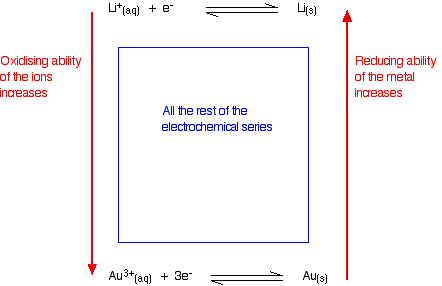
According to this image, (on the chemguide page I referenced to last post) I would be able to create better combinations of circuits using multiple types of electrocatalysts at one instant, rather than both electrodes with cobalt on them, or magnesium, etc. My only problem seeing this is if I'd have enough materials (and time) to coat a ton of reserve graphite electrodes, seeing that there is a high possibility of a catalyst flaking off, if you had ever seen steel or iron rust and disintegrate into the water during electrolysis.
Would anyone know perchance a prediction of how many grams of a metal salt would cover approximately 5.7 square inches of graphite? (it's actually a cylinder, with dimensions 3in. (usable height), .6in. (diameter).
First of all, I guess I should clarify what I'm going to do with this. My science project is going to be 4th year continuation project (spending two years for this one to find a qualified scientist and lab) that will involve the use of catalysts. I want to find out how electrocatalysts affect the results of electrodialysis, and which of those types that I have previously mentioned, and probably others, are the most efficient. My hypothesis? Right now, I don't have my independent variables (this is what I'm searching for), but out of these three compounds, I believe that cobalt nitrate would perform the best (I don't have any reasoning for that, though. I don't actually know what makes these different from each other in terms of conductivity, and electrical properties.) According to research on electrolysis and electrodialysis electrocatalysts though (which is actually very little), commercial platinum is used most, and is obviously the most effective. Unfortunately, I do not have the resources to purchase any or experiment with any platinum alloys or compounds (which seems a rather interesting further project to do)
This is actually turning into a full-on engineering project, as I am currently trying to fix and enhance every other part of my electrodialysis circuit, but what I'm looking for is better energy consumption efficiency, more hydrogen production(keeping this aspect of electrolysis), less pollution- less corrosion during electrodialysis process (I cannot manipulate this one, but just observe which material is the best at it), and the observance of salinity reduction in my dilute compartment.
Urgh, it is really confusing learning reduction and oxidation. Maybe I'm just confusing whether the material would be the agent or not.
Would OIL RIG and LEO says GER pertain to the oxidee? (if the other material at hand was the oxidizing agent) If it is, I found the flaw in my reasoning.
Another question (sorry for so many questions
) I have been mulling over the past few weeks is: should I be able to use two types of electrocatalysts separately onto my anode and cathode?According to this image, (on the chemguide page I referenced to last post) I would be able to create better combinations of circuits using multiple types of electrocatalysts at one instant, rather than both electrodes with cobalt on them, or magnesium, etc. My only problem seeing this is if I'd have enough materials (and time) to coat a ton of reserve graphite electrodes, seeing that there is a high possibility of a catalyst flaking off, if you had ever seen steel or iron rust and disintegrate into the water during electrolysis.
Would anyone know perchance a prediction of how many grams of a metal salt would cover approximately 5.7 square inches of graphite? (it's actually a cylinder, with dimensions 3in. (usable height), .6in. (diameter).