/-/https/www.sciencebuddies.org/Files/21464/5/sb-logo.png)
/-/https/www.sciencebuddies.org/Files/21464/5/sb-logo.png)
I was thinking about cure for AIDS that is caused by HIV virus...
HIV virus directly attacks the helper T cells in our blood
if we remove those protein connectors of the virus from the surface while it is inside the helper t cells ,then the newly formed viruses will have no connectors to attack any other cells
I just want to know whether it is possible or not.
HIV
Moderators: AmyCowen, kgudger, MadelineB, Moderators
-
deleted-224136
- Former Expert
- Posts: 19
- Joined: Sun Aug 31, 2014 7:48 am
- Occupation: Graduate Student
- Project Question: I would like to be an "Ask an Expert" Volunteer
- Project Due Date: N/A
- Project Status: Not applicable
Re: HIV
Hello,
That is a great question and idea. Unfortunately, I don't think it would be possible to inhibit cell-to-cell communication between all T-cells or between T-cells and other immune cells, because your immune system would be essentially non-functional. If there was a way to inhibit cell-to-cell communication immediately after the HIV virus is integrated into the cell, that would be a great therapy.
If you look at the link below:
http://img.medscape.com/fullsize/migrat ... 3.fig2.gif
there are many ways that therapies are trying to treat HIV. The thought has been to use multiple classes of these types of inhibitors in order to reduce the prevalence of HIV resistance. These "cocktail" therapies have shown a great improvement, but the problem is that there are these HIV-infected T cells that are "latent" or temporarily turned off/hidden from the immune system. These latent cells are not able to be killed by the therapies, until they are found to be functional again. By the time this happens again, the latent cells are usually too resistant to drugs and therapies can no longer effectively treat the patient.
Currently, there has been a big push for combining the current therapies with drugs that will turn on all latent cells and allow them to be attacked in one full swoop. If you find that the targeted cell-to-cell communication inhibition doesn't work, investigating how to take HIV-infected T cells out of latency could be another idea.
Good luck and let us know if you have any questions.
That is a great question and idea. Unfortunately, I don't think it would be possible to inhibit cell-to-cell communication between all T-cells or between T-cells and other immune cells, because your immune system would be essentially non-functional. If there was a way to inhibit cell-to-cell communication immediately after the HIV virus is integrated into the cell, that would be a great therapy.
If you look at the link below:
http://img.medscape.com/fullsize/migrat ... 3.fig2.gif
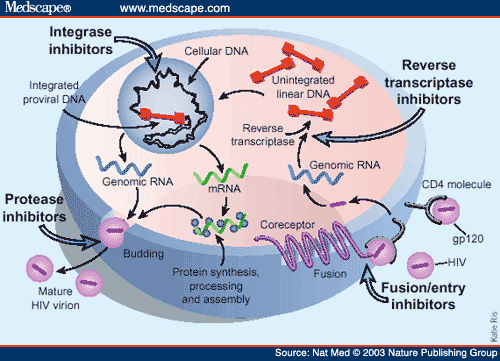
there are many ways that therapies are trying to treat HIV. The thought has been to use multiple classes of these types of inhibitors in order to reduce the prevalence of HIV resistance. These "cocktail" therapies have shown a great improvement, but the problem is that there are these HIV-infected T cells that are "latent" or temporarily turned off/hidden from the immune system. These latent cells are not able to be killed by the therapies, until they are found to be functional again. By the time this happens again, the latent cells are usually too resistant to drugs and therapies can no longer effectively treat the patient.
Currently, there has been a big push for combining the current therapies with drugs that will turn on all latent cells and allow them to be attacked in one full swoop. If you find that the targeted cell-to-cell communication inhibition doesn't work, investigating how to take HIV-infected T cells out of latency could be another idea.
Good luck and let us know if you have any questions.