Project Question: I did a project similar to the "rollercoaster marbles: Converting kinetic energy to potential energy" available on sciencebuddies.com And I believe I have determined the potential and kinetic energy for each height, however, I am not sure how to display energy conversion in my findings.
Project Due Date: January 8, 2014
Project Status: I am finished with my experiment and analyzing the data
I am doing a project similar to the 'Roller Coaster Marbles: Converting Potential Energy to Kinetic Energy' available on Sciencebuddies.com, and I believe that I have the potential and kinetic energy (they are very different from each other though ), but I don't know how to display the energy conversion in my results. This project is due on 1/8/13 so I kind of need an answer as soon as possible. Thanks
Energy is conserved, so if you add the potential and kinetic energies at the different points you measured the marble, that number shouldn't change. However, some energy gets converted to waste heat via friction, etc. in your experiment. So, you might have places (particularly towards the end of the coaster) where the sum of the kinetic and potential energies is less than the initial potential energy of the marble suggesting making a graph of potential energy as a function of time. You could plot kinetic energy as a function of time on the same graph. Look at the pattern. Does potential energy go up when kinetic energy goes up? Or does potential energy go down when kinetic energy goes up? A graph like the one I described should make that pattern clear.
Energy is conserved, so if you add the potential and kinetic energies at the different points you measured the marble, that number shouldn't change. However, some energy gets converted to waste heat via friction, etc. in your experiment. So, you might have places (particularly towards the end of the coaster) where the sum of the kinetic and potential energies is less than the initial potential energy of the marble suggesting making a graph of potential energy as a function of time. You could plot kinetic energy as a function of time on the same graph. Look at the pattern. Does potential energy go up when kinetic energy goes up? Or does potential energy go down when kinetic energy goes up? A graph like the one I described should make that pattern clear.
Hi my name is Anny, and I'm working on the roller coaster and converting potential and kinetic energy sci fair project! I need help on how to graph kinetic and potential energy I read above that I could graph kinetic and potential energy as a function of time but I still don't understand how to graph that if you could put a link that's has a picture of the graph or like a more detailed description of how to make the graph that would be really helpful! Also I was wondering if could get back to me quickly thanks!
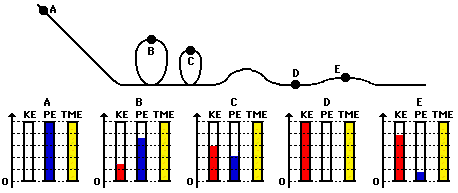
In order to convert this from a bar graph that illustrate the energy level at the different location, you can determine how much time it took to get to those "location" and then plot the KE and PE level for those time with one line for PE and one for KE. The last line would be for the total energy, i.e. KE + PE.
At the end of the this, you graph may look something like this:
(Note that this image describe something going up a hill and is not part of the roller coaster example above)'
Hope this helps. Please let us know if there's anything else we can do to help.
Good Luck!
Willey
Thank you for replying so fast so um I've been looking at the link you gave me and I'm having a much better understand of the first graph.so I understand the first picture with the bar graph but I don't understand the 2nd picture with the hill and the dots. Could you please explain the 2nd graph to me? I was wondering if anyone could please respond to my question,thanks!
I also was wondering how you would make that graph with the dot plot and the energy and time graph because I don't understand that well how to make a graph online?
Hi Anny,
Sorry about the delayed response.
In regards to how to generate the dot graph. If you are using something like google doc (sheets), go to the "Insert" menu and then look for for Chart. Under chart type, look for the scatter type.
In regards to the data itself, think of the second chart as a different way to present the bar graph. This type of graph have the position of the "ball" on the horizontal axis. If you were to place a "dot" for location A, you would have a dot at 0 for KE, 100 for PE, and 100 for TME at location or time A. Similarly, the second group of dot would be at location or time B, where it would 20KE, 80PE, and 100TME. You will want to format your chart like this:
Location / Energy KE PE TME
A 0 100 100
B 20 80 100
I hope this make sense, please let us know if there's anything else we can do to help.
Willey
It's fine,I'm just glad your taking the time to help me! Thank you for your help on The scatter plot I have managed to finish it and print it out on google spreadsheet (I like it better than excel:)] Also,I would like to add a picture of the roller coaster like the one on top of the bar graph you showed me on physicsclassroom.com.But I would like to know if I could make it how my own roller coaster looks like. Im wondering if making my own roller coaster picture is possible and where to make something like that on! Thanks
Hi Anny,
Glad to hear your success with the scatter plot.
In regards to drawing your own roller coaster path, I would suggest trying "google drawing" (It's one of the apps within the "google drive" groups of program) and you should be able to import this graphic directly over to your scatter plot. (P.S. Once you are in "google drawing", look for the "line" icon and there should be 6 or so different line type such as line, curve, and scribble, that you can use for your roller coaster track.)
Otherwise, I would suggest something like Sketchup, which is more of engineering tools. (Google search term "Free CAD tools")
Good Luck and please let us know if there's anything else we can do to help!
Willey
Thank you so much for your help! I've just realized that this project might've been a bit to hard for me because I didn't really understand physics that well or at all! But it's too late for me too change my science fair project . Anyways my last question (hopefully) is that my kinetic and potential energy is not adding up to my total mechanical energy. The way I calculated kinetic energy was I used the formula (KE=1/2•mass(3grams)•velocity squared) but I had trouble calculating velocity so i divided the distance traveled by the average time it took to get to the point,and that was my velocity. So for potential energy I used the formula (PE=mass(3 grams)•gravity standard (9.•height) and I measured the height of every single point and since I built the roller coaster on the ground the height was very low except for the starting point (taped on a bookshelf) and the loop (which was in the air). I also changed everything to meters for example the height and everything. So I really don't know what I did wrong and why the kinetic and potential energy doesn't equal the total mechanical energy. I've done a whole lot of research (should've done that before I chose the project) but um I don't know why it's not adding up.
Hi Anny,
How far are you results "off"? You could have losses due to friction between the track and marble and, as a result, the further you are from the track, the more "off" the TME would be since that energy is dissipated as heat.
Also, in order to get more accuracy, is there way to get a more detail look at the speed? If you have a cellphone, try placing marker at various point along the track and then try to capture the marble's path on video. Using this video and the time marker on the video, you can make more detail measurement and calculate a more accurate velocity. If you would like, please post a couple of sample data point and we can crunch the number and see if they make sense.
By the way, I just want to say nice work with your experiment! You are asking all the right questions and getting to the bottom of things!
/-/https/www.sciencebuddies.org/Files/21464/5/sb-logo.png)
/-/https/www.sciencebuddies.org/Files/21464/5/sb-logo.png)
 ), but I don't know how to display the energy conversion in my results. This project is due on 1/8/13 so I kind of need an answer as soon as possible. Thanks


 •height) and I measured the height of every single point and since I built the roller coaster on the ground the height was very low except for the starting point (taped on a bookshelf) and the loop (which was in the air). I also changed everything to meters for example the height and everything. So I really don't know what I did wrong and why the kinetic and potential energy doesn't equal the total mechanical energy. I've done a whole lot of research (should've done that before I chose the project) but um I don't know why it's not adding up.